A Detailed Guide to Star Anise Tree Planting Techniques and Management Methods
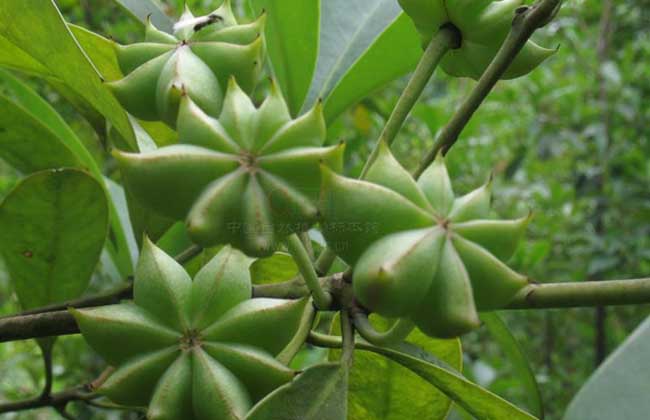
The star anise tree is a species of the genus Illicium in the family Schisandraceae (Illiciaceae), found mainly in subtropical warm and humid valleys. It is distributed across Fujian, Guangdong, Guangxi, Guizhou, Yunnan and other provinces and regions. It has high economic value and a wide range of uses, is an excellent seasoning, and has medicinal effects such as dispelling wind, strengthening the stomach, resolving phlegm and relieving cough. It can be developed as an economic tree species valued for both fruit and timber. Let us take a look at star anise tree planting techniques below!
Seed Treatment of Star Anise
1. Seed collection: Select superior varieties. Generally, choose robust mother trees aged 20-50 years that grow vigorously and have a history of high yields as the seed collection targets. In mid-to-late October, when the star anise fruits turn from green to yellow and the fruit segments have not yet split open, the fruits can be harvested. Remove small fruits, shriveled fruits and misshapen fruits, and carry out tree and fruit selection. Good varieties and strong seedlings are the foundation for achieving high and abundant yields in star anise plantations. Fruits collected too early or too late are of poor seed quality and are not suitable for seed.
2. Seed treatment: Spread the harvested star anise fruits indoors to dry, turning them 1-2 times per day to prevent them from heating up. After 3-4 days the fruit segments gradually split open and the seeds can be collected, or the seeds can be extracted with a small knife or a thin wooden blade (without damaging the seed coat). In frost-free areas, it is best to sow as soon as the seeds are collected. If spring sowing is chosen, good insulation and moisture retention work should be done; generally, storing the seeds in fine sand is best. If long-distance transport is needed, pack them in boxes at a ratio of fine sand to seeds of 5:1 and ship to the destination, then pour them out, place them indoors in the shade to dry, and use the sand storage method for insulation and moisture retention. When the temperature rises to 10-15°C, sowing and seedling raising can begin.
Star Anise Seedling Raising Methods
1. Site selection and land preparation: For the star anise nursery, yellow mud mountain land with good drainage and deep, fertile soil is best. Leave about 30 cm walkways between beds. When preparing the land, dig beds 17-20 cm high, 18-20 cm deep and 1 m wide, and apply turf ash or compost at 22.5-25.0 tonnes/ha.
2. Sowing method: Generally, for frost-free areas, sowing from December to January of the following year is best. In frost-prone areas, sowing should preferably be done in February-March when the temperature rises above 12°C. Drilling is the preferred method. The seed spacing within the row is 2-3 cm, the depth is 3-4 cm, and the row spacing is 15-20 cm. The seeding rate is generally 90-120 kg/ha. After sowing, cover with burnt turf mud, mix in 1.5 cm of fine yellow mud, then cover with a layer of thatch grass and water thoroughly.
3. Cultivating strong seedlings: Generally about 20 days after sowing, the seeds germinate and emerge, at which point the thatch covering can be removed and a shade shed with a high north side and a low south side can be built, generally with the low side 70 cm high and the high side 1 m. Pick up any fallen broken grass clean. Water frequently, preferably in the morning and evening, to keep the bed surface moist. During the growth of the seedlings, loosen the soil, fertilize and weed diligently, and carry out timely pest and disease control. Generally, urea or diluted human and animal manure can be used for topdressing. Apply the first fertilization when the seedlings reach 2-3 cm in height, the second at 10-12 cm, and the third at 15-20 cm. In the following spring, when the seedling ground diameter is 0.4 cm and the height is 40 cm, and before the new terminal buds sprout, water the seedlings thoroughly and then lift them for outplanting and establishment.
Star Anise Tree Planting Techniques
1. Woodland preparation: For star anise tree planting, choose plots on the north slopes of rolling, relatively wind-sheltered hilly and mountainous land, with deep, fairly fertile and loose soil and convenient irrigation and drainage. Planting under natural mixed woodland can make use of its shading effect, so when clearing the woodland, only remove shrubs, vines and lower-story small trees, and carry out unified planning for strip preparation or full reclamation. The star anise tree has a shallow root system, with its main root not deep and its lateral roots mostly distributed within 50 cm of the soil layer. Its branches are quite brittle, so places exposed to strong winds are not suitable for planting star anise trees.
2. Timely establishment: The best time for star anise planting is around Great Cold (Dahan). For fruit-producing plantations, the planting spacing is generally 4 m × 5 m or 3 m × 4 m, and the planting density is preferably 750 trees/ha. Dig pits 30 cm deep and 40 cm wide, and apply 0.5-1.0 kg of compound fertilizer per hole. For leaf-producing plantations, the planting spacing is generally best at 1.5 m × 1.5 m, and the planting density is preferably 45,000 trees/ha. Generally, 2-4 days before lifting the seedlings, leave only 1/3 of the leaves and cut away the rest. It is best to plant on the same day the seedlings are lifted. If they cannot be planted immediately, dip the roots in yellow mud slurry in good time and transport them to the planting site for planting. To improve the survival rate of planting, it is best to plant on cloudy and rainy days, when the survival rate can reach 85%-90%. The planting depth is best when soil covers 2-3 cm above the root collar.
3. Scientific fertilization: The best time to fertilize star anise is February and June each year. Spring fertilizer can promote shoot growth, and summer fertilizer can promote vigorous growth of star anise. Fertilization is mainly nitrogen-based. For young plantations over three years old, compound fertilizer can also be applied. For one- to two-year-old trees, apply 50-150 g of urea per tree per year. For three-year-old trees, apply 100-200 g of compound fertilizer per tree and 150-250 g of urea per tree each time. For mature fruit-producing plantations, a special star anise fertilizer should be applied, twice a year, which can increase yield by 25%-44%. It is suitable for star anise trees over seven years old, applied at 0.5-1.0 kg per tree each time. In addition, compound fertilizer should also be applied 1-2 times per year, at 0.5-1.0 kg per tree each time. Both the special fertilizer and the compound fertilizer are applied by the method of trench application and soil covering, and the yield-increasing effect is fairly obvious.
4. Timely weeding: Weeds easily consume nutrients and water in the soil, so the star anise plantation should be cultivated and weeded at least 1-2 times per year, respectively in January-February and May-June. Where weed damage is light, weeding can be done manually. For woodland with a large affected area, glyphosate can be used directly for chemical weeding, taking care not to damage the star anise seedlings.
5. Young plantation management
① Pruning and shaping: Pruning and shaping can generally be carried out when the young plantation is 1.5-2.0 m high, to promote branching. Keep 2-3 branches per tree. Cut off from the base the water sprouts that disrupt the tree shape and grow vigorously, crossing branches, and branches growing upright on scaffold branches, dead branches, overly dense branches, diseased and pest-infested branches, and weak slender branches.
② Shading and moisture retention: An important task in young star anise plantation management is to cover most of the exposed bare ground. Natural plants such as weeds, shrubs and mixed woodland can be used as shade trees, to achieve the purposes of balancing soil temperature, keeping the woodland moist, preventing sunscald and reducing soil erosion.
6. Mature plantation management
① Pruning and shaping: Cut few or no sparse branches. Appropriately prune heavily the sparse-fruiting, overly dense or inner canopy branches in the lower part of the crown, prune lightly the outer branches or the middle and upper crown branches, and prune heavily the branches with many dry parts and the abnormally developed diseased and pest-infested branches. Topping and removing terminal buds can generally be carried out 3-4 years after planting, and after 4-5 years, leaves can generally be harvested for steam distillation of oil.
② Reclamation of mature plantations: Reclamation can change the soil structure of star anise plantings, replenish soil moisture, and promote normal flower bud differentiation and the growth and development of young fruits. Reclamation is generally carried out once every 3-4 years.
7. Disease control
① Star anise anthracnose: To effectively reduce the sources of disease in the control of star anise anthracnose, the infected branches and leaves can be completely removed and burned in a centralized manner. In the early stage of the disease, spray 0.5% Bordeaux mixture for control. To improve the star anise tree's own disease resistance, apply more phosphorus and potassium fertilizer or farmyard manure.
② Star anise leaf beetle: For the star anise leaf beetle, spray with 80% trichlorfon or 80% dichlorvos emulsifiable concentrate diluted with water.
③ Star anise hanging-thread caterpillar: For the star anise hanging-thread caterpillar, spray with leafhopper powder emulsifiable concentrate or 203 emulsifiable concentrate diluted with water. After spraying, once the insects are startled and drop down on their threads, spray the insects on the ground once more.