How long does it take for an star anise tree to bear fruit after planting?
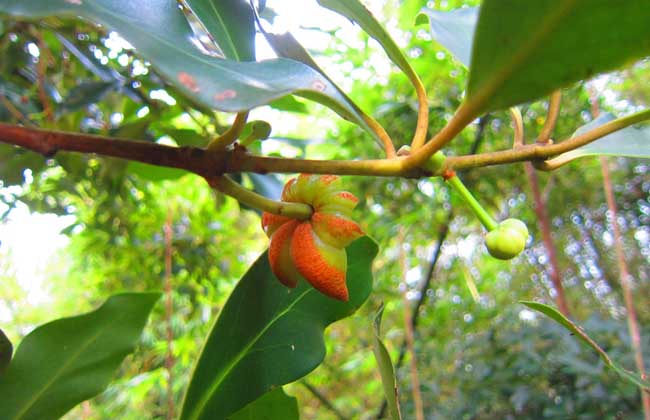
Star anise belongs to the Schisandraceae family as an evergreen tree, mainly distributed in China, Vietnam, Indonesia, Thailand, etc. In China, it is mainly distributed in Guangxi, Guangdong, Yunnan, Fujian, Sichuan and other places. It is an economic forest tree species unique to southern China and has high planting value. Let's take a look below at how long it takes for an star anise tree to bear fruit!
How long does it take for an star anise tree to bear fruit
The fruit-bearing time of planted star anise trees is at least 3-4 years and at most 5-8 years. Plantations of 8-18 years and fast-growing forests of 6-15 years are the early fruiting stage for young and middle-aged star anise. Starting from 19 years of age, and for fast-growing forests from 16 years until the plant ages, this is the full fruiting stage of star anise. Under normal circumstances, the full fruiting stage of soft-branch star anise can last as long as 60-70 years, while that of hard-branch star anise is 40-50 years. If the habitat conditions in all aspects are superior, the full fruiting stage can be extended.
The planting environment of star anise trees
Star anise is a shade-loving tree species, suitable for planting on loose, acidic sandy soil with short sunshine duration, lush vegetation, deep soil layers, good drainage and rich humus. For forest management, choose north-facing slopes of rolling, relatively wind-sheltered hilly and mountainous land, with plots that have deep, relatively fertile and loose soil layers and convenient irrigation and drainage.
Star anise trees bloom but do not bear fruit
1. Forest land environment: Keep the star anise forest well ventilated and lighted, and clean, and remove weeds and shrubs in the forest to avoid competing with star anise for fertilizer and light.
2. Hoeing and reclamation of forest land: Hoe and reclaim the forest land to increase soil aeration and promote the sprouting of new roots. For forest land with a slope of less than 25 degrees, full reclamation can be used, while for forest land with a slope greater than 25 degrees, strip reclamation should be used.
3. Reasonable dense planting: It is advisable to maintain 30-45 plants per mu, with 1-2 m between the crowns of mature plants. Reasonable thinning should follow the principles of removing the inferior and keeping the superior, removing the weak and keeping the strong, and removing the dense and keeping the sparse.
4. Reasonable pruning: For overly dense trees with few fruits, prune appropriately heavily; for sparse trees, prune little or not at all. Prune the inner branches in the lower part of the crown appropriately heavily, and prune the branches in the middle and upper part of the crown and on the outer edge lightly. For trees with abnormal growth and development and many diseased and pest-damaged branches and dead branches, prune heavily; for healthy ones, prune lightly. For star anise with relatively vigorous tree vigor, ring barking should also be carried out.
5. Reasonable fertilization: The amount of fertilizer should be mainly compound fertilizer, about 4 kg per plant, increased or decreased according to the actual tree vigor, applied 2 times a year. The first time should be from late October to early March of the following year, and the second time from June to August.
6. Protecting flowers and fruits: Spray fruit-drop prevention agent and foliar fertilizer during the flowering and fruit-setting stages. When 70-80% of the flowers have fallen, use one packet of fruit-drop prevention agent and one packet of potassium dihydrogen phosphate, diluted with 60 kg of water, and spray.
7. Pest and disease control: Pay attention to inspection in daily management, and control pests and diseases in a timely manner. From March to April and June to July each year, spray with 500 times diluted dichlorvos or dimethoate solution to kill them.