Detailed Explanation of Key Points on Paris polyphylla Pest and Disease Control Techniques
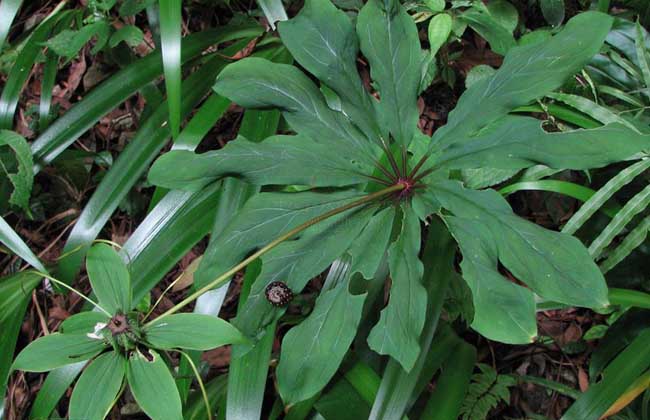
Paris polyphylla, also known as Qiyeyizhihua, Zaoxiu, Chixiu, Chongtai Gen, etc., is a perennial herbaceous plant with a long growth cycle, taking 8 to 10 years from sowing to harvest. It is one of the main ingredients of nationally protected traditional Chinese medicines such as "Yunnan Baiyao" and "Gongxuening", and has very high cultivation prospects. Let us take a look at Paris polyphylla pest and disease control techniques below!
Damping-off
[Damage characteristics] Damping-off is a seedling-stage disease, occurring severely during low-temperature and rainy conditions from April to May. In the early stage of the disease, yellow-brown water-soaked lesions appear at the base of the seedling stem and spread around the base, causing the seedlings to wither, and in severe cases, patches of seedlings die and collapse.
[Control methods] ① Strengthen seedbed management with appropriate ventilation and light transmission. ② When the disease first appears, spray 65% chlorothalonil wettable powder at 600 times dilution, 60% mancozeb wettable powder at 500 times dilution, or 62.2% propamocarb aqueous solution at 600 times dilution, once every 6 to 10 days, for 2 to 3 applications. ③ Promptly remove diseased plants and adjacent diseased soil.
Black spot disease
[Damage characteristics] The disease starts from the leaf tip or leaf base, producing circular or nearly circular lesions. Sometimes the disease spreads to the flower axis, causing leaf blight and stem blight.
[Control methods] ① Pay attention to drainage and moisture removal, reduce air humidity, and alleviate disease incidence. ② In the early stage of the disease, spray 5% moroxydine aqueous solution or 50% thiophanate-methyl suspension concentrate.
Stem rot
[Damage characteristics] Stem rot mostly occurs during the seedbed stage, and is more severe during the field stage under high temperature and rainy conditions. First, yellow-brown lesions appear at the base of the stem. After the lesions expand, the leaf tips lose water and droop, and in severe cases, the stem base becomes wet and rotted, causing the seedlings to collapse.
[Control methods] ① Rotate with gramineous crops for more than 3 years. ② Before transplanting, spray the seedbed with 50% carbendazim wettable powder as a "send-off medicine". ③ Thin out diseased seedlings. ④ In the early stage of field disease, irrigate the planting holes with 95% fenaminosulf wettable powder, once every 10 days, for 2 to 3 consecutive applications.
Anthracnose
[Damage characteristics] Anthracnose is caused by the genus Colletotrichum. Brown dotted, nearly circular, or irregular lesions appear on the leaves. The center of the lesions is light brown or grayish-white, and when humidity is high, black dot-like fruiting bodies form on them. The edges of the lesions are dark brown. When the disease is severe, multiple lesions on the leaves join into patches, causing yellowing, withering, and death. The pathogen overwinters in diseased plant residues in the soil, infects healthy plants when the rainy season arrives the following year, and breaks through the host epidermis through acervuli. The conidia on the acervuli are spread by wind and rain and repeatedly cycle to infect and cause damage in the field. Fields with high planting density, poor drainage, cloudy and rainy humid conditions, and years of continuous cropping have severe disease incidence.
[Control methods] ① Promptly remove diseased and residual tissues in the field. ② Implement annual rotation with crops such as gramineous or leguminous crops, and plant at a reasonable density. ③ In the early stage of the disease, use 50% thiram (triforine), 75% chlorothalonil, 80% anthracnose thiram wettable powder at 800 times solution, 40% flusilazole at 3000 times solution, 10% difenoconazole water-dispersible granules at 2000 times solution, or 30% triflumizole wettable powder at 1000 times solution to spray and control central diseased plants.
Pythium damping-off
[Damage characteristics] Pythium damping-off is caused by Pythium. The symptoms begin with infection at the base of the stem, initially water-soaked, and quickly spread upward to the aboveground parts. The diseased part does not change color or turns yellow-brown, constricts, and softens. The disease develops rapidly, and sometimes the cotyledons or leaves are still green when the plant suddenly collapses. At first, often only individual seedlings are affected. When conditions are suitable, with the diseased plants as the center, it rapidly spreads outward, forming patch after patch of diseased areas. High humidity is the main cause of the disease.
[Control methods] In the early stage of the disease, use 70% fenaminosulf wettable powder at 500 times solution, 25% metalaxyl wettable powder at 300 times solution, or 68.75% fluopicolide·propamocarb suspension concentrate at 2000 times solution to irrigate the roots or splash-apply, spraying once every 7 days for 2 to 3 consecutive applications. After the disease occurs, promptly pull out diseased plants and irrigate the diseased area with quicklime water.
Underground pests
[Damage characteristics] The underground pests of Paris polyphylla include scarab beetles (white grubs), mole crickets, cutworms, wireworms, etc. They mainly cause damage when Paris polyphylla emerges, biting off plants, eating all the leaves, or biting the rhizomes into holes.
[Control methods] Carry out tropism-based trapping and killing according to the living habits of different pest species. For example, scarab beetles have phototaxis to black light, so use black light lamps to trap and kill them. Mole crickets have phototaxis, attraction to manure, and preference for sweet and fragrant substances, so black light lamps, toxic fresh horse manure, and fried fragrant wheat bran poison bait can be used for trapping and killing. Cutworms prefer sweet and sour tastes and have phototaxis to black light, so black light lamps, sex pheromones, and sugar-vinegar-alcohol liquid poison bait can be used to trap and kill adults. The pesticides used for poison bait include 80% trichlorfon soluble powder and 50% phoxim emulsifiable concentrate. In the field, 10 kg of 3% phoxim granules per mu can be mixed with fine soil and broadcast around Paris polyphylla plants.
Aboveground pests
[Damage characteristics] The main aboveground pest of Paris polyphylla is thrips, whose adults and nymphs suck sap on plant leaves, causing mosaic leaves, poor growth, and virus transmission.
[Control methods] Spray systemic insecticides including 40% dimethoate at 1500 times solution and 20% imidacloprid at 5000 times solution, applying once every 15 days for 2 to 3 consecutive applications.