Origin Distribution and Main Producing Areas of Paris polyphylla
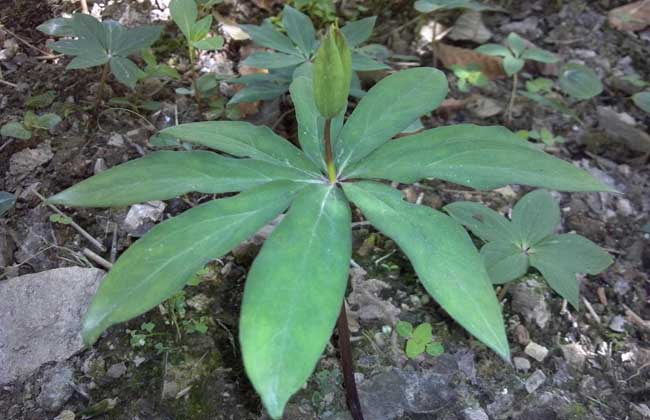
Paris polyphylla, also known as Qiyeyizhihua, Huachonglou, Qiyelian, Tiedengtai, etc., is the dried rhizome of Paris polyphylla var. yunnanensis or Paris polyphylla of the genus Paris in the family Liliaceae. It is a precious traditional Chinese medicinal herb with the effects of clearing heat and detoxifying, reducing swelling and relieving pain, and cooling the liver to calm fright. Let's take a look at the origin distribution of Paris polyphylla below!
Origin Distribution of Paris polyphylla
The origins of Paris polyphylla var. yunnanensis are mainly distributed in Yunnan, Guizhou, Sichuan and other places, while the origins of Paris polyphylla are mainly distributed in Guangdong, Guangxi, Jiangxi, Fujian, Shaanxi, Sichuan and other places.
Origin Environment of Paris polyphylla
1. Soil: Paris polyphylla grows best in slightly acidic humus soil or fertile sandy soil with good water permeability. It cannot grow in alkaline soil or clay soil, and soil that is sticky, prone to water accumulation and hardened is not suitable for growth.
2. Water: Paris polyphylla prefers a cool, shady and moist environment with moderate moisture. It is afraid of both drought and water accumulation. If the soil moisture content is too low, it is easy to cause the stems and leaves to lose water and the root system to dry up and die, while if it is too high, it is prone to pests, diseases and rhizome rot.
3. Temperature: Paris polyphylla plants are relatively cold-tolerant and suffer no frost damage at low temperatures. From late February to early March, it can sprout and grow at a temperature of 5°C, and even at a minimum temperature of 2°C. At a temperature of 1-2°C, no frost damage occurs to the buds. Generally, the suitable temperature for seed germination, root growth and development, and terminal bud germination is 18°C-20°C, for seedling emergence it is 20°C, for aboveground plant growth it is 16°C-20°C, and for underground rhizome growth it is 14°C-18°C.
4. Light: Paris polyphylla is a shade-loving plant that prefers slanting or diffused light and avoids direct strong light. Its growth requires a shaded environment. Strong light will cause the leaves to wither. Generally, the seed germination and seedling stages require better shading, while two years before maturity, shading should be appropriately reduced and light increased, which is beneficial to the accumulation of secondary metabolites and dry matter.
Effects and Functions of Paris polyphylla
[Nature and Flavor] Bitter in taste, slightly cold in nature, with slight toxicity.
[Meridian Tropism] Liver meridian.
[Effects] Clearing heat and detoxifying, reducing swelling and relieving pain, cooling the liver and calming fright. It mainly treats boils, carbuncles and sores, sore throat, snake and insect bites, traumatic injuries, convulsions and spasms, etc.
[Usage] Decoct for oral use, 3-9 grams; for external use, an appropriate amount, ground into powder and applied after mixing.
1. Carbuncles, swellings and boils: It can be used alone as powder and applied externally after mixing with vinegar, or used together with Coptis chinensis, Radix Paeoniae Rubra, Lonicera japonica, etc., as in Duoming Tang.
2. Convulsions and spasms: Paris polyphylla is bitter and cold and enters the liver. It has the effects of cooling the liver and purging fire, extinguishing wind and calming fright. For example, in Weisheng Yijian Fang, this product is used alone, ground into powder and taken with water, or it is combined with Uncaria rhynchophylla, Chrysanthemum morifolium, cicada slough, etc., and has good effects on children with extreme heat generating wind, twitching of hands and feet, etc.
3. Traumatic injuries: Paris polyphylla enters the blood aspect of the liver meridian and can reduce swelling, relieve pain, dissolve blood stasis and stop bleeding. It can be used alone, ground into powder and taken with water, to treat external bleeding, traumatic injuries, and blood stasis swelling and pain. It can also be used together with Panax notoginseng, dragon's blood, pyrite, etc.
4. Sore throat: Often used together with Arctium lappa, Forsythia suspensa, Isatis indigotica, etc.
5. Scrofula and phlegm nodes: Can be used together with Prunella vulgaris, oyster shell, Fritillaria thunbergii, etc.