Detailed Explanation of the Correct Sowing Method for Blackberry Lily Seeds
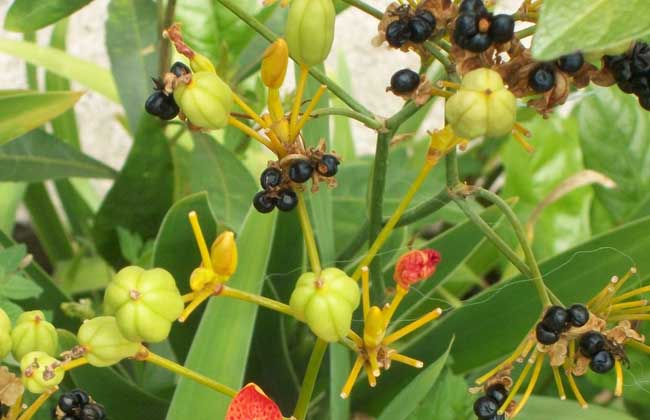
Blackberry lily (Belamcanda chinensis) is usually propagated by seeds and rhizomes. Rhizome propagation gives an early harvest and quick results, but the propagation coefficient is low, and long-term planting can also lead to germplasm degradation. Although seed propagation has a long production cycle, it has a high propagation coefficient and does not cause germplasm degradation, so seed propagation is also commonly used in actual production. Let's take a look together below!
Collection of Blackberry Lily Seeds
Usually in late September to early October, when the seed pods of blackberry lily turn yellow and are about to split open, cut them off together with the fruit stalks, place them in a ventilated indoor area to dry, and then thresh them.
Germination of Blackberry Lily Seeds
After collection, blackberry lily seeds must never be exposed to the sun, otherwise the hardness of the seed coat will increase. Because they have after-ripening characteristics, physiological after-ripening can only be completed under low-temperature and moist conditions. Seeds sown in spring must undergo low-temperature treatment before they can germinate. Seeds harvested in autumn should be mixed with 3 times their volume of wet sand, buried in a pit outdoors, with the size and depth of the pit depending on the quantity of seeds, kept moist and protected from freezing, then dug out and sown the following spring. Seeds sown in autumn must be soaked in warm water at 40-50°C for 24 hours, then dried in the shade before sowing.
Sowing of Blackberry Lily Seeds
For seed propagation of blackberry lily, both direct sowing and seedling transplanting can be used. The sowing period differs depending on open-field cultivation and plastic film mulching. Let's continue to look at open-field direct sowing, open-field seedling raising, and plastic low-tunnel warming seedling raising for blackberry lily seeds!
1. Open-field direct sowing: Spring sowing is carried out around Qingming, and autumn sowing is carried out in September to October. Furrow sowing is generally used. On the prepared seedbed surface, open furrows and make holes at a spacing of 25 cm × 30 cm, with a furrow depth of about 5 cm. The furrow bottom should be level and loose. Apply farmyard manure in each hole, cover with about 2 cm of fine soil, then sow 5-6 germinated seeds in each hole. After sowing, cover with soil and press firm, water appropriately, and cover with grass to retain moisture and heat. The seeding rate is 2-3 kg per mu, and seedlings emerge about 20 days after sowing.
2. Open-field seedling raising: Spring sowing is carried out in March, and autumn sowing is carried out in September to October. Before sowing, first water the seedbed surface thoroughly. After the water has drained, open furrows horizontally at a row spacing of 20 cm, with a depth of 6 cm and a sowing width of 10 cm. Then evenly sow the germinated seeds into the furrows, cover with fine soil mixed with farmyard manure to a thickness of 5 cm, or broadcast the previously prepared seeds into the seedbed and cover with 5-6 cm of fine fertilized soil. After sowing, press lightly, and cover with grass to retain moisture and heat. The seeding rate is 8-10 kg per mu.
3. Warming seedling raising: Usually, in order to extend the growing period in the year of sowing blackberry lily, plastic low tunnels can be used for warming, allowing early sowing and early seedling emergence. For seedling raising with plastic low tunnels, conventional operation methods can be used in early to mid-January. First sow the seeds that have been stored mixed with sand and have split open into the seedbed, cover with a thin layer of soil, then spray warm water once each morning and evening. Seedlings can emerge in about 1 week. After emergence, strengthen fertilizer and water management, and by mid to late March they can be transplanted into the field.