A Detailed Guide to Identifying True and False Coptis chinensis: Learn to Tell Genuine from Fake with Ease
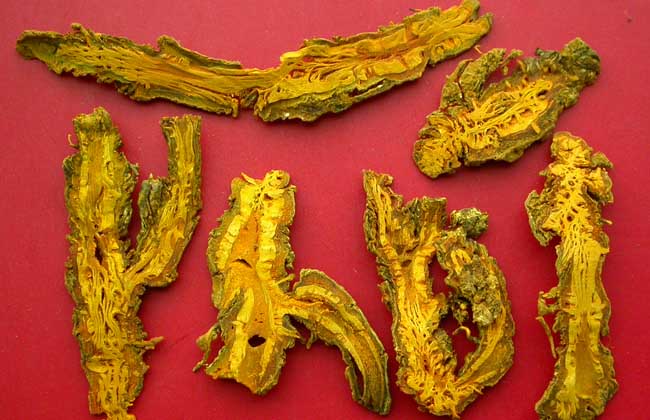
Coptis chinensis is a commonly used medicinal herb, first recorded in the Shennong Bencao Jing. There are many counterfeit products. Besides being adulterated with plants of the same family such as Yinzhou Huanglian, Tuhuanglian, Diandougen, and Fengweilian, the rhizomes of plants from the Berberidaceae, Pteridaceae, and Papaveraceae families such as Epimedium sagittatum, Pteris vittata, and Eomecon chionantha are also used to pass off as Coptis chinensis. Let us now take a look at the identification methods for Coptis chinensis!
Authentic Producing Areas of Coptis chinensis
1. Chuanlian: Chuanlian is mainly produced in Sichuan and Hubei provinces. In addition, it is also cultivated in counties such as Sangzhi and Longshan in Hunan. In the past, commercial goods were divided into south bank goods and north bank goods based on production on the mountain areas along both banks of the Yangtze River in eastern Sichuan and western Hubei. It is generally believed that north bank goods have thick and sturdy rhizomes, few "guoqiao" (bridge) sections, and a golden yellow color, making their quality superior.
2. Yalian: Yalian is Coptis deltoidea, produced in Emei, Hongya, Leshan and other places in Sichuan, mostly cultivated, with a small amount growing wild.
3. Yunlian: Yunlian is curved and hook-shaped, mostly single-branched. Those with thick and sturdy strips, a solid texture, and a red-yellow cross-section are considered superior. Yunlian is a famous medicinal material of Yunnan Province, produced in counties such as Fugong, Bijiang, Gongshan, Lushui, and Tengchong, mainly in Fugong, Gongshan, and Tengchong. Together with Sichuan's "Yalian," it is listed as a treasure among Coptis species and is renowned both domestically and internationally.
Identification Methods for Coptis chinensis
1. Chuanlian: The rhizome mostly shows clustered or capsule-shaped branching, curved, shaped like a chicken claw, with a total length of 3-9 cm and a diameter of 3-8 mm. The surface is brown or green-brown, rough, with numerous hard fine roots and root scars left after fibrous roots have fallen off. Sometimes smooth and slender internodes are visible, commonly known as "guoqiao" (bridge). The texture is hard; the fractured surface shows a dark brown cortex, a golden yellow xylem with visible radial striations, and a red central pith, sometimes hollow. The odor is faint and characteristic, and the taste is extremely bitter.
2. Yalian: The rhizome is mostly single-branched, rarely branched, and mostly has a distinct cylindrical internode section (commonly known as "guoqiao"), with a total length of 5-10 cm and a diameter of 3-12 mm. The surface is yellow-brown; the internode portion is relatively flat with longitudinal striations, while the rest is densely covered with scale leaves, fibrous roots, and leaf stalk remnants, appearing extremely rough. The texture is light but hard, and the fractured surface is slightly lighter in color than Chuanlian. The odor and taste are the same as Chuanlian.
3. Fengweilian: The rhizome is cylindrical and curved, with few branches, 3-9 cm long and 3-9 mm in diameter. The apex often retains leaf stalks made into a (phoenix-tail) marker; the leaf stalks are clustered, 3-6 in number, about 12 cm long, smooth, with longitudinal ridges. The rhizome surface is grayish-black to dark green, covered with numerous scale leaves and fibrous roots. The texture is light but hard, and the fractured surface is slightly lighter in color than Chuanlian. The odor and taste are the same as Coptis chinensis. Its distinguishing feature is the "dragon head and phoenix tail," curved like a "shrimp shape."
4. Yunlian: This is the rhizome of the Ranunculaceae plants Coptis teeta and Coptis quinquesecta. It is mainly produced in Weixi, Bijiang, Deqin, and Jinping in Yunnan. It was originally wild but has recently been changed to domestic cultivation. The rhizome is slightly cylindrical, mostly single-branched, curved, 2-5 cm long and 2-4 mm in diameter. The surface is grayish-yellow, rough, with residual scale leaf and fibrous root scars and leaf stalk remnants. The texture is hard and brittle, easily broken; the fractured surface is yellow-brown, the xylem is lighter in color, and the central pith cavity commonly becomes hollow. The odor and taste are the same as Coptis chinensis.
5. Japanese Coptis: This is the rhizome of the Ranunculaceae plant Coptis japonica. It is curved and cylindrical, with few branches, bearing bead-like nodules, 2-4 cm long and 2-4 mm in diameter. The surface is grayish-yellow, with residual scale leaves and fibrous roots, and the apex sometimes often has leaf stalk remnants. The texture, fractured surface, and odor are similar to Yunnan Coptis.
Commercial Specifications of Coptis chinensis
1. Weilian
① First grade: Dry goods. Mostly aggregated into clusters, with many curved branches, shaped like chicken claws or single branches, plump and solid, occasionally with guoqiao, not exceeding 2 cm in length. The surface is yellow-brown, and the cluster surface is free of hairs and fibrous roots. The fractured surface is golden yellow or yellow. The taste is extremely bitter. No broken sections, residual stems, scorched pieces, impurities, or mold shorter than 1.5 cm.
② Second grade: The difference from first grade is that the strips are thinner and smaller, with guoqiao, and occasionally broken sections, broken fragments, and scorched pieces, but no residual stems, impurities, or mold.
2. Yalian
① First grade: Dry goods. Single-branched, cylindrical, slightly curved, with plump and sturdy strips, few guoqiao, not exceeding 2.5 cm in length. The texture is hard. The surface is yellow-brown, and the fractured surface is golden yellow. The taste is extremely bitter. No broken sections, hairs and fibrous roots, scorched pieces, impurities, or mold.
② Second grade: The difference from first grade is that the strips are thinner and smaller, with more guoqiao. Occasionally with broken sections, hairs and fibrous roots, and scorched pieces, but no impurities or mold.
3. Yunlian
① First grade: Dry goods. Single-branched, cylindrical, slightly curved, with brownish-green scale leaves and leaf remnants at the apex. The strips are thick and sturdy, with a solid texture, and a diameter of 0.3 cm or more. The surface is yellow-brown. The fractured surface is golden yellow. The taste is extremely bitter. No hairs and fibrous roots, guoqiao, impurities, or mold.
② Second grade: The difference from first grade is that the strips are thinner and smaller, occasionally with guoqiao. The diameter is below 0.3 cm. The surface is dark yellow. No hairs and fibrous roots, impurities, or mold.