Detailed Explanation of Pest and Disease Control Techniques for Corydalis yanhusuo
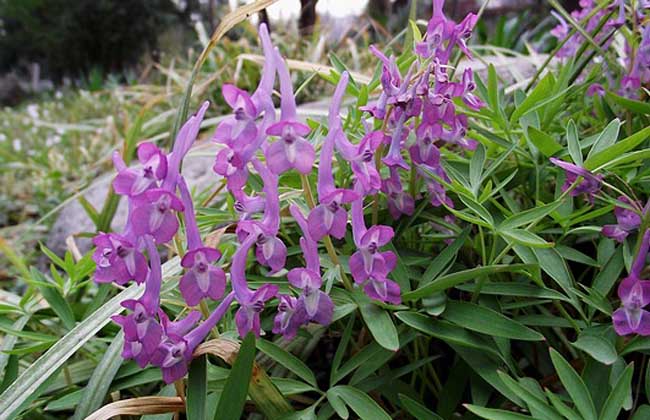
Corydalis yanhusuo is a perennial herbaceous medicinal plant, with its tubers used as medicine, and it is one of the commonly used medicinal materials. In the past two years, more medicinal farmers have been planting Corydalis yanhusuo, but many farmers have experienced low yields due to inadequate production techniques, and pest and disease control techniques are the most important aspect of this. Let's take a look together below!
Corydalis yanhusuo Downy Mildew
[Disease Characteristics] The leaf disease rate of Corydalis yanhusuo downy mildew is 0-17.4%, with an average of 3.5%. The development trend is moderately severe, and control measures need to be carried out immediately, with another spray 7 days after the first application to ensure effectiveness.
[Control Methods] ① 72% Kelu 75-100 grams mixed with 30-40 liters of water for fine spraying. ② 58% Metalaxyl · Mancozeb 100 grams mixed with 30-40 liters of water for fine spraying. ③ 64% Sandofan 100 grams mixed with 30-40 liters of water for fine spraying.
Corydalis yanhusuo Sclerotinia Rot
[Disease Characteristics] Corydalis yanhusuo sclerotinia rot causes patchy wilting and lodging of Corydalis yanhusuo. It usually first appears in early April, with a moderate to mild occurrence trend, and requires one control treatment in early April.
[Control Methods] ① 50% Procymidone 75 grams mixed with 40 liters of water for spraying. ② 50% Iprodione 75 grams mixed with 40 liters of water for spraying. ③ 70% Thiophanate-methyl 75 grams mixed with 40 liters of water for spraying. ④ 30% Pyrimethanil 100 grams mixed with 40 liters of water for spraying.
Corydalis yanhusuo Rust
[Disease Characteristics] The pathogen is a type of basidiomycete fungus. It is prone to occur during the mid-growth period when the climate is humid. It mainly damages leaves and stems. Early symptoms are yellow-green lesions, which later turn yellow-brown. After the lesions on the underside of leaves and on stems rupture and protrude, large amounts of rust-yellow powder are released.
[Control Methods] ① Apply additional phosphorus and potassium fertilizers, and drain water promptly. ② Spray 0.2 degrees Baume lime sulfur mixture at the early stage of disease onset. ③ 65% Zineb wettable powder 500 times dilution.
Corydalis yanhusuo Weevil
[Damage Symptoms] The Corydalis yanhusuo weevil is an important pest that causes significant yield reduction in Corydalis yanhusuo. The main damage symptoms are that larvae first bore into leaves to feed, forming brown linear tunnels, then enter the leaf petioles and bore downward from top to bottom, causing entire leaves to wilt and dry up. Fields covered with compost or other organic matter such as straw, as well as fields planted continuously for years, suffer more severe damage. For fields where 1st-2nd instar larvae damage leaves from late February to early April with a damage rate of 3-5%, control measures need to be carried out immediately.
[Control Methods] ① 48% Chlorpyrifos 1000 times dilution. ② 52.25% Nongdile 1000 times dilution. ③ 5% Fipronil 2000 times dilution. ④ 20% Triazophos 500 times dilution. Do not apply more than 2 times.
Cutworms
[Damage Symptoms] Belonging to the order Lepidoptera, family Noctuidae, mainly including the black cutworm and the yellow cutworm, damaging as larvae by biting through the root-stem area.
[Control Methods] During the day, they can often be caught and killed at the root zone of damaged plants or in the surface soil nearby.