What regions are the main production areas of Cornus officinalis distributed in?
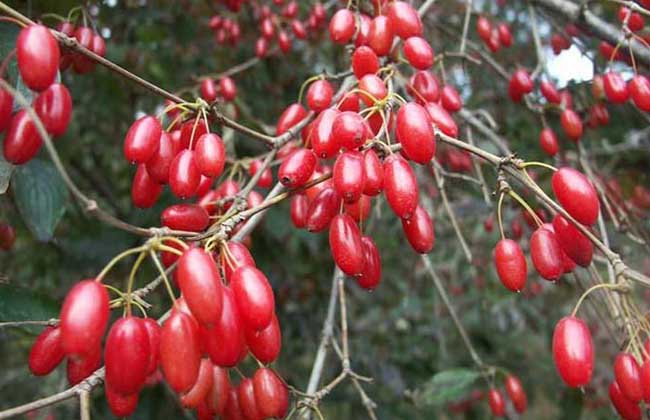
Cornus officinalis is also called Shanyurou, Shanyurou, Shanyurou, etc. Its ripe fruit is used as traditional Chinese medicine. The main production areas include Shanxi, Shaanxi, Gansu, Shandong, Jiangsu, Zhejiang, Anhui, Jiangxi, Henan, Hunan, etc. Let us take a look at the production area distribution of Cornus officinalis below!
Production area distribution of Cornus officinalis
The production areas of Cornus officinalis are mainly located in China's Shanxi, Shaanxi, Gansu, Shandong, Jiangsu, Zhejiang, Anhui, Jiangxi, Henan, Hunan and other provinces. It is also distributed in Korea and Japan. It grows at an altitude of 400-1500 m, rarely up to 2100 m, at forest edges or in forests. It has been introduced and cultivated in Sichuan. The areas with relatively concentrated distribution are the Funiu Mountains in Henan, the Tianmu Mountains in Zhejiang and the Hanzhong area in Shaanxi. At present, the main producing areas with relatively large output that can supply the market are Xixia County and Neixiang County in Henan Province.
Production area environment of Cornus officinalis
Cornus officinalis is a heliophilous tree species of the warm temperate zone. Its suitable growth temperature is 20~30°C, and growth is poor when it exceeds 35°C. It has strong cold resistance and can withstand a brief low temperature of -18°C while growing well. Cornus officinalis is relatively shade-tolerant but also likes sufficient light. It usually grows well in the middle and lower parts of hillsides, on shady slopes, sunny slopes, valleys and both banks of rivers. It is generally distributed in areas at an altitude of 400~1800 m, among which 600~1300 m is more suitable.
Cornus officinalis is suitable for planting in well-drained, fertile sandy loam rich in organic matter. Clay soil should be mixed with an appropriate amount of river sand to increase drainage and aeration.
The three major production areas of Cornus officinalis
1. Foping Cornus officinalis: Foping Cornus officinalis is produced in Foping County, Shaanxi. Foping is also the main production area of Hanzhong Cornus officinalis and has long been known as the “Hometown of Cornus officinalis”. The area is mountainous, with lush trees, a warm and humid climate, and abundant rainfall, which is extremely suitable for the growth and reproduction of Cornus officinalis. Since ancient times, it has been a famous national production area for Cornus officinalis.
2. Linqi Cornus officinalis: Linqi Cornus officinalis is produced in Linqi Town, Chun'an County, Zhejiang Province. The natural conditions here, such as environment, climate, temperature, moisture and sunlight, are very suitable for the growth of Cornus officinalis. Its flesh is thick and soft, and it has always been rated as the best in quality. Linqi has therefore become Zhejiang's only “Hometown of Cornus officinalis”. In Tongxin Village in the town, there is a “King of Cornus officinalis”. The tree is already several hundred years old, with luxuriant branches and leaves, and its crown covers about 1 mu of land. It can still produce over 100 kg of fresh fruit annually.
3. Xixia Cornus officinalis: Xixia Cornus officinalis is produced in Xixia County, Nanyang City, Henan Province. It is a Chinese geographical indication product and is mainly distributed on the southern slope of the Funiu Mountains, especially in the deep mountain area south of Laojieling, the main peak of the Funiu Mountains. In 1999 and 2001, Xixia Cornus officinalis was rated as a high-quality product of the World Expo. Xixia County was assessed by the State Forestry Administration as a “Famous, Excellent and Special Economic Forest——Hometown of Cornus officinalis”, and Xixia Cornus officinalis was approved by the General Administration of Quality Supervision, Inspection and Quarantine as a “National Geographical Indication Product”. In 2003, Xixia's 220,000 mu Cornus officinalis medicinal material base passed GAP certification. It is not only China's first Cornus officinalis GAP base, but also one of the country's first batch and Henan's first GAP traditional Chinese medicinal material base.