What are the requirements for the growing environment of reishi mushroom? Detailed explanation of the conditions
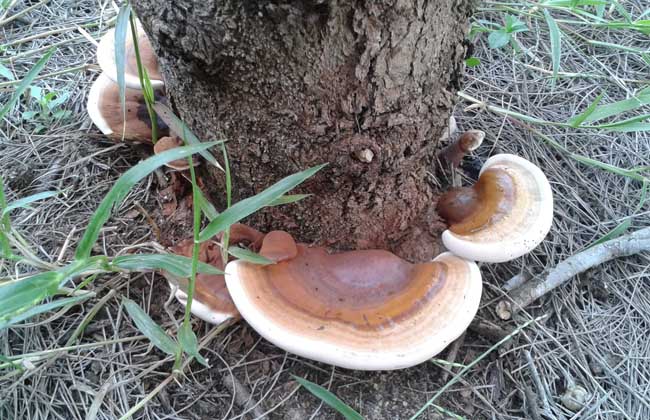
Reishi mushroom is also known as Chizhi, Hongzhi, Danzhi, Ruicao, wood reishi, fungus reishi, Wannianxun, reishi grass, etc. Its shape is umbrella-like, with a kidney-shaped, semicircular or nearly round cap. It is the fruiting body of the fungus Ganoderma lucidum in the family Polyporaceae. It has the effects of tonifying qi and calming the mind, relieving cough and asthma, and is used for dizziness, insomnia, palpitations, shortness of breath, and consumptive cough and asthma. Let us take a look below at the growing environment of reishi mushroom!
Temperature
The primordia of the reishi fruiting body can form in large numbers at 25-30°C, occur less at below 22°C, and grow slowly. Although they can still occur above 34°C, after the primordia form they very easily develop nodular protrusions and stop developing. The reishi cap grows faster at 28-30°C, with more widely spaced concentric rings and a lighter surface color. At 24-26°C, the growth period is longer, more active components accumulate, and the texture is harder, so reishi grown at this temperature is of better quality. In order to balance growth time and fruiting body quality, the room temperature during the primordium differentiation and growth stage is best controlled at (28±1)°C, and during the cap growth stage at (26±1)°C.
Temperature
The fruiting body of reishi mushroom has a demand for temperature characterized by high humidity and constant humidity. The suitable relative humidity is 90%-95%, and it is required that from the appearance of the primordium to the maturity of the fruiting body, the humidity should remain relatively constant, so that the fruiting body can grow normally and evenly. However, because the fruiting body growth period is long and the air temperature is high, the amount of water evaporation is large. To achieve the required humidity, water must be applied to the ground or trenches 3-4 times a day, combined with misting water into the air. If the humidity is normal, the top of the young reishi or the growing part at the edge of the cap is rounded and regular in shape and dark white. When the air is dry, this part turns grayish white, then yellow, while the surface becomes rough or uneven and loses its luster. Based on this, it can be judged whether the fruiting body is short of water. If water shortage is found, mist water can be sprayed directly on the fruiting body, combined with watering (sprinkling) on the ground (trench). During the spore release period, avoid direct spraying on the cap, and the indoor relative humidity is lowered to the lower level of 85%-90%.
Aeration
The fruiting body of reishi mushroom is very sensitive to the carbon dioxide content in the air. According to measurements, the primordium of the fruiting body can differentiate normally when the carbon dioxide volume fraction is less than 0.1%. When the carbon dioxide volume fraction in the air is within 0.03%-0.06%, the cap differentiates relatively quickly and develops normally. When the carbon dioxide volume fraction reaches above 0.1%, the cap is difficult to differentiate and form, and the stipe can elongate and branch into an antler shape. Therefore, during the formation and development of the fruiting body, good ventilation conditions should always be maintained indoors. In order to resolve the contradiction between ventilation and heat preservation, it is generally better to ventilate in the evening or early morning, or to maintain a slow air flow all day.
Light
The fruiting body of reishi mushroom is also very sensitive to light and has the characteristic of growing toward light. Light intensity and the direction of the light source both have a great influence on the growth of the fruiting body. According to measurements, when the light intensity is 4000-6000LX, the fruiting body develops normally, the stipe is thick and strong, and the cap is thick and large. When the light is stronger, the stipe is thin and small, and the cap does not differentiate or forms a small and thin cap. After the primordium of the fruiting body forms, the direction of the light source must not be changed arbitrarily, nor should the position of the cultivation bag be moved, otherwise the normal growth of the fruiting body will be affected and deformed reishi will easily form. If upright bag cultivation is used, in order to allow the fruiting body to develop normally, generally after the primordium forms, light is first allowed in from the top surface so that the stipe extends upward. After the cap differentiates, the top surface is shaded and changed to single-side light transmission, so that the cap grows horizontally toward the light source. In this way, a regular fruiting body with the stipe perpendicular to the cap and the cap fan-shaped can be formed.