What are the growing conditions for Panax notoginseng? A detailed explanation of its environmental requirements
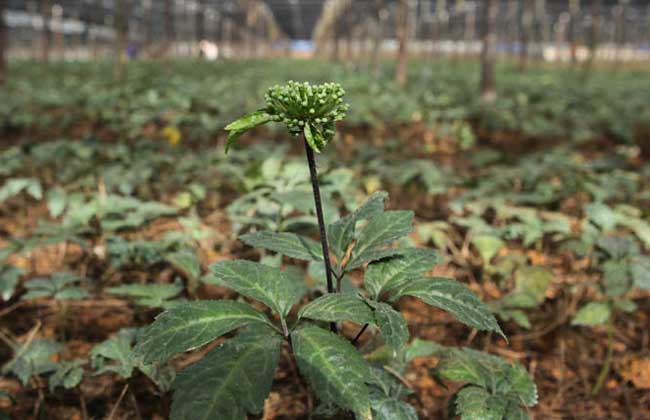
Panax notoginseng is a shade-loving plant. It prefers a warm winter and cool summer environment, and fears severe cold and intense heat. It likes moisture but is afraid of waterlogging; the ideal soil moisture content is 22% to 40%. It can grow under growing environment conditions such as summer temperatures not exceeding 35°C, winter temperatures not falling below minus 5°C, and a temperature of 18 to 25°C.
Panax notoginseng has low soil requirements and a wide range of adaptation, but sandy loam soil that is loose and well-drained is best. Any plots that are too clayey, too sandy, or low-lying and prone to waterlogging are not suitable for planting. Continuous cropping is taboo, and the soil pH is 4.5 to 8.
One-year-old Panax notoginseng has only 1 palmately compound leaf. Two-year-old plants have 2-3 palmately compound leaves, each composed of 5 to 7 leaflets, and begin bolting and flowering. Three- and four-year-old Panax notoginseng generally produces 3 to 5 palmately compound leaves, most of which are composed of 7 leaflets, with a few having as many as 9 leaflets. In Panax notoginseng over five years old, the number of compound leaves can reach 6. The number of palmately compound leaves in each year of growth is affected by growth and development conditions; with sufficient nutrients and suitable development conditions, the number of palmately compound leaves is greater.
For Panax notoginseng of each year of growth, in the production areas seedlings emerge in February to March, and the emergence period is 10 to 15 days. After emergence, Panax notoginseng enters the leaf expansion period. In the early stage of leaf expansion, stems and leaves grow relatively quickly, and usually within 15 to 20 days the plant height can reach 2/3 of the normal plant height; afterward, stem and leaf growth slows. As the buds sprout and emerge all at once, once the stems and leaves grown from the formed buds are damaged, there will be no seedlings above ground.
Panax notoginseng is sensitive to light and prefers slanted, scattered, and diffuse light, and avoids strong light. Generally, a light transmittance of 30% is suitable. If light is too weak, the plants grow leggy, the leaves are soft, the main root grows slowly, and they are prone to disease. If light is too strong, the plants are short and the leaves are easily scorched.
Panax notoginseng seeds have after-ripening characteristics and must be stored under moist conditions to complete physiological after-ripening and germinate. The suitable temperature for seed germination is about 20°C. Under natural conditions, the lifespan of the seeds is about 15 days. Once the seeds dry out, they lose their vitality; therefore, it is best to sow them as soon as they are harvested, or subject them to stratification treatment.