A Detailed Guide to Forsythia Planting Techniques and Management Methods
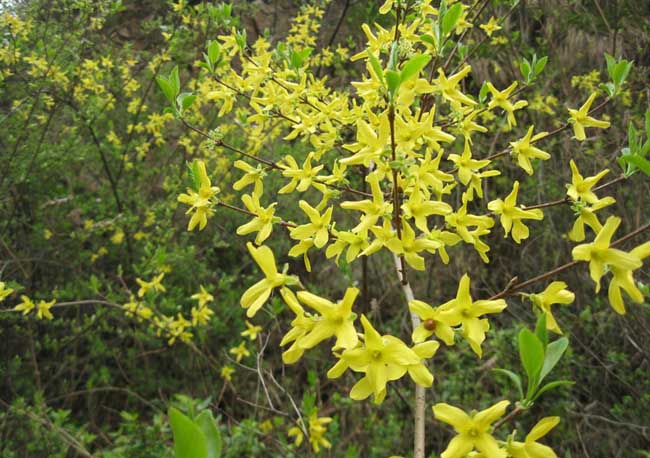
Forsythia, also known as Huangshoudan, Huanghuagan, Huangshoudai, and Shoudaidan, is classified under the genus Forsythia in the family Oleaceae. It is produced in the northern, central, and northeastern provinces of China, and is now widely cultivated in various regions. Forsythia blooms all over the tree in spring, and its golden-yellow branches sway naturally and elegantly in the spring breeze. It is an important early-spring flowering shrub. Below, the editor introduces forsythia planting techniques for reference.
Growth Habits of Forsythia
Forsythia prefers light and has a certain degree of shade tolerance; it prefers warm, humid climates and is also very cold-hardy; it is drought-tolerant and tolerant of barren conditions, but fears waterlogging; it is not particular about soil and can grow normally in neutral, slightly acidic, or alkaline soils.
It can grow on dry sunny slopes or in soil-filled rock crevices, and even on weathered parent material of bedrock or purple sandstone and shale. Forsythia has a well-developed root system. Although the main root is not very prominent, its lateral roots are relatively thick and long, with numerous fibrous roots spreading extensively around the main root, greatly enhancing its ability to absorb nutrients and stabilize soil. Forsythia has strong cold resistance; after cold acclimation, it can tolerate temperatures as low as -50°C. Its astonishing cold hardiness makes it an outstanding choice for landscaping in northern regions. Forsythia has strong sprouting ability and rapid clump formation, allowing it to quickly expand its distribution range. Therefore, forsythia has very strong vitality and adaptability.
Experiments show that forsythia can grow normally in areas with an altitude of 250m-2200m, an average temperature of 12.1°C-17.3°C, an absolute maximum temperature of 36°C-39.4°C, and an absolute minimum temperature of -4.8°C-14.5°C, but it grows better under site conditions with sufficient sunlight, deep fertile soil, and adequate moisture.
Propagation Techniques for Forsythia
Forsythia can be propagated by seeds, cuttings, layering, and division, with seed and cutting propagation being the main methods in production.
1. Seed Propagation
① Seed collection: Select superior mother plants. Choose superior individual plants that are robust in growth, with short and thick internodes, densely set and plump flowers and fruits, free from pests and diseases, and of pure variety as mother trees. Observe the flowering and fruiting periods carefully and grasp the appropriate seed collection time. Collection should be timely to avoid seeds falling off naturally after maturity. Generally, mature fruits are collected from mid-to-late September to early October. Collect forsythia fruits that are fully developed, with plump seeds, large and heavy. Then spread them thinly in a ventilated and shaded place, dry them in the shade, and thresh them. After careful selection and removal of impurities, select neat, plump seeds free from pests and diseases, and store them for seeding.
② Seed storage: Storing forsythia seeds under different conditions greatly affects their germination rate. A research institution in Beijing collected forsythia seeds in 1977 and stored them in a chicken-heart bottle at room temperature. By February 26, 1979, the measured germination rate was 43.7%. According to experiments by the Hainan Pharmaceutical Station: forsythia seeds are better stored in a desiccator. After 11 months of storage, the seedling emergence rate could still reach 85.3%; when stored in sand for 7 months, the emergence rate dropped to 31.3%; after more than 8 months of storage, germination ability was completely lost. When stored in moist sand, the seeds had already begun to germinate successively during storage, so the emergence rate at the later sowing stage was not as high as that of desiccator storage.
③ Seed germination: Forsythia seeds germinate easily. It should be said that the seeds are suitable for germination at relatively high temperatures. Based on seed storage and germination conditions, combined with practical experience, the cultivation time can be arranged in spring or winter. Spring sowing is in mid-to-early April, and winter sowing is carried out before the soil freezes.
④ Seed seedling raising: The seed coat of forsythia is relatively hard. If sown directly in the nursery without pretreatment, it takes more than one month to germinate and emerge. Therefore, germination can be promoted before sowing. This method can be used in newly introduced areas. The specific method is: select mature and plump seeds, soak them in warm water at about 30°C for about 4 hours, remove them, mix with 3 times their volume of moist sand, place in a wooden box or small vat, cover with plastic film, and place in a wind-sheltered sunny place. Turn twice a day and keep moist regularly. After more than 10 days, the seeds will sprout and can be sown. After sowing, seedlings can emerge in 8-9 days, about 20 days earlier than seeds without pretreatment. If the land is dry, water the seedbed first, and sow when the water has seeped down and the surface soil is slightly loose. Spring sowing is around “Qingming” and winter sowing is before the soil freezes (seeds need no treatment and can emerge the following year).
⑤ Seed sowing: When sowing seeds, on the prepared seedbed, open furrows 1 cm deep at a row spacing of 20—25 cm, mix the seeds with fine sand, evenly scatter them into the furrows, cover with soil and level it, and press lightly. Seedlings can emerge in 10-15 days. The seeding rate is about 2-3 kg per mu. The soil covering should not be too thick, generally about 1 cm, and then cover with grass to maintain moisture. After the seeds emerge, remove the grass immediately. When the seedlings are 10 cm tall, thin them to a plant spacing of 10 cm. In early April of the second year, when the seedlings are about 30 cm tall, they can be transplanted to the field.
⑥ Direct field sowing: Open holes at a row spacing of 2 m and a plant spacing of 1.5 m, apply compost and plant ash, and mix with soil. Start sowing from late March to early April, or sow before the soil freezes in late autumn. Sow more than 10 seeds per hole, cover with soil after sowing, and press lightly. Note that sowing should be done when soil moisture is good.
2. Layering Propagation
Layering propagation involves burying the drooping branches of the plant into the soil in spring, and cutting them from the mother plant the following spring for planting. Generally, cutting propagation is the main method. Seedlings should be planted in fertile soil that is sunny and well-drained. If the site is improperly chosen and the soil is barren, growth will be slow and yield low. After flowering each year, dead branches, weak branches, and overly dense or old branches should be pruned, and attention should be paid to fertilizing around the roots.
3. Cutting Propagation
Cuttings can be taken after leaf fall in autumn or before bud break in spring, but spring is preferable. Select robust young shoots 1-2 years old, cut them into cuttings 20—30 cm long. The upper cut should be 0.8 cm from the first node, and each cutting must have 2-3 nodes. Then cut the lower end near a node into a flat surface. To improve the survival rate of cuttings, bundle the cuttings into groups of 30—50, soak the base (1-2 cm) of the cuttings in 500 ppm ABT rooting powder or 500—1000 ppm indolebutyric acid solution for 10 seconds, remove and dry before planting.
In the south, cuttings are mostly taken in the open field in early spring, while in the north they are mostly taken in summer. Before cutting, rake the seedbed fine and level it, make a high bed 1.5 m wide, and insert the cuttings diagonally into the bed at a row spacing of 20×10 cm, with a depth of 18-20 cm in the soil. Leave the topmost node of the shoot exposed above the ground, then cover with soil and press firmly. Water frequently in dry weather to keep the soil moist, but not too wet, otherwise the part of the cutting in the soil will turn black and rot. With normal management, the survival rate of cuttings can reach as high as 90%. With strengthened field management, the seedlings can reach more than 50 cm tall after autumn, and can be dug and planted in the following spring.
4. Division Propagation
After “Shuangjiang” or before bud break in spring, dig out the young shoots growing beside trees more than 3 years old with soil and transplant them, or dig out the entire tree for division and transplanting. Generally, one plant can be divided into 3-5 plants. The key to this method is to ensure that each divided small plant carries some fibrous roots, so that the survival rate is high and results are quick.
Planting Techniques for Forsythia
Before planting forsythia, apply fertilizer in the holes first. Apply decomposed farmyard manure or rural mixed fertilizer and an appropriate amount of compound fertilizer in each hole (see site selection and land preparation). When planting, make the seedling roots spread out, firm the soil layer by layer, and cover the planting point with soil higher than the hole surface to prevent the soil from sinking after rain, which is unfavorable for survival and growth. To overcome the self-incompatibility of forsythia within the same plant and improve pollination and fruiting rates, long-styled and short-styled flower plants must be reasonably arranged at planting points during cultivation. According to relevant reports, plants of these two different flower types grown simultaneously in different environments show great differences in fruiting rate. Under alternating cultivation (row mixing), the fruiting rate was 63.9%, while in plots with more fruit under natural conditions, the fruiting rate was only 47%. Therefore, changing the same cultivation to plant-to-plant mixed arrangement results in a higher fruiting rate, because plant-to-plant mixing places long-styled flower plants and short-styled flower plants in mutual proximity, and pollination is less affected by wind direction, slope aspect, and upslope/downslope effects than row mixing, significantly improving the pollination rate.
In plant-to-plant mixing of forsythia, the arrangement of long-styled and short-styled plants in two adjacent rows differs, and the two should be staggered vertically and horizontally, that is, the plants in single rows and single rows, and in double rows and double rows, should be consistent. Apart from the flowering period, long-styled and short-styled forsythia plants are not easy to distinguish in appearance, especially seedlings. To meet production needs, when they bloom, they can be propagated separately by cuttings, layering, division, and other methods, among which cuttings are mainly used, because the source of propagation material is wide, the utilization rate is high, and the propagation coefficient is large, which can meet afforestation needs. In this way, the shortage of seedlings for mixed planting of the two different flower types can be solved.
1. Water and Fertilizer Management
Forsythia is drought-tolerant but prefers humid environments. In the first three years of planting, watering management should be strengthened. In addition to watering well for the first three times, water 1-2 times per month from April to September depending on temperature and rainfall. July and August are periods of abundant rainfall, so when the weather is not particularly dry, water less or not at all. In late November or early December, water thoroughly for freeze protection. In the following year, water well for thawing in early March. During the flowering period, watering should be controlled. After flowering, when new leaves sprout, water thoroughly once. From April to September, also water 1-2 times depending on temperature and rainfall. In the third year, management should also follow the watering method of the first two years. From the fourth year onward, water well for thawing and freeze protection in early March and late November each year, water during high-temperature periods in spring and summer depending on rainfall, and rely on natural growth at other times.
Forsythia prefers fertilizer. With sufficient fertilizer, the branches and leaves are luxuriant, and the flowers are large and brightly colored. When fertilizing forsythia, in addition to applying sufficient base fertilizer at planting, apply dried chicken manure or sesame paste residue once in late autumn of the same year in conjunction with watering for freeze protection, apply nitrogen fertilizer once after flowering in the second year, apply phosphorus-potassium compound fertilizer once during the flower bud differentiation period in July and August, and apply dried chicken manure once again in late autumn. Thereafter, management can follow this method each year.
2. Pruning Methods
The common plant shape of forsythia is a clustered round-headed form. After the seedlings are planted, heavily shorten the selected main branches to promote branching. During winter pruning, remove thin and weak branches and root suckers sprouting from the root crown. For weak, thin, curved growing branches, cut off 1/5 of the total length, retaining only plump flower buds in the middle of the branch. For upright long flowering branches with relatively vigorous growth and a slightly heavier top, select 3-4 and leave them unpruned, and treat the remaining overly long flowering branches by heading back. For water sprouts, heavily shorten them to promote more branching and increase flowering branches, or keep them as replacement branches for future use.
In addition, forsythia can also be pruned into an umbrella shape. This plant shape, when a breeze blows during the flowering season, is very elegant and free-spirited, and is often used to decorate rockeries. When planting, select the most robust branch and cut it back at 40-50 cm from the ground, and remove all other branches. New branches sprout from the top of the retained trunk. Select 3-4 branches with relatively even distribution and suitable opening angles as main branches, remove all others, and shorten the retained main branches to make them produce more lateral branches. Because forsythia branches are slender and soft and tend to droop, an umbrella shape is thus formed. After the umbrella shape is basically formed, root suckers should be removed regularly, the branches should be pinched back regularly, and overly dense lateral branches should also be removed to maintain ventilation and light penetration.
3. Pest and Disease Control
The common disease of forsythia is leaf spot, caused by infection by fungi of the Deuteromycetes class. The pathogen first infects the leaf margins, and as the disease develops, it gradually spreads toward the middle of the leaf. The boundary between diseased and healthy tissue is obvious, and in the late stage the entire leaf withers and dies. This disease begins in mid-to-late May, with peak incidence in July and August. High-temperature and high-humidity weather and poor ventilation favor the spread of the disease. To control leaf spot, first, pay attention to pruning, removing redundant and overly dense branches so that the plant maintains ventilation and light penetration. Second, strengthen water and fertilizer management, pay attention to nutritional balance, and do not apply excessive nitrogen fertilizer. If it occurs, spray 75% chlorothalonil wettable powder 1200 times dilution or 50% carbendazim wettable powder 800 times dilution for control, once every 10 days, continuously spraying 3-4 times to effectively control the disease.
Common pests of forsythia include: Euricania clara, Orosanga japonica, Pseudaulacaspis pentagona, Aspidiotus hedericola, and the round-spotted leaf-rolling weevil, the brilliant noctuid moth, the pine-oak tussock moth, and the white-whiskered hawk moth.
If they occur, during the period when nymphs gather on branches to cause damage, spray 10% imidacloprid wettable powder 2000 times dilution or 25% chlorfenapyr suspension concentrate 1000 times dilution to kill Orosanga japonica and Euricania clara; during the peak hatching period of nymphs, spray 95% pyridaben emulsifiable concentrate 400 times dilution or 20% fenpropathrin emulsifiable concentrate 1000 times dilution to kill Pseudaulacaspis pentagona; during the adult stage of the round-spotted leaf-rolling weevil, spray 3% high-penetration fenoxycarb emulsifiable concentrate 3000 times dilution for control; during the larval stage of the brilliant noctuid moth, spray 20% acetamiprid concentrated soluble liquid 3000 times dilution for control; during the young larval stage of the pine-oak tussock moth, spray 3% high-penetration fenoxycarb emulsifiable concentrate 3000 times dilution for control; when white-whiskered hawk moth damage is severe, spray 1.2% nicotine-matrine 1000 times dilution for control.
Harvesting and Processing of Forsythia
Due to differences in harvest time and processing methods, traditional Chinese medicine divides forsythia into three types: Qingqiao, Huangqiao, and Lianqiaoxin:
1. Qingqiao: Harvest immature green fruits from August to early September, boil them briefly in boiling water or steam them for half an hour, remove and sun-dry. Those that are dry, unopened, and relatively green are considered best.
2. Huangqiao: Harvest fully ripe yellow fruits in early October, sun-dry them, and remove impurities. They are commonly called “Laoqiao”. Those that are dry, with large segments, thick shells, and relatively yellow color are considered best.
3. Lianqiaoxin: Screen out the seeds from inside the fruit shells and sun-dry them; this is Lianqiaoxin.