What is the flower language and meaning of datura?
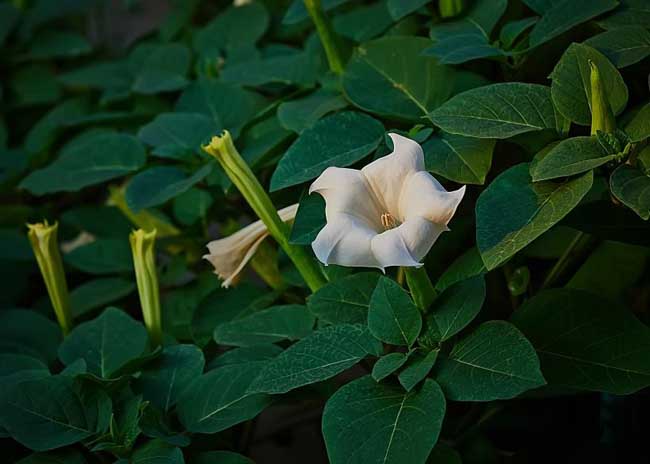
The flower language of datura is interminable love and revenge, representing unpredictable death and love. The datura plant is tall, and its flowers are large and beautiful. Common types include fragrant-flowered datura, red-flowered datura, and white-flowered datura. The whole plant is toxic, with the fruit, especially the seeds, being the most toxic, followed by the young leaves; dried leaves are less toxic than fresh leaves. It is also called mandala, yangjinhua, maple eggplant flower, ten-thousand peach flower, naoyanghua, yangjinhua, large trumpet flower, mountain eggplant, and so on.
The meaning of the datura flower
In our country, datura is regarded as a sacred and pure object of Buddhism, and only those born lucky have the chance to see it; seeing it can bring endless happiness. Because Buddhist practice is about observing the world with a pure heart and walking the red dust with few desires, holding nothing in hand and seeing all phenomena as empty, so long, long ago this white flower without a pistil was seen by people as an incarnation of the divine, symbolizing emptiness of heart, no-mind, and peace of mind.
In ancient India, the datura flower was both the door ring of the gate of desire and the base for constructing magnificent scenes. It was spread out and became a grand mandala ritual site, serving as the “angel's (devil's) trumpet.”
But in Western legends, datura has always been given a terrifying color. It is said that in ancient Spain, the datura flower was like an indifferent onlooker, often blooming near execution grounds, numbly praying over every soul as life faded. This flower is highly toxic in all its parts, and it is said that among ten million people only one has the chance to see it bloom, so whoever encounters its bloom will have their beloved die an untimely death.
In legend, datura is a flower that exists only in the underworld. It is said that the King of the Underworld specially brought it to the mortal world to commemorate his grandson's reincarnation as a human. This is incorrect: there is only one flower in the underworld, namely the spider lily. The white spider lily blooms on the other shore, that is, in heaven, and is called mandarava; the red one blooms by the Three-Life Stone at the Wangchuan River and is called manjusaka.
The flower language of datura in different colors
1. Purple datura: terror.
2. Blue datura: false affection, deceptive love.
3. Pink datura: comfort.
4. Green datura: endless hope.
5. Black datura: unpredictable darkness, death, and a love of wandering and displacement. Interminable love and revenge, the lovelessness and hatredlessness of the mortal world, the resilient and wounded heart that has been hurt, the road of no return in life.
6. Golden datura: respect and love, a person born lucky, with endless happiness.
7. White datura: love flower; if swallowed with alcohol, it will make people laugh and has an anesthetic effect. It is a flower that blooms in heaven, white and soft; those who see this flower will have evil removed from them.
8. Red datura: bleeding, bloody love
9. Tea-colored datura: rationality, wisdom, elegance.
10. Yellow datura: nobility, power, endless turmoil and strife.
Note: As a plant itself, datura is a highly toxic plant that can cause cancer and hallucinations, and its fragrance has hallucinogenic effects. Unless it has a special purpose, it seems unsuitable for growing at home, to avoid children or passersby accidentally eating it or inhaling its fragrance and being poisoned.