Detailed Explanation of Polygonatum Cultivation Techniques and Management Methods
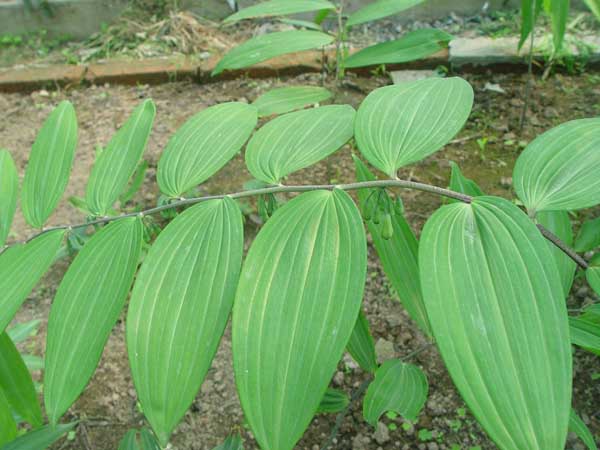
Polygonatum is the dried rhizome of Polygonatum sibiricum, Polygonatum cyrtonema, or Polygonatum kingianum of the Liliaceae family. According to differences in medicinal herb characteristics, it is commonly called "chicken-head polygonatum" or "ginger-shaped polygonatum." Polygonatum is neutral in nature and sweet in taste. It has the effects of tonifying the spleen and moistening the lungs, replenishing qi and nourishing yin. Polygonatum sibiricum is mainly produced in Hebei, Inner Mongolia, Shaanxi Province and other provinces and regions. Polygonatum cyrtonema is mainly produced in Guizhou, Hunan, Yunnan, Anhui, Zhejiang and other provinces. Polygonatum kingianum is mainly produced in Guizhou, Guangxi, Yunnan and other provinces and regions.
Morphological Characteristics
Polygonatum is a perennial herb with a horizontal, fleshy, pale yellow rhizome, the tip sometimes protruding like a chicken head. The stem is upright, 50-90 cm tall. Leaves are whorled, 4-6 per whorl, linear-lanceolate, 8-15 cm long, 0.4-1.6 cm wide, with curled tips. Flowers are axillary, usually 2-4 small flowers, drooping, with a total peduncle 1-2 cm long; the perianth is tubular, white to pale yellow, 0.9-1.2 cm long, with 6 shallow lobes at the tip; 6 stamens, filaments relatively short, 0.5-1 mm long; the style is 1.5-2 times the length of the ovary; the berry is spherical, black when mature. Flowering period is May-June, fruiting period is July-September. The main characteristics of Polygonatum cyrtonema are: stem 40-100 cm tall, leaves alternate, elliptic, ovate-lanceolate to oblong-lanceolate, with 3-5 veins. Pedicels bear 2-7 flowers, arranged in umbels on the total peduncle; perianth yellow-green, 1.8-2.5 cm long; filaments have small papillae or fine hairs, enlarged at the tip to form sac-like protrusions. The main characteristics of Polygonatum kingianum are: stem 1-3 m tall, the tip often twining, leaves whorled, 4-8 per whorl, leaves linear to linear-lanceolate, 6-20 cm long, 0.3-3 cm wide, apex acuminate and climbing-curled. Pedicels bear 2-3 flowers, not umbellate; perianth pink, 1.8-2.5 cm long; berry red when mature.
Growth Habits
Polygonatum grows wild in shady, moist mountain shrub thickets and forest edge grasslands. It is cold-resistant, and seedlings can overwinter in the field, but it is not suitable for growing in dry areas. Seed germination takes a relatively long time, with a germination rate of 60%-70%, and seed viability is 2 years.
Cultivation Techniques
1. Site Selection and Land Preparation
Choose moist plots with sufficient shade. Soil should preferably be loam or sandy loam with loose texture and good water retention. Before sowing, deep plow once. During land preparation, apply 2000 kg of farmyard manure per mu, plow it into the soil as base fertilizer, then harrow finely and level, and make beds 1.2 m wide.
2. Propagation Methods
① Rhizome propagation: In late autumn or around late March in early spring, select healthy, pest-free plant rhizomes 1-2 years old, take the young and tender tip portions, cut into several sections, each with 3-4 nodes. Let the wounds dry slightly, then plant at a row spacing of 22-24 cm, plant spacing of 10-16 cm, and depth of 5 cm. After covering with soil, press lightly and water. Thereafter water once every 3-5 days to keep the soil moist. When planting in late autumn, cover with some barnyard manure and grass after the ground freezes to keep warm.
② Seed propagation: After the seeds mature in August, select mature, plump seeds and immediately carry out sand storage treatment: mix 1 part seeds with 3 parts sandy soil evenly. Store in a pit 30 cm deep in a shaded place, keeping it moist. In late March of the following year, sieve out the seeds and evenly broadcast them in shallow furrows on the bed surface at a row spacing of 12-15 cm. Cover with about 1.5 cm of soil, press lightly, water, and cover with a layer of grass to retain moisture. Remove the covering grass before seedlings emerge. When seedlings are 6-9 cm tall, thin appropriately where too dense. Transplant after 1 year. To meet the shade conditions required for polygonatum growth, corn can be planted on the bed ridges.
3. Field Management
In the early growth stage, frequently carry out intertillage and weeding, once each in April, June, September, and November every year. Shallow hoeing is appropriate, with proper hilling. In the later stage, simply pull weeds. If drought occurs or if planted in a relatively sunny, dry place, water in time. Each year, combine intertillage and weeding with topdressing. After the first 3 intertillage operations, apply 1500 kg of farmyard manure per mu, mixed evenly with 50 kg of superphosphate and 50 kg of cake fertilizer, then apply in furrows between rows and cover with soil to cover the fertilizer. Polygonatum avoids waterlogging and prefers shade, so attention should be paid to drainage and intercropping with corn.
Pest and Disease Control
1. Black spot disease: Mostly occurs in spring, summer, and autumn, damaging leaves. Control methods: Clean the garden at harvest and eliminate diseased residues; spray 1:1:100 Bordeaux mixture in the early stage, once every 7 days, for 3 consecutive times.
2. White grubs: Larvae cause damage, harming roots, biting off seedlings or gnawing seedling roots, causing broken seedlings or hollow roots, with serious damage. Control methods: Use 75% phoxim emulsifiable concentrate to dress seeds at 0.1% of seed weight; or during field occurrence, drench with 90% trichlorfon 1000-fold solution.
Harvesting and Processing
Generally harvested in spring and autumn, with better quality from autumn harvest. After 3-4 years of cultivation, harvest in autumn after the aboveground parts wither. Dig out the rhizomes, remove the aboveground parts and fibrous roots, wash off the soil, place in a steamer and steam until oily and glossy, then take out and sun-dry or oven-dry, or boil in water, then remove and sun-dry or oven-dry.
Seed Preservation Techniques
Polygonatum can be propagated by rhizomes and seeds, but in production, rhizome propagation is preferred. In late autumn or around late March in early spring, select healthy, disease-free plants, dig out the underground rhizomes, and use them directly as propagation material for planting.