What conditions are needed to grow ginseng?
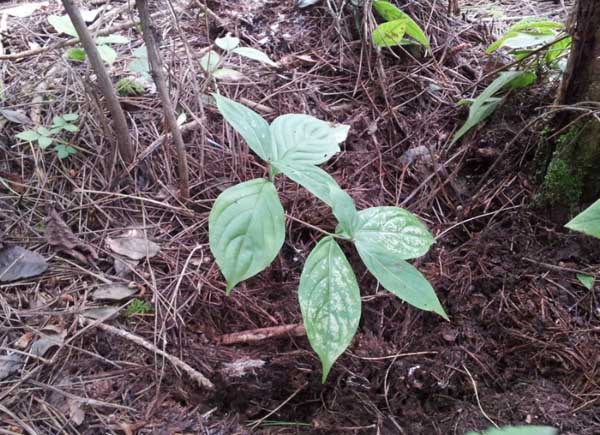
Ginseng mostly grows between 40 and 45 degrees north latitude, with an average January temperature of -23 to 5°C, an average July temperature of 20 to 26°C, strong cold tolerance, able to withstand low temperatures of -40°C, a suitable growing temperature of 15 to 25°C, annual accumulated temperature of 2000 to 3000°C, a frost-free period of 125 to 150 days, snow cover of 20 to 44 cm, and annual precipitation of 500 to 1000 mm. The soil is well-drained, loose, fertile brown forest soil or mountain podzolic brown forest soil with a deep humus layer, with a pH value of 5.5 to 6.2. It mostly grows under coniferous and broad-leaved mixed forests dominated by Korean pine (Pinus koraiensis) or under deciduous broad-leaved forests, with a canopy density of 0.7 to 0.8. Ginseng usually blooms in 3 years and bears fruit in 5 to 6 years, with the flowering period from May to June and the fruiting period from June to September. It grows under deciduous broad-leaved forests or coniferous and broad-leaved mixed forests at an altitude of several hundred meters.
Environmental requirements
Generally, broad-leaved forests and coniferous and broad-leaved mixed forests dominated by oak and linden are chosen. Ginseng prefers a cool climate and can be cultivated under conditions with an average annual temperature of 2.4 to 13.9°C and annual rainfall of 500 to 2 000 mm.
Soil conditions
Yellow sand and black sand humus soil, loam, and sandy loam with an organic matter content above 3%, soil pH value of 6.0 to 6.5, and a water, air, and solid volume ratio of 1:2:1. The concentration of benzene hexachloride in the soil must not exceed 0.4 mg/kg of soil, and the concentration of pentachloronitrobenzene must not exceed 0.3 mg/kg of soil. The slope should be within 15 degrees. Use soil that has been left for one year, and carry out proper disinfection of the soil, seeds, and seedlings before sowing and transplanting.
Ginseng is neither drought-tolerant nor waterlogging-tolerant, and a soil relative moisture content of 70% to 80% or above is preferable. Therefore, doing a good job of drainage and irrigation is extremely important.
Light conditions
Ginseng is a shade-loving plant with relatively strict light requirements, and its light compensation point is about 400 lux. When light increases from 400 lux to 10 000 lux, its photosynthetic rate appears to rise in a straight line.
If the light is too strong, the plant is short, with thick and yellow leaves. If the light is too weak, the plant is slender and tall, with thin and dark green leaves, and growth is abnormal. Therefore, when cultivating ginseng, shading should be carried out to regulate light transmittance, avoid direct strong light, and use scattered light and refracted light.
The optimal light intensity for ginseng growth varies with latitude and temperature. High latitude and low temperature require high light intensity, and vice versa it is lower. In high-latitude low-temperature areas it is 7000-22 000 lux, and in warmer low-latitude areas it is 7000 to 10000 lux.
Fertilizer requirements
Ginseng likes fertilizer, but is also afraid of unrotted fertilizer. What it likes is organic fertilizer and inorganic fertilizer, and what it fears is applying unrotted manure and a lack of soil moisture after fertilization, which causes ginseng root burn and root rot.