Detailed Explanation of Tree-form Honeysuckle Planting Techniques and Management Methods
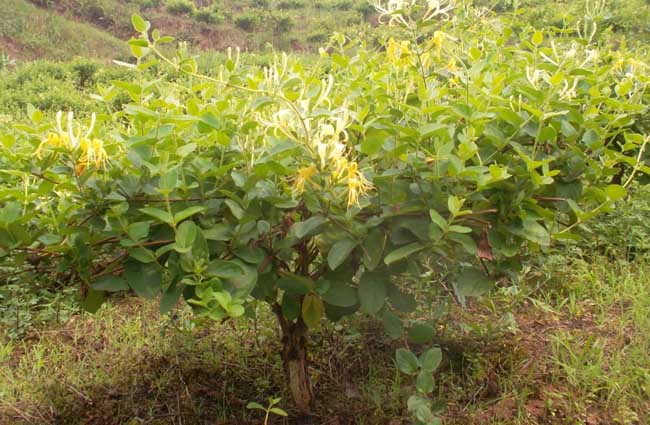
Tree-form honeysuckle has few leggy branches, and most naked buds also become short flower branches; even with heavy water and fertilizer, it does not produce leggy vines. The internodes are short, and most flowers open from the first internode, with an upright angle of 45 degrees to the ground. It grows fast, reaching 0.5 cm in thickness in 50 days. Harvesting saves labor, and the yield is 2 times that of traditional varieties. Besides showing high yield, high quality and other economic traits, tree-form honeysuckle also has extremely strong adaptability and stress resistance: thick stems and leaves, dark green leaf color, strong photosynthesis, thick and long stem and leaf hairs, especially the young leaves whose hairs are thick and long, extremely resistant to the honeysuckle round-tailed aphid, thick and abundant leaf wax layer, well-developed root system, extremely strong drought resistance and barren tolerance, and very strong capacity for soil and water conservation and windbreak and sand fixation.
Planting Techniques
1. Site selection and land preparation
For planting honeysuckle, scattered plots on barren slopes, field edges, ditch sides, and around houses can be used, or good land can be chosen. First deep-plow the land, apply sufficient base fertilizer, level and harrow finely, and make high beds or high ridges for planting.
2. Transplanting
Carry out before early spring sprouting or during the autumn and winter dormant period. On the prepared planting site, dig holes at a row spacing of 100 cm and a plant spacing of 60 cm, and apply 5 kg of farmyard manure mixed with subsoil into each hole. Then plant 1 strong seedling per hole, fill with fine soil, press firmly, tread solid, and water thoroughly to settle the roots. Strengthening field management of honeysuckle is the main link for high yield. Field cultivation management generally includes rational arrangement of population structure, intertillage and weeding, fertilization and watering, and pest and disease control, etc. The relevant contents of early-stage close planting, pruning and shaping, and conventional intertillage, weeding, fertilization and watering are provided for producers to apply in field management.
Management Techniques
1. Rational close planting
The rationalization of the honeysuckle population structure is generally achieved through early-stage close planting (1111 plants per mu) and later-stage pruning and transplanting, so that the competition among plants within the population for light, water, air, and fertilizer is adjusted to maximize overall benefits, thereby improving ventilation and light transmission of the population and the utilization rate of water and fertilizer, and achieving rationalization of plant population structure and density. Rational close planting generally refers to rational close planting in the early stage.
2. Intertillage and weeding
After transplanting and survival, carry out intertillage and weeding 3 to 4 times each year, or adopt spring film mulching management (before sprouting, weed, apply herbicide, mulch); film-mulched planting can reduce intertillage and weeding, raise ground temperature, and increase yield. For intertillage and weeding, the 1st time is when new leaves emerge in spring sprouting; the 2nd time is in June; the 3rd time is in July to August; the 4th time is in late autumn and early winter. After intertillage and weeding, soil should also be banked around the plant rhizosphere to facilitate overwintering. During intertillage, it should be shallow around the plant rhizosphere and slightly deeper farther away, to avoid damaging the roots, otherwise it will affect the growth of the plant root system. After the 3rd year, depending on weed growth, the number of intertillage and weeding operations can be appropriately reduced.
3. Topdressing
After sprouting in early spring each year and after each harvest of flower buds, 1 topdressing should be carried out. In spring and summer, apply decomposed human and livestock manure water or nitrogen fertilizers such as ammonium sulfate and urea (a mixture of fermented chicken manure and compound fertilizer works better), by opening shallow furrows beside the plants and scattering it in, then covering with soil to cover the fertilizer; in winter, apply 5 to 10 kg of decomposed barnyard manure or compost, 100 g of ammonium sulfate, and 200 g of superphosphate per clump, by opening a ring-shaped furrow around the flower clump, applying it in, then covering with soil and banking soil 5 cm thick.
4. Shaping and pruning
After transplanting and survival, plant only 1 plant per hole; tree-form four-season honeysuckle can automatically grow into an upright small corymb-shaped shrub. The specific shaping and pruning method: within 1 to 2 years after planting, mainly cultivate an upright and thick main trunk. When the main trunk height is 30 to 40 cm, cut off the top shoot to promote lateral buds to sprout into branches. After sprouting in the 2nd spring, select and retain 4 to 5 thick branches on the upper part of the main trunk as main branches, arranged in two layers.
In winter, from the first-order branches growing from the main branches, retain 5 to 6 pairs of buds and cut off the upper part. Thereafter, from the second-order branches growing from the first-order branches, retain 6 to 7 pairs of buds and cut off the upper part. Then, from the flower branches growing from the second-order branches, remove the hook-shaped tender tips. If there are no such tender tips, do not remove them. Generally, after entering spring, young branches with dense and short internodes and fine leaves that sprout from the second-order branches or the original old flower branches are all flower branches and should be retained. Through shaping and pruning, the honeysuckle tree becomes a corymb-shaped shrubby flower clump with sparse branches, uniform distribution, ventilation and light transmission, and a thick upright main trunk.
Because honeysuckle has the characteristic that newly grown branches of the current year can develop into flower branches, the above pruning measures can promote the production of more new branches and more flower buds, thereby achieving the purpose of increasing yield. Winter pruning is carried out each year from after Frost's Descent to before the ground freezes, and dead old branches, diseased and pest-infested branches, thin and weak branches, and long branches that cross and disrupt the tree shape should also be cut off, so that nutrients are concentrated on producing new branches and forming flower buds. After each crop harvest, summer pruning is likewise carried out. After each pruning, 1 topdressing should be applied. Winter pruning can also leave 3-4 pairs of buds per branch.
5. Drainage and irrigation
If the flowering period encounters dry weather or excessive rain, it will cause a large number of fallen flowers, soaked flowers, cracked young flowers, and other phenomena. Therefore, irrigation and drainage work should be done promptly.
6. Overwintering management
Honeysuckle can overwinter naturally in most areas of our country, but when planting honeysuckle in cold areas such as Jilin, attention should be paid to protecting old branches for overwintering. If old branches are frozen to death, new branches will regrow the next year, with fewer flowers and lower yield. The specific method is: before the ground freezes, lay the old branches flat on the ground, cover with 6 to 7 cm thick wormwood grass, then cover the grass with soil, so they can overwinter safely; before sprouting the next spring, remove the covering.
Pest control
1. Honeysuckle pests. Mainly aphids, which can be killed with decis.
2. Pest and disease control. Powdery mildew (mainly in southern regions) causes relatively great harm to honeysuckle leaves, so pruning and shaping should be carried out to improve ventilation conditions; in addition, 1500-fold liquid of triadimefon can be used for leaf spraying. Other pests and diseases can be controlled by conventional methods.
Harvesting and processing
Four-season tree-form honeysuckle blooms in the same year after transplanting. Generally, the first crop of flowers is picked in early May, and flowers are picked once every 1 month, with five crops possible, until late October. The harvest period must be before the flower buds have opened; when the flower buds turn from green to white, with the upper part swollen and the lower part still greenish, the honeysuckle picked is “er bai hua”; when the flower buds have completely turned white, the flowers harvested are called “da bai zhen”. The picked flower buds should be dried in the air or by heat promptly, and should not be piled up to become moldy. The general yield per mu is about 150-200 kg; those that are dry, free of foreign leaves, with normal flower bud color and a delicate fragrance are considered best quality.
1. Sun drying
Mostly choose flat ground or stone slabs that are sheltered from the wind, sunny, and have long sunshine hours; spread the flowers in a thin layer in the morning, and collect them the same day after drying. This method saves labor and time, but windy days and rainy days will affect quality.
Sun drying mostly uses the basket drying method. Make a basket frame about 1.7 m long, about 0.7 m wide, and 5-7 cm high from wooden sticks, with sorghum stalks or a mat as the bottom (sorghum stalks are not peeled; the mat should be used flipped over to absorb water better). Dry 2.5-3 kg of fresh flowers per basket. Place the baskets in a ventilated and sunny place in a north-south orientation, with the north side raised, and after drying to 80 percent dry, they can be poured onto a mat for turning and further drying. At night or in rain, the baskets can be stacked in the courtyard, with two crossbars placed between baskets, and covered with mats (or rainproof equipment) on top. When the flower buds reach 80 percent dry, they absolutely must not be turned, otherwise they will turn black and quality will decline.
2. Heat drying
This should be carried out in a drying room. The operating procedure is mainly: pre-drying (room temperature 30°C) → loading flowers (35°C, swap upper and lower flower baskets every 2-3 hours) → heating and ventilation (ventilate at 40°C; within 5-10 hours, keep the temperature at 45-50°C, ventilate for 5 minutes each time; after 10 hours, when the temperature rises to 55°C, dry quickly, about 18 hours in total) → removing from the drying bed (reduce the fire 1 hour before removal and ventilate; when the temperature drops below 10°C and the honeysuckle is 80 to 90 percent dry, take the flower baskets out to air-dry).
For heat drying, the drying room generally uses a two-room type, 6 m long and 5 m wide. At one end of the house, two furnace openings are built; inside the room, a return dragon drying-bed-style flue is built; a chimney and skylight are left on the roof; at 0.3 m above the ground, each room has a pair of opposite ventilation holes on the front and rear walls; on both sides inside the room, 20 cm from the wall, one steel bar or wooden drying rack is set up each, with a 1.4 m passage left between the racks; the rack is 5.6 m long, 1.6 cm wide, and 2.6 m high, divided into 10 layers with a layer spacing of 20 cm, the bottom layer 40 cm from the flue, each layer holding 8 honeysuckle baskets, with a basket spacing of 10 cm, for a total of 160 flower baskets loaded.
Before loading flowers, pre-dry first to remove indoor moisture and raise the temperature. When the room temperature rises to 35°C, the flowers can be loaded. Keep the fresh flower thickness at 3-4 cm, arrange the baskets neatly on the drying racks, close doors and windows, block the ventilation holes, and begin baking. Every 2-3 hours of baking, swap the positions of the upper and lower baskets once. After loading the honeysuckle, immediately increase the fire; when the room temperature rises to about 40°C, the fresh flowers begin to release water, and the skylight can be opened to discharge water vapor. Within 5-10 hours, the room temperature should be kept at 45-50°C, and the air holes opened so that water vapor is quickly discharged. If the temperature is insufficient, part or all of the air holes can be blocked, and ventilation should be carried out again when indoor moisture is high, for only about 5 minutes each time. After 10 hours, most of the water vapor of the fresh flowers has been discharged, the room temperature reaches 55°C, and the honeysuckle dries quickly; one drying run lasts 18 hours. About 1 hour before removal from the drying bed, gradually reduce the fire and keep ventilating continuously; when the temperature drops below 40°C, and when held in the hand the flowers feel firm and make a sound, the flower baskets can be taken out.
Whether sun-dried or heat-dried, after 1-2 days they should be dried (or sun-dried) once more to make them thoroughly dry. A smokeless coal ball stove can also be used for heat drying. At present, in the Shandong production area, flower farmers mainly use the basket drying method; only those with large yields use drying rooms for heat drying. Processing plants of medicinal material companies mostly use the sulfur fumigation method, which should now be prohibited.