Detailed Explanation of Key Points for High-Yield Cultivation Techniques of Astragalus complanatus
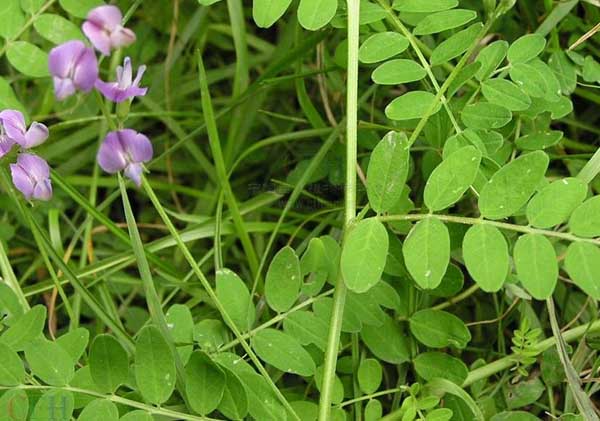
Astragalus complanatus, also known as Tongjili, Vinescent Milkvetch, Xiahuangcao, and Shayuanjili, is the plant Astragalus complanatus of the Leguminosae family, Astragalus genus, with flat stems, and its seeds are used as medicine. It has the effects of tonifying the liver and kidneys, securing essence, and improving eyesight. It mainly treats dizziness and blurred vision, soreness and weakness of the waist and knees, spermatorrhea, premature ejaculation, frequent urination, and enuresis. It is mainly produced in Jilin, Liaoning, Hebei, Shanxi, Inner Mongolia, Shaanxi, Gansu, Ningxia and other provinces. For developing the great Northwest and returning farmland to forest, planting trees and grass, it is one of the best varieties, with strong drought resistance, cold resistance, and adaptability. It was planted very well in the comprehensive management of the Loess Plateau during the "7th Five-Year Plan" and "8th Five-Year Plan," and it is also a commonly used clinical medicine.
Plant Characteristics
Perennial herb, 30-100 cm tall, the whole plant covered with soft hairs. Root long and stout. Stem slightly flat, relatively slender and weak, base often prostrate, branched. Odd-pinnate compound leaves alternate, stipules small, very needle-shaped; leaflets 9-21, oblong-elliptic, 0.6-1.4 cm long, 0.3-0.7 cm wide, apex rounded or slightly concave, with a small slender tip, petiolules inconspicuous. In summer, yellow papilionaceous small flowers bloom, raceme axillary, peduncle slender and long, upper part sparsely bearing 3-9 flowers, pedicels 0.1-0.2 cm long; corolla about 1 cm long, standard petal nearly round, apex concave, base with claw; didynamous stamens shorter than pistil, stigma with beard-like hairs. Pod inflated, spindle-shaped, about 3 cm long, apex with a pointed beak, surface covered with black hard hairs, inside with a false septum. Seeds 20-30, round-kidney-shaped, about 0.2 cm long, about 0.15 cm wide, less than 0.1 cm thick. Surface brown to dark brown, smooth. Both sides slightly concave, with an obvious hilum on the concave side.
Growth Characteristics
Astragalus complanatus has strong adaptability, likes a ventilated and light-transmitting environment, is cold-resistant, drought-resistant, and afraid of waterlogging. It has no strict requirements for soil, and can be planted in sandy loam, loam, and clay loam. It is not suitable for continuous cropping, and the previous crop is best as corn.
Cultivation Techniques
1. Land Selection and Preparation
Choose high and dry terrain with good drainage, such as field edges, field ridges, and sloping mountain land. Sandy loam, loam, and clay loam are all acceptable.
2. Propagation Methods
Astragalus complanatus is propagated by seeds. Sowing is divided into spring and autumn seasons. Spring sowing is from late March to late April, and autumn sowing is from August to September. Drill sowing is carried out in the prepared land, with a row spacing of 33 cm. Draw small furrows along the border about 1.65 cm deep, evenly scatter the seeds into the furrows, cover with soil 0.6-1 cm, and water after sowing. There is also irrigation sowing: in non-irrigated land, after the water recedes, sow the seeds according to row spacing, cover with shallow soil on top, or sow before or after rain. The sowing rate per hectare is 15-22.5 kg. At a temperature of about 15°C, germination can occur in 2 weeks.
Astragalus complanatus can also be intercropped with wheat, corn, and cotton. The method is: when sowing wheat, leave a 23.1 cm empty space every 165 cm, and intercrop Astragalus complanatus in March-April of the second year. After wheat harvest, plant corn. After corn harvest, remove the stalks to facilitate the growth of Astragalus complanatus.
3. Field Management
Water appropriately before emergence to promote seedling emergence. After emergence, do not water too much to avoid excessive growth. When the seedlings are about 8 cm tall, thin them according to a plant spacing of 10-13.2 cm, leaving 2-3 strong seedlings, and immediately support the seedlings and earth up. Pay attention to drainage during the rainy season. During the growth period and bud period, combine loosening soil and weeding with topdressing human feces and urine or ammonium sulfate 2 times. Afterwards, each year at the green-up stage, apply 45000-60000 kg of barnyard manure per hectare, mix manure with soil, and cover on the ground to promote plant green-up and growth. In particularly cold places, water with frozen water before freezing. After harvest each year, carry out intertillage and weeding, and topdress to overwinter.
4. Pest and Disease Control
① Powdery mildew
Caused by fungal infection, damages leaves, with white powdery substance on both sides, turning into small black spots at the late stage.
Control method: Clean the garden, burn diseased plants. At the early stage of disease, spray with 50% thiophanate-methyl 800-1000 times solution or 65% zineb 400 times solution, once every 7 days, for 2-3 consecutive times.
② Wireworm
Occurs from June to August, damages roots. Broadcast lead phosphate for control.
Harvesting and Processing
The yield of Astragalus complanatus is low in the first, third, and fourth years, and high in the second year. Before Frost's Descent, when 80% of the pod outer skin changes from green to yellow and fades, cut all the plants 6.7 cm above the ground, dry in the sun and thresh, and remove all impurities.