Detailed Explanation of the Key Cultivation Techniques for Dendrobium officinale
Dendrobium officinale, also known as black-joint grass, belongs to the genus Dendrobium in the orchid family (Orchidaceae) and is a precious wild medicinal plant. Its active components are mainly dendrobium polysaccharides, dendrobine, and amino acids, among which the polysaccharide content is as high as 21.7%. It can significantly improve the body's immune function and has effects such as nourishing the stomach and promoting fluid production, tonifying the kidney and boosting strength, nourishing yin and clearing heat, tolerance to hypoxia, anti-fatigue, and anti-tumor.
The methods of artificially cultivating Dendrobium officinale can be divided into two major categories: “wild-simulated cultivation” and “facility cultivation.” According to the different cultivation carriers chosen, the cultivation methods can be further subdivided into: stone-attached cultivation, tree-attached cultivation, stone wall cultivation, rock wall cultivation, three-dimensional cultivation, pot cultivation, three-dimensional pot cultivation, seedbed ground cultivation, and so on. At present, the most widely used, efficient, and high-yielding method is “facility cultivation.” The modes of “facility cultivation” include: shade shed cultivation, solar greenhouse, balcony three-dimensional cultivation, indoor three-dimensional pot cultivation, and so on.
In areas south of the Yangtze River, Dendrobium officinale can be directly cultivated on tree trunks in forests, without the need for “facility cultivation” or the construction or use of facilities for cultivation, and the cost is very low; in cold northern areas, “facility cultivation” can be created by appropriately adjusting or modifying house balconies, disused vegetable greenhouses, and the like, and by using three-dimensional pot cultivation of Dendrobium officinale, there is no need to build new greenhouses, and the cost is also very low.
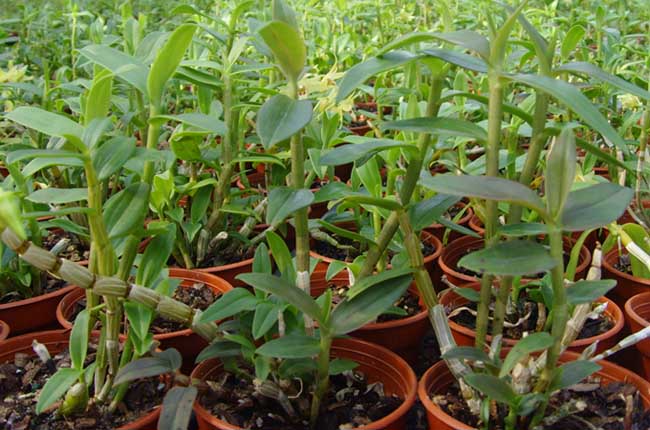
Environmental Requirements for Planting Dendrobium officinale
In “facility cultivation,” this refers to the small environment inside the cultivation facility, while in “wild-simulated cultivation,” it refers to the local climate environment, rather than requiring the climate of an entire province or region. There are the following main conditions:
1. Temperature: The survival temperature is -2-41°C, the growth temperature is 10-35°C, and the optimum growth temperature is 20-32°C. At high temperatures, such as in summer, the greenhouse must be shaded and ventilated, and frequent misting is needed to cool and maintain moisture; at low temperatures, such as in winter, insulation and heating are needed.
2. Humidity: Humidity needs to be adjusted accordingly with the rise and fall of temperature. During vigorous growth, it is best to keep the air humidity of the small internal planting environment at 60%-90%. High temperatures require high humidity, and low temperatures require low humidity. During high temperature and high humidity, ventilation should be strengthened to prevent bacterial and fungal diseases.
3. Substrate: Cultivation requires the use of a substrate, and the substrate must keep the root environment easy to drain, easy to ventilate, and rich in pores.
4. Water quality: The water used for watering Dendrobium officinale should be weakly acidic or neutral water.
5. Light: Shading should be adjusted according to temperature and light, and during suitable growth, the shading degree should be controlled at 50-80%.
6. Ventilation: The cultivation site must have good ventilation conditions. Simply put, there are two major requirements: first, the small cultivation environment should be “warm, humid, and weakly lit”; second, the cultivation substrate should be “loose, breathable, and draining.”
Artificial Cultivation Methods for Dendrobium officinale
For the cultivation site or carrier, flat ground, hillsides, walls, rock walls, tree trunks, balconies, and flower pots can all be chosen, with the requirement of no water accumulation and easy drainage. During cultivation and planting, a 3-5 cm cultivation substrate can first be laid down, and then the washed seedlings can be planted into the substrate just like planting tree seedlings. The cultivation substrate can be selected from: stones, limestone, bark, sawdust, discarded mushroom culture material, and so on, mixed in a certain proportion; one may also choose humus soil formed from fallen leaves and branches under the forest, mixed with stones in a certain proportion; or use some crop husks as the cultivation substrate.
Transplanting Dendrobium officinale
The natural reproduction rate of Dendrobium officinale is extremely low. Rapidly propagating large numbers of tissue-cultured Dendrobium officinale seedlings through tissue culture has become an effective way to solve the seedling problem. Planting tissue-cultured Dendrobium officinale seedlings on raised beds allows watering by misting at any time and drainage of excess water at any time, so roots will not rot and seedlings will not die due to too much water, and it can also ensure ventilation and breathability for the root system, thus greatly increasing the transplant survival rate, which can reach more than 95%.
1. Hardening seedlings: Before transplanting, first place the bottle seedlings in a hardening room for 2-3 weeks of hardening, allowing the bottle seedlings to transition from a closed and stable environment to an open and changing environment, and gradually adapt to the natural environment. Wait until the bottle seedlings grow robustly, the leaf color is normal, the roots are more than 3 cm long, the fleshy stems have 3-4 internodes and 4-5 leaves, the leaf color is normal, the roots are more than 3 cm long, there are 4-5 roots, the root skin is white with a touch of green, there are no black roots, no deformities, and no variations.
2. Removing from bottles: When taking the tissue-cultured seedlings out of the bottles, open the bottle stopper and gently take out the culture medium together with the small seedlings, place them neatly in a basin for washing, and place contaminated seedlings, bare-root seedlings, or few-root seedlings separately. For normal tissue-cultured seedlings, first wash off the culture medium in tap water, especially the agar, to avoid mold from the agar causing root rot, then rinse once more with tap water. For bare-root or few-root tissue-cultured seedlings, after the above washing, the roots of the small seedlings also need to be soaked in 100 mg/L ABT rooting powder for 15 minutes for rooting induction. For contaminated seedlings, after washing, soak the whole small seedling in 1000-fold carbendazim for 10 minutes. Proper later-stage management can effectively control the occurrence of contamination.
3. Preparation of the substrate: Suitable substrate should be selected for transplanting tissue-cultured Dendrobium officinale seedlings. The roots of Dendrobium officinale are aerial roots, with obvious aerophilic and shallow-rooted characteristics. Therefore, the substrate is required to be loose, breathable, well-draining, not prone to mold, and free of hidden pathogens and pests. Sphagnum moss, limestone, broken bricks, bark, wood shavings, fern roots, board edges, spent mushroom substrate, sawdust, and the like can be chosen as the transplanting substrate.
Field Management of Dendrobium officinale
1. Watering: If the air humidity is too low in the later stage of Dendrobium planting, water frequently to maintain moisture, and a sprayer can be used to water in the form of mist.
2. Topdressing: During the growing season of Dendrobium, attention should be paid to topdressing. Decomposed peanut meal, rapeseed cake, superphosphate, and the like can be mixed with river mud and scattered at the roots. In addition, 0.05-0.1% potassium dihydrogen phosphate can be used for foliar topdressing.
3. Pruning: Before new shoots emerge each spring, while harvesting old stems, cut out the dead stems within the clump, and remove diseased stems, weak stems, and diseased roots. After 6-8 years of planting, depending on the growth of the clump base, turn over the clump and divide it again for propagation.
Pest and Disease Control of Dendrobium officinale
1. Dendrobium black spot disease: It damages the leaves and causes them to wither, occurring from March to May. For control, spray 1-2 times with 50% carbendazim 1000-fold solution.
2. Dendrobium anthracnose: It damages leaves and stems, and affected leaves develop brown or gray lesions, occurring from January to May. For control, spray 2-3 times with 70% thiophanate-methyl 1000-fold solution.
3. Dendrobium scale insect: It parasitizes the edges or backs of plant leaves and sucks sap, with late May being the peak hatching period. For control, spray with biological pesticide Haizheng Miechongling 4000-fold solution to kill them, or gather old branches with scale shells and burn them centrally.
Harvesting and Processing of Dendrobium officinale
1. Harvesting. Harvest before budding in late spring each year. When harvesting, cut off stems and branches that are more than three years old, and leave the tender stems to continue growing.
2. Processing. Due to differences in varieties and commercial medicinal materials, there are two methods:
① Wash the harvested stems clean of mud and sand, remove the leaves and fibrous roots, separate them into individual stems, put them into hot water at 85°C and scald for 1-2 minutes, take them out, spread them on bamboo mats or a cement yard to sun-dry, and when they are 50% dry, rub off the sheath membrane by hand, then spread them out to dry again, taking care to turn them frequently, until fully dry.
② The washed Dendrobium can also be put into boiling water and soaked for 5 minutes, taken out and air-dried, placed on bamboo mats to sun-dry, turned 2-3 times a day, and when the stems become soft, rub them while drying, repeating many times until the remaining leaf sheaths are completely removed, then sun-dry until fully dry.