Detailed Guide to Ginseng Cultivation Techniques: Master the Scientific Planting Methods
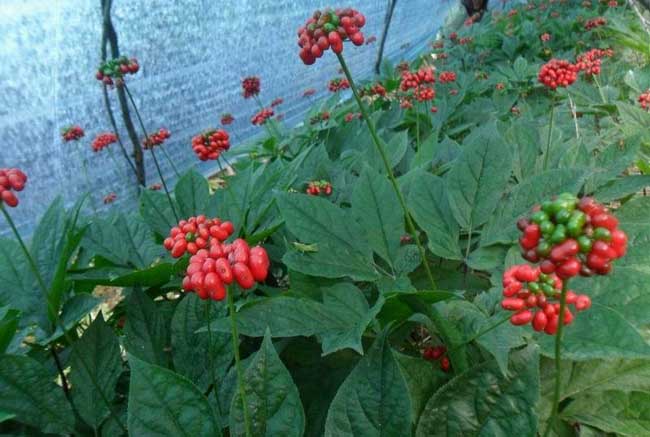
Ginseng is a perennial herbaceous plant that prefers a cool, humid climate and mostly grows on gentle or sloping mountain land at an altitude of 500-1100 m where the temperature difference between day and night is small, in mixed coniferous-broadleaf forests or mixed woods. Because its root is thick and fleshy, spindle-shaped, often forked, and in overall appearance closely resembles a person's head, hands, feet and limbs, it is called ginseng. In ancient times, the elegant names for ginseng were huangjing, dijing and shencao. Ginseng is called the “king of a hundred herbs” and is one of the far-famed “Three Treasures of the Northeast” (ginseng, marten fur and deer antler velvet); it is a precious medicinal material renowned at home and abroad and known to young and old alike.
Plant Characteristics
The ginseng plant is 33-66 cm tall, with a single, upright, cylindrical stem that is smooth and hairless. The leaves are palmately compound, with long petioles; the basal leaves are the smallest, and the leaflets are elliptical with finely serrated edges, green on the surface, and sparsely hairy along the leaf margin. The umbel is borne singly at the top, with 4-40 or more small pale yellow-green flowers. The lower end of the stem is often forked, and the top has a rhizome, commonly called the rhizome head.
Growth Characteristics
Ginseng likes to grow in cool, semi-shaded, semi-sunny places; it is cold-tolerant and avoids direct strong light. When cultivated, a shade shed must be built. For ginseng beds, sunlight entering before 8 a.m. and after 6 p.m. is suitable, while direct strong light at noon will cause the ginseng leaves to scorch and wither. It is suitable for growing at temperatures below 25°C. Forest humus soil is most suitable for planting ginseng; farmland soil with fully decomposed pig manure, compost and other cool-natured fertilizers added can also be used for planting. It requires broadleaf forest land with oak, linden, hazel and similar trees, and neutral or slightly acidic soil. For ginseng planted in farmland, the previous crop is best one that has grown gramineous and leguminous crops, such as corn, sorghum, millet, soybean and wheat. Root crops are not a good previous crop. Land where ginseng has been planted should not be planted with ginseng again in the short term. It fears waterlogging and avoids drought.
If ginseng seeds are sown immediately after being collected, they need 20-21 months to germinate; after 8-9 months of stratification treatment, they can germinate. This is because ginseng seeds have two processes, embryo after-ripening and physiological after-ripening, and completing these processes requires certain temperature and humidity conditions. Under field conditions, sow the seeds in soil 5 cm deep, with soil moisture of about 35%; from sowing to the seed cracking open, the soil temperature should be about 17-18°C. At this time, the change in soil temperature from high to low can be roughly divided into three stages: the first stage is from sowing to when the embryo is visibly a small dot, when the average temperature is about 21°C; the second stage is from the visible embryo dot to the point where it occupies 1/2 of the endosperm, when the average soil temperature is about 17.4°C; the third stage is from the embryo occupying 1/2 of the endosperm to cracking open, when the endosperm still continues to grow for a period, then passes through more than 3 months of low temperature (about 5°C), and when the spring temperature rises to 11.8-15.2°C, the germination rate can reach more than 90% in about 20 days.
Planting and Cultivation Techniques
1. Site Selection and Land Preparation
The environment chosen for planting ginseng must be free from flood, drought, wind and freezing damage. For cultivating ginseng in farmland in plain areas, land with high terrain, loose and fertile soil, strong water retention and good drainage must be chosen. Ginseng likes forest humus soil; if the soil's organic matter content is low, organic fertilizer must be added during land preparation so that the soil is fertile and its properties approach those of forest humus soil. If ordinary farmland is used as the cultivation site, the previous crop is better corn, millet, beans or wheat; corn and beans can also be sown in spring and then turned under in summer as green manure. Apply 1/3 decomposed pig manure, decomposed fallen leaves, green manure (soybean stalks) and cake fertilizer, and 1/3 peat; if the soil is very compact, add an appropriate amount of fine sand, and repeatedly turn and mix 3 times with 1/3 of the bed surface to make it uniform, then make high beds. When mixing the soil, apply 0.01-0.025 kg of superphosphate per sq m to increase fertility, or apply 2.5 kg of pig manure, 1 kg of old house soil, and 0.5 kg each of soybean cake and superphosphate per sq m, and mix evenly with the bed soil. For cultivating ginseng on mountain slopes, choose gentle slopes with a gradient of 5-25 degrees that are high and dry; for terraced land and mountain land, generally 20-30 degrees is suitable. Too steep a slope makes work inconvenient and easily causes soil erosion. It is best to choose soil with thicker humus (about 13 cm), and if possible, apply a certain amount of base fertilizer as well.
After the mountain site is selected, carry out site treatment. Remove trees and stones from the site, then cut the shrubs and grass close to the ground, spread them evenly on the ground to dry, make firebreaks around the perimeter, choose a windless day with clear skies, light the fire, let everything turn into red embers, and put out the fire. Cover with soil or pour water, either is fine; this increases phosphorus and potassium fertilizer and also kills underground pests. It raises the ground temperature and speeds up decomposition.
There is a principle for planting ginseng on mountain land: “wear a hat on the head, a belt around the waist, and boots on the feet,” the purpose being to prevent soil erosion. According to the steepness or gentleness of the slope, leave water-blocking and drainage dams. Therefore, after burning the site, determine the positions of the drainage dams. Generally, set a terrace step every 2000-4000 cm, 100 cm wide; the angle between the slope of the step and the mountain contour line should preferably be 2-3 degrees, and leave tree stumps on the step to play a fixing role. When turning the soil, do not turn the positions fixed for the steps. Stones and debris should be picked out and piled beside the steps. Make them into dam shapes to block and drain water.
Determine the direction of the ginseng beds: mainly make use of morning sun and late sun, and avoid direct noon sunlight. The direction of ginseng beds on mountain land is mostly due south. For a due north orientation, if there are high mountains on the east and west affecting it, it is better to be slightly toward the west; for north and south slopes, beds can be made following the mountain; if east and west slopes are not steep and rainwater can flow along them, beds can be made across the mountain or diagonally across it; on especially steep mountains, make beds diagonally across or following the mountain. After the direction is determined, drive in marker stakes, or spread white lime as a mark. The standard line for the direction of the ginseng bed is measured with a compass or theodolite. Set up the instrument at one end of the land, adjust the degree on the instrument to match the degree required for the bed, find the position of the standard rod through the telescope so that it coincides with the crosshair of the compass, insert one marker stake at the standard point and one at the point indicated by the plumb bob of the compass, connect the two stakes with a measuring rope, and spread white lime along the measuring rope to form the baseline. Draw perpendicular lines from the two endpoints of the baseline to form the end lines. Starting from the two endpoints of the baseline, along the direction of the end lines, measure out the width of the bed rows (bed width and working path width) with a measuring rope or measuring rod and insert the marker poles. Connect the two corresponding marker stakes on the end lines with a measuring line to form a center line parallel to the baseline. The area between two rows of lines is one ginseng bed; the length of the bed is determined according to the plot and terrain.
Land preparation: plow the land in the year before use, using the alternate-year method, carried out in summer and autumn. For sowing land, plow in July of the second year. For transplanting land, plow 15-20 cm deep in September; where transportation is inconvenient, use manual digging, turning up the soil along the bed rows with a pick or shovel and placing it in the middle of the bed rows, piling it into ridges for weathering. Dig out all tree roots, fill the pits and tamp them firm to prevent water accumulation. Break up the soil. After it is fine, pile it in the middle of the bed rows, and before sowing or planting ginseng turn the soil once more, thoroughly remove impurities such as crushed stones and tree roots, and make the beds. In China, ginseng is planted using the American ginseng planting method: one shed with multiple beds, bed width 130-150 cm, spacing between two beds 50 cm, working path width 200 cm; one shed with two beds, bed width 130-150 cm, spacing between adjacent beds 50 cm, working path width 200 cm; one shed with one bed, bed width 120-150 cm, working path width 150-200 cm, and bed height is 20-25 cm in all cases.
While selecting the site, the direction of the beds should also be determined. Ginseng avoids direct strong sunlight; after a shade shed is set up over the ginseng beds, in principle direct strong noon sunlight should not fall on the ginseng seedlings. Ginseng beds use high beds, 20-33 cm high; bed width is based on convenience for work, generally 100-130 cm; bed length is not limited, and working path width is 130-300 cm, which should be based on maintaining convenience for work and ventilation. For mountain ginseng cultivation, the traditional Chinese ginseng cultivation method has always been in the Changbai Mountains and the Greater and Lesser Khingan Mountains. In 1998, the catastrophic floods in Northeast China and regions south of the Yangtze River were directly related to deforestation; in the future, when planting ginseng on mountain land, attention should be paid to soil and water conservation.
2. Propagation Methods
Seed propagation, first raising seedlings and then transplanting, is mostly adopted in artificial cultivation.
① Seedling Raising
There are spring sowing, summer sowing and autumn sowing. Spring sowing is done in mid-March, and autumn sowing in late October; depending on the specific situation, the seeds used can be sown after stratification or sown without treatment. For spring sowing, sow the seeds after stratification; in early June (before Grain in Ear) the dry seeds from the previous year can be sown; for summer sowing, from late July to late August the fresh seeds collected that year can be sown, and this method is mostly used at present. Autumn-sown seeds also need stratification treatment.
There are many methods of stratification treatment, allowing the seeds to complete their embryo after-ripening stage under suitable temperature and humidity conditions and accelerating their germination. Two methods are introduced below: soak the dry seeds in clean water for 48 hours so they absorb water fully, take them out and mix them evenly with twice their amount of moist sandy soil (half fine sand and half humus, with humidity of about 35%, such that it forms a ball when held in the hand and breaks apart when dropped), put them into a pot or basin, place at 18-20°C, keep them moist at all times, and after 2-3 months most of the seeds have cracked open and can be sown. If not sown immediately, they should be placed in a cellar to freeze or buried outdoors in soil in winter for storage, to inhibit sprout elongation.
② Outdoor Stratification
Choose a sunny, wind-sheltered, high, dry site with good drainage, dig a pit 23-33 cm deep, and place in it a bottomless wooden frame (or make a frame with bricks and stones); the size of the frame depends on the amount of seed. Mix the seeds with twice their amount of mixed soil (1/3 fine sand and 2/3 humus mixed, moistened with water to the degree that it forms a ball when held in the hand and breaks apart when dropped, then mixed with the seeds) and put them into the pit, cover with about 6 cm on top, and tamp firm. Cover with straw curtains at night and on rainy days, and uncover for sun exposure during the day and on clear days; every 1-2 weeks take them out and turn and mix once, adjust the moisture, and put them back into the pit; after 2-3 months the seeds crack open.
In areas with higher temperatures, dry seeds can be trial-sown directly in early June; their embryo after-ripening stage is completed after sowing, and they emerge in spring of the following year. In practice, seeds with incomplete stratification treatment do not emerge that year but can still emerge the following year, which is the reason for this.
③ Fresh Seed Sowing
Wash the pulp off the seeds collected in July-August and sow them directly. The seeds can also be collected and stored successively in moist sandy soil, then sown together. In this way they can complete the embryo after-ripening stage under natural conditions and emerge in the following spring.
Sowing methods include dibbling, drilling and broadcasting. Dibbling means pressing holes at a spacing of 3 cm and placing 1 seed in each, which makes the ginseng seedlings grow evenly and saves seed but is labor-intensive; broadcasting wastes seed and saves labor; drilling is between the two. At present, broadcasting is mostly used. When broadcasting, use a wooden board to scrape a groove 5-6 cm deep in the bed surface, scatter in the seeds, and cover back with the original soil to keep the soil moist. If seedlings are to emerge the following year, cover with a layer of grass and press on 3-6 cm. Each sq m requires 0.03-0.05 kg of seed. Transplanting: seedlings are transplanted after growing for 2-4 years, generally mostly after 3 years. If soil fertility is not high, they can be transplanted once more. Transplanting can be done in both spring and autumn; at present, production areas in China adopt two-year-old ginseng seedlings for transplanting, first so that the small seedlings can fully use the water, fertilizer and light in the soil, which is beneficial to the growth of the ginseng seedlings. Two-year-old ginseng seedlings have a high survival rate because the seedlings are small and easy to re-establish, and the reproductive growth period is increased by one year, which is beneficial to increasing the weight of the ginseng root.
Generally autumn planting is mostly used, carried out in October. The day before planting ginseng, dig out the seedlings; dig out only as many as will be planted, and for long-distance transport, wrap them externally with moss. Select ginseng seedlings with plump buds, sufficient sap, intact rhizome heads and intact, healthy fibrous roots. For disinfection of ginseng seedlings, soak the seeds for 5-10 minutes in medicinal solutions such as 150 units of antimycin or 120 times Bordeaux mixture; do not soak the buds, take them out and let them dry slightly, then transplant. For convenience of field management, divide the ginseng seedlings into three to seven grades according to size, generally into three grades. The ginseng seedlings must be tightly covered with white cloth to prevent wind and sun. Scrape furrows in the ginseng bed surface with a scraper (26 cm long, 16 cm wide, with a thin blade underneath and a comb-like back). The furrow bottom is flat or sloped. Place the ginseng seedlings evenly with the rhizome heads facing the end of the bed, cover with soil using the scraper and press the fibrous roots along the ginseng, then cover with soil again. When planting the last row, plant in reverse, that is, with the rhizome heads facing the end of the bed and the fibrous roots facing each other. After planting, rake the bed surface level, making the middle of the bed slightly higher so as to drain water, cover with plant straw and fallen leaves, and cover with 3-6 cm of soil. The plant and row spacing, number of ginseng seedlings per plant, and soil covering depth for transplanting should differ according to the size of the ginseng seedlings.
3. Field Management
After the soil thaws, before the buds sprout, remove the winter protection grass and use a rake to loosen the soil deeply once, to a depth that does not injure the roots. Subsequent loosenings should be shallow, 3-4 times each year. After removing the winter protection material, promptly use chemicals to thoroughly disinfect the bed surface; this is an effective measure for preserving seedlings, preventing disease and increasing yield. Especially for transplanting land and plots with severe disease, before applying winter protection material and after removing winter protection soil, use 50% carbendazim 1000 times solution, 1% copper sulfate 100 ml/L, polyoxin or zineb 500 times solution, or mancozeb 1000 times solution to thoroughly disinfect the bed surface, ginseng shed and working paths. The amount applied should be such that it penetrates 1-2 cm into the bed surface, then loosen the soil to let the medicinal solution seep into the soil. Ginseng emerging against the chemical plays a role in sterilization, seedling preservation and disease prevention. After the first loosening, just as the seedlings emerge or before they emerge, set up the shade shed; the front eave height is 100-130 cm, the rear eave height 66-100 cm, and the difference is called the opening, generally 26-33 cm. Cover the top with straw curtains, reed curtains or boards; reeds can also be used. Simple curtains made of materials such as tree branches woven to let light through and rain leak through, with curtain width 200-250 cm and light transmittance of about 30%, can be used. A double-permeable large flat shed can be used, meaning it allows both light and rain to pass through. After ginseng unfolds its leaves, cover the simple bed surface with 3-5 cm of tree leaves to maintain soil moisture, prevent soil compaction and rain erosion, and reduce disease.
When the soil is dry, water appropriately; especially for ginseng planted in farmland in areas with low rainfall, more attention should be paid to watering. After watering, loosen the soil, and in the rainy season prevent water accumulation.
Except for seed-producing land, other plots should have the flower clusters pinched off at the bud stage to increase ginseng root yield. Pinching method: support the ginseng stem with the left hand and pinch with the right hand; never pull or tug hard, for fear of injuring the plant. Dry the pinched-off flower clusters in a concentrated way to make ginseng flower tea, ginseng flower extract or to extract saponins. Generally only five-year-old seeds are kept.
In the hot summer season, insert broadleaf tree branches at the front and rear eaves of the beds to block direct strong light and prevent ginseng leaves from being scorched and dying from early leaf fall. For simple-curtain ginseng beds, planting a row of corn behind the bed is better, as it can also provide shade. Ginseng has phototropism; four- to five-year-old large seedlings growing outside the bed surface are very large and also phototropic, so earth up at the roots and prevent damage from strong wind, rain and lodging. Lines can also be strung to prevent ginseng from leaning outward due to phototropism.
Autumn ginseng management: from late July to early August, the fruits mature successively. Collect in two batches; after the fruits turn red, remove the seeds or cut off the flower stalks, remove diseased seeds and fruit stalks, rub off the pulp, pour the seeds into clean water and wash, skim off the pulp and shriveled grains, take out the plump seeds that sink to the bottom, place them on a mat to dry in the sun or in the shade, and store them when the seed moisture content drops to about 15%. Mix with sand and put into a certain container, bury in a cool place, and prevent rain from soaking them. Take them out the next year for stratification, or sow directly without sand storage. After ginseng withers in autumn, cover the bed surface with grass to overwinter; the curtains can be removed or not.
4. Winter Field Management
① Adding and Removing Snow
After winter begins, generally board sheds and curtain sheds should be taken down or opened up so that winter snowfall falls onto the beds and plays a role in cold protection and heat preservation. When there is little snow on the bed surface in winter, snow must be added manually; especially for ginseng beds whose sheds are not removed, the snow on the working paths must be scooped onto the bed surface and spread evenly, with a thickness of more than 15 cm.
From late autumn to freezing or during spring thaw, snow that falls on the bed surface, after melting into snow water, easily seeps into the beds and causes ginseng to become diseased, with rotten buds, rotten roots and split bellies; this snow must be removed promptly. For ginseng sheds whose curtains are not removed, when the accumulated snow thickness reaches more than 10 cm, it easily crushes the ginseng shed, so it must also be removed promptly.
② Preventing Peach Blossom Flood
Every year from March to April, the accumulated snow begins to melt; often because drainage ditches are poorly dug or blocked, the snow water cannot flow out, and water accumulates where it is blocked and seeps into the beds; where the water flows, it easily damages the ginseng beds or flows over the bed surface; ginseng in the affected areas is prone to disease, rotten buds and rotten roots. Therefore, preventive work must be done well. When ice and snow melt, assign specially designated people to inspect, clear the places where water accumulates, and lead out the peach blossom flood.
③ Preventing Thaw-Freeze Damage
In early winter and early spring, the temperature changes greatly; especially on sunny slopes and in wind gaps, it thaws during the day and freezes at night, and the alternating freezing and thawing very easily causes ginseng roots to suffer thaw-freeze type freezing damage, commonly known as thaw-freeze damage. This must never be taken lightly; be prepared for every possibility and leave nothing to chance. Therefore, when applying winter protection soil or winter protection materials, standards must be met; in conjunction with clearing drainage ditches, add more soil to the bed surface or cover with a layer of curtain to prevent thaw-freeze damage.
Disease Control
1. Damping-off
Also called soil pinching disease, the pathogen is a kind of imperfect fungus among the fungi. This disease mainly occurs during the seedling emergence and leaf unfolding stage, and one- to three-year-old ginseng is severely affected. The stem of affected ginseng seedlings at the boundary of dry and wet soil below the soil surface shows brown ring-shaped constriction, and the seedlings collapse and die.
Control Methods
① One to two months before sowing, fumigate the soil with 80-120 ml of chloropicrin per sq m. When making the bed, apply 0.01-0.015 kg of 50% carbendazim wettable powder per sq m, mix into the 3-5 cm deep soil layer for soil disinfection, and then sow. If mixed with dexon or metalaxyl, it can also control damping-off caused by Pythium. Alternatively, mix 0.4-0.8 kg of 50% thiram wettable powder and 0.4-0.7 kg of 70% hymexazol wettable powder per 100 kg of seed evenly and then treat the seed, or treat the seed with 0.5 kg of 40% seed dressing dual wettable powder.
② When diseased plants are found in the seedbed, pull them out promptly, and pour the above chemicals onto the bed surface to prevent spread.
2. Leaf Spot Disease
The pathogen is a kind of imperfect fungus among the fungi. This disease mainly harms leaves, and stems and fruits can also be harmed when red and ripe. The leaves produce irregular or nearly round brown spots, and in severe cases the leaves fall early. After red-ripe fruits are harmed, they turn black and shriveled, and the seeds also show varying degrees of blackening.
Control Methods
① Do a good job of clearing the garden, promptly remove and burn the pathogen.
② In the early stage of leaf unfolding, use 100-200 units of polyoxin; after leaf unfolding, especially once the rainy season begins, switch to spraying 1:1:120 Bordeaux mixture, 50% iprodione 500-800 times solution or imazalil 400 times solution, etc., and it is best to use them alternately.
③ For plots with severe disease, immediately use 100 units of polyoxin or 1% copper sulfate solution to thoroughly disinfect the ginseng bed working paths and ginseng shed.
3. Phytophthora Blight
Phytophthora blight is also called “drooping towel,” and the pathogen is a kind of algae-like fungus among the fungi. This disease mainly harms leaves, and roots can also be harmed. Diseased leaves appear dark green and water-soaked. After roots are harmed, they appear light yellowish-brown and soft-rotted, the root skin is easily peeled off, and the internal tissue shows yellowish-brown irregular patterns. The disease is more severe in the rainy season.
Control Methods
When the central diseased plant is found, pull it out immediately, and disinfect the diseased hole and surrounding soil with copper-ammonium mixture (1:1:1500), 1% copper sulfate or 70% dexon 500 times solution to prevent spread. Strengthen field management and drain water promptly in the rainy season. In the early stage of disease, spray 1:1:120 Bordeaux mixture, 40% fosetyl-aluminum 300 times solution or 58% metalaxyl-mancozeb 1000 times solution, or drench the middle and lower parts of the plants and the soil surface; it is best to spray after heavy rain, once every 7-10 days, for 2-3 consecutive times.
4. Rusty Root Rot
The pathogen is a kind of imperfect fungus among the fungi. This disease mainly harms the roots and buds, and the stem base can also be harmed. The lesions on the roots are rusty red and gradually expand, causing the roots to rot.
Control Methods
Strengthen cultivation management; when planting ginseng, choose disease-free plants, avoid causing wounds, soak the roots for 10 minutes with 200 ml/L, or soak the ginseng roots for 15 minutes with 5% carbendazim 500 times solution; before planting, use 0.01-0.015 kg of carbendazim per sq m to disinfect the bed soil; the soil must be fully turned and mixed evenly before planting ginseng. Drain water promptly in the rainy season, promptly pull out dead diseased plants, and treat the diseased holes with lime. During the disease period, drench the diseased holes with 50% carbendazim or 50% thiophanate-methyl 500 times solution. Rotation with gramineous crops has a certain preventive effect.
5. Sclerotinia Disease
The pathogen is a kind of ascomycete among the fungi. This disease harms the roots; after the affected roots rot, only the epidermis remains, and there are brown mouse-dropping-shaped sclerotia both inside and outside.
Control Methods
Treat seeds with 50% procymidone or iprodione wettable powder at 0.1%-0.3% of seed weight, or drench with the above chemicals and 40% dimethachlon 500 times solution. When diseased plants are found, pull them out promptly and disinfect the diseased holes with quicklime or 1%-5% lime milk.
6. Root Rot
The pathogen is a kind of imperfect fungus among the fungi. This disease harms the roots; the affected roots are grayish-black and wet-rotted inside.
Control Methods
Drain water promptly in the rainy season and avoid excessive humidity. When planting, treat the soil with 50% carbendazim, 70% hymexazol or 50% thiram per sq m; combined with drenching with the above chemicals at 500 times solution during the disease period, it also has a control effect.
Pest Control
1. White Grubs
White grubs are also called “white soil silkworms” and belong to the family Scarabaeidae of the order Coleoptera. The larvae cause damage, biting off ginseng seedlings or gnawing on ginseng roots, causing broken seedlings and hollow broken roots, and the damage is severe. During the day they are often found 3-6 cm above or below ground at or near the roots of affected plants.
2. Cutworms
Cutworms are also called “soil silkworms” and “black soil silkworms,” etc., and belong to the family Noctuidae of the order Lepidoptera, mainly the small cutworm and the yellow cutworm. The larvae cause damage, biting off the root crown. During the day they are often found at or near the soil surface at the roots of affected plants.
3. Mole Crickets
Mole crickets are also called “soil dogs” and “lala crickets,” etc., and belong to the family Gryllotalpidae of the order Orthoptera, mainly the North China mole cricket and the African mole cricket. Adults or nymphs bite off seedlings and make tunnels in the soil; the broken parts of affected seedlings often appear fibrous.
4. Click Beetles
Click beetles are also called snapping beetles and belong to the family Elateridae of the order Coleoptera, mainly the slender chest click beetle and the grooved click beetle. The larvae damage seedling roots.
The control methods for the above four types of underground pests are basically the same
① The manure applied must be fully decomposed, and high-temperature composting is best.
② Use light to trap and kill adults. In the field, use black light lamps or barn lanterns or electric lights to trap and kill them; place a container for holding insects under the light, put an appropriate amount of water in it, and add a little kerosene to the water.
③ Treat seeds with 75% phoxim emulsifiable concentrate at 0.1% of seed weight.
④ During the occurrence period in the field, drench with 90% trichlorfon 1000 times or 75% phoxim emulsifiable concentrate 700 times solution.
⑤ Poison bait trapping. Mix 25 g of chlorpyrifos emulsifiable concentrate with 5 kg of roasted fragrant bait, add an appropriate amount of water to make a poison bait, and scatter it in the field or on the bed surface in the evening to trap and kill.
Harvesting and Processing
Generally, ginseng is harvested and processed after six years of cultivation (six-year-old), and some are harvested only after more than six years. Dig from mid-September to mid-October; prevent wounds when digging, remove the aboveground stems, then put the ginseng roots into gunny bags or baskets and transport them back for processing.
1. Red Ginseng
Select ginseng roots with sufficient sap, not soft, intact and without disease spots, wash them clean, put them in a steaming basket and steam for 2-3 hours, first with a strong fire and then with a gentle fire. Large processing units already use steam to steam ginseng, which is fast for large quantities. Take them out to dry in the sun or roast dry; during the drying process, cut off the rhizome head and the lower section of the branch roots. Dry the cut-off branch roots in the sun and tie them into bundles, which are red ginseng whiskers. The small fibrous roots that cannot be tied into bundles are also red after steaming and drying, and are curved whiskers.
2. Sugar Ginseng
Brush and wash ginseng roots that are soft and have insufficient sap, put them in a fumigation box, light sulfur and fumigate for 10-12 hours. After taking them out, place them head down in a basket, blanch in boiling water for 15 minutes, and when the ginseng roots become soft and the inner core is slightly firm, take them out and sun-dry for about half an hour. Place the ginseng roots flat on a wooden board and prick upward with a needle-row device, pricking all over the ginseng body. Then use a bone-made straight needle to prick along the ginseng root from bottom to top several times, but not through. After pricking, place the ginseng heads facing outward, tails inward, flat in a vat; do not fill it too full. Place a curtain on top and press down with a stone. When the sugar is boiled until it is bright when lifted and forms unbroken threads, pour it while hot into the vat containing the ginseng roots, and take them out after 10-12 hours. Place them in a ginseng tray to dry in the sun until they are no longer sticky, then carry out the second needle-row and sugar pouring. After pouring sugar 3 times by this method, dry in the sun or roast dry.
Sugar Boiling Method
For the first sugar pouring, 0.5 kg of ginseng requires 0.65 kg of white sugar, and 0.5 kg of sugar requires 0.15 kg of water. First put the water in a pot, add the sugar and then light the fire, stir while boiling, and boil until the required standard is reached. For the second sugar pouring, 1.5 kg of ginseng and 0.5 kg of sugar require 100 g of water; add to the first syrup and boil again. Use the second syrup for the second sugar pouring; just bring it to a boil.
3. Sun-Dried Ginseng
Sun-dried ginseng is divided into trimmed-whisker sun-dried ginseng and whole-whisker sun-dried ginseng. For trimmed-whisker sun-dried ginseng, select short-bodied ones with disease scars; for whole-whisker sun-dried ginseng, select ginseng with a large body, good shape and complete whiskers. For trimmed-whisker sun-dried ginseng, except for keeping the main root and large branch roots, remove all the rest. For whole-whisker sun-dried ginseng, do not trim the whiskers, only remove the small main whiskers. After trimming the whiskers, wash off the soil, scrape the disease scars clean with a bamboo knife, put in a fumigation box and fumigate with sulfur for 10-12 hours, then take out and dry in the sun or roast dry.