A Complete Analysis of the Key Points of Scientific Cultivation Techniques for Panax notoginseng
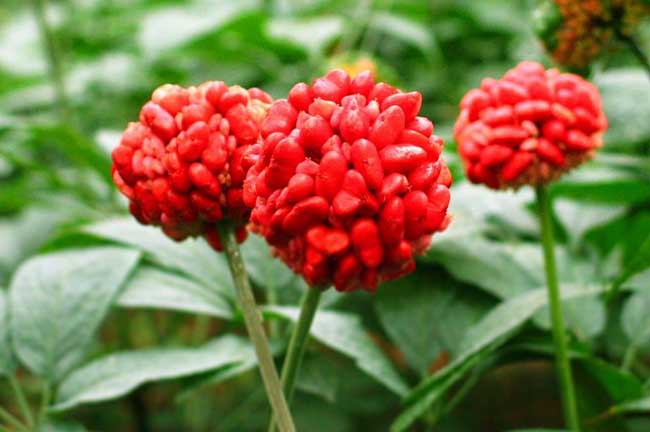
Panax notoginseng is a plant of the genus Panax in the family Araliaceae. It is a precious traditional Chinese medicinal material in China, mainly produced in Yunnan and Guangxi, and historically also in Guangdong, Sichuan, Guizhou, Hunan and other places. In recent years, the safety of medicinal material production has attracted increasing attention. In order to bring Panax notoginseng production in line with international requirements, the focus of Panax notoginseng production must shift from yield to quality, so as to ensure that commercial Panax notoginseng has the characteristics of high saponins, low pesticide residues and low heavy metal content. The cultivation and planting techniques for Panax notoginseng are introduced below for reference and application.
Site Selection and Land Preparation
For Panax notoginseng planting, it is advisable to choose slightly acidic sandy loam soil, with convenient drainage and irrigation, and a plot with a certain slope. The soil pH value is 5.5-7.0, and an altitude of 1000-1800m is preferable. In order to ensure the production of high-quality Panax notoginseng, it is necessary to consider whether the pesticide residues and heavy metal content in the soil exceed the limits. The limit standards are as follows: BHC ≤0.2mg/kg, DDT ≤0.2mg/kg, Pb ≤50mg/kg, Cu ≤80mg/kg, Cd ≤2mg/kg, Hg ≤lmg/kg, As ≤20mg/kg. Land preparation for Panax notoginseng requires three ploughings and three harrowings, fully breaking up the soil clods, and exposing them to sunlight. For plots where Panax notoginseng has been planted, 50-70kg of lime per mu of land is needed for disinfection treatment.
Shed Construction and Bed Making
Mark points and drive stakes at 1.8×1.8m. For shed construction materials, special shade nets for Panax notoginseng can be used, or local materials can be used, such as tree branches, mountain grass and crop straw, but their light transmittance needs to be adjusted to between 8%-15%, preferably not exceeding 20%, and absolutely not exceeding 30%, otherwise Panax notoginseng cannot grow normally. The height of the shade shed is preferably about 1.8-2m. Too low is not conducive to farming operations, and too high makes it prone to wind damage. For Panax notoginseng bed making, the width is required to be 120-140cm, the height 15-20cm, and it should be made into a curved-tile shape, with the bed soil firm on top and loose below.
Sowing and Transplanting
Panax notoginseng seeds have after-ripening characteristics and need to be stored in wet sand until December to January of the following year to break their dormancy, at which point they can be sown. For sowing, use a self-made template at a spacing of 4x5cm, punch soil holes 2-3cm deep on the bed surface for dibbling, and the sowing rate is 180,000-200,000 seeds per mu. For seedling transplanting, it is required to dig and transplant immediately from December to January of the following year. The method is also to punch holes with a 10×12.5cm or 10×15cm template, so that the dormant buds face downward during transplanting, and the planting density is 26,000-32,000 plants/mu. Before sowing and transplanting, seed treatment must be carried out by soaking with 500-fold solution of 64% Sandofan + 50% carbendazim. After planting, cover with burnt soil or fine soil mixed with farmyard manure until the sowing material is no longer visible, and then scatter a layer of crushed mountain grass or pine needles.
Field Management
1. Drought-resistant watering: After sowing Panax notoginseng, seedlings do not emerge until March-April. During this period, artificial watering is needed (if the soil has night moisture, it may not be watered). The method requires sprinkling with a nozzle until water runs off the bed surface. Generally, water thoroughly 2-3 times a month until the rainy season arrives.
2. Adjusting light transmittance: One- and two-year-old Panax notoginseng require relatively low light transmittance, generally about 10% is suitable, while three-year-old Panax notoginseng requires stronger light transmittance, preferably about 15%. By adjusting the light transmittance of the shade shed, the goal of increasing individual root weight can be achieved.
3. Topdressing: The budding stage (June) and flowering stage (September) of Panax notoginseng are peak periods of fertilizer absorption, and topdressing should be carried out at this time. Topdressing for Panax notoginseng is mainly farmyard manure, supplemented with a small amount of compound fertilizer. The topdressing rate of farmyard manure is 2000-2500kg/mu/time, and the topdressing rate of compound fertilizer is 10-15kg/mu/time.
4. Bud removal, flower thinning and fruit protection: In cool regions where the main goal is producing tuberous roots, when the flower stalk of Panax notoginseng grows to 3-5cm, remove it, which can greatly increase tuberous root yield. In seed-production fields, thinning out 1/3 of the inflorescence of the central flower buds during the flowering stage of Panax notoginseng can enable the red seeds (fruit) of Panax notoginseng to obtain a satisfactory yield.
5. Cleanliness of the Panax notoginseng garden: Promptly pull out all kinds of weeds in the Panax notoginseng garden by hand, remove diseased plant residues, and burn or deep-bury them far away from the garden. Cleanliness of the Panax notoginseng garden is an important measure to improve light penetration and prevent the spread of diseases, and must be given great attention.
Pest and Disease Control
Because Panax notoginseng has a long cultivation period (2-3 years) and grows in a shaded and highly humid cultivation environment, it has many diseases and they spread rapidly. The main diseases are black spot disease and root rot. Panax notoginseng insect pests generally do not cause harm, and controlling them once or twice with phoxim during the entire growth period is sufficient.
1. Black spot disease: It spreads epidemically in the rainy season, manifested as light brown oval lesions on leaves and stems, which then become sunken and produce black mold-like substances, and in severe cases twisting and breaking occur. The control method is to spray the leaf surface with 500-fold solution of 40% dimethachlon + 500-fold solution of 70% thiophanate-methyl in the early stage of the disease, or spray the leaf surface with 1000-fold solution of 45% amobam aqueous solution.
2. Root rot: Panax notoginseng root rot is a soil-borne disease, mainly occurring at the seedling emergence stage (March-April) and the flowering stage (August-October). Its symptoms are drooping and yellowing leaves, and rotting of tuberous roots or rhizomes. The control method is to mix 1kg/mu each of 10% phenazine oxide + 70% dexon + 25% triadimefon with 150kg of fine soil to make medicated soil and broadcast it in the early stage of the disease, which has a good control effect.
Prohibited Pesticides
In the cultivation of high-quality Panax notoginseng, highly toxic and high-residue pesticides must be prohibited. Organochlorines: DDT, BHC, quintozene, dicofol. Organophosphates: phorate, methamidophos, omethoate, isoprothiolane, trichlorfon. Organic arsenics: tecnezene, tianan, asomate. Carbamates: carbofuran, cartap. Organic mercuries, fluorine preparations, etc.
Harvesting
Spring Panax notoginseng (not kept for seed) is harvested in October, and winter Panax notoginseng (kept for seed) is harvested in December; after cleaning, it is classified and sun-dried or oven-dried, maintaining a moisture content of 12%-13%, and then rubbed and polished to become commercial Panax notoginseng.