Detailed Explanation of Honeysuckle Planting Techniques and Management Methods
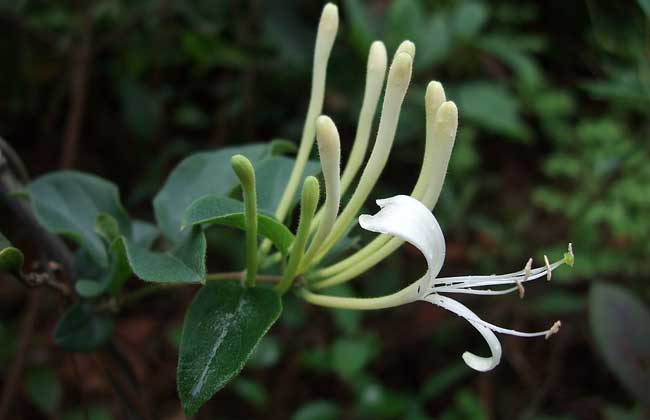
Honeysuckle, also known as silver flower, double flower, second flower, and erbao flower, is a perennial vine of the Caprifoliaceae family. Its medicinal part is the flower bud. It is mainly produced in Henan and Shandong, and is distributed in most parts of the country, growing on hills, in valleys, and at forest edges. Since ancient times, honeysuckle has been widely famous for its medicinal value. Its main effects are clearing heat and detoxifying, and it is mainly used to treat warm disease with fever, heat-toxin bloody dysentery, carbuncles, and furuncles.
Growth Habits of Honeysuckle
The growth and development process of honeysuckle can be roughly divided into three periods: the bud-breaking and leaf-unfolding period, the budding and flowering period, and the growth stagnation period:
1. Bud-breaking and leaf-unfolding period: leaf buds break in late March, and leaves unfold and grow in early April.
2. Budding and flowering period: budding begins in late May, and flowering occurs 15 days later. The first batch of flowers blooms from Xiaoman to Mangzhong (late May to early June), accounting for 80%-90% of the annual yield. The second batch of flowers blooms from late July to early August, accounting for 15%-20% of the annual yield. Buds are green at first, then turn white, and open at 4-5 p.m.
3. Growth stagnation period: after the second batch of flowers blooms, fruiting begins, and the fruit ripens in September. After Frost's Descent in late October, some leaves wither and the plant enters the overwintering state.
Honeysuckle produces more flowers after 3-5 years of planting, enters a high-yield period after 7-8 years, and gradually declines only after 20 years, requiring renewal. Honeysuckle likes sunlight and a mild, humid environment, with an optimum growth temperature of 20-30 degrees. It is cold-tolerant and drought-tolerant, and has low soil requirements; it can grow in both acidic and saline-alkaline land.
Honeysuckle Planting Techniques
1. Land selection and soil preparation
For seedling cultivation, choose sandy soil that is loose, fertile, and well-drained, and a place with convenient irrigation and a water source. After selecting the land, plow the soil more than 30 cm deep, break up the clods, level and harrow finely, and apply sufficient base fertilizer. Then make high beds 1, 3 m wide for sowing and raising seedlings or for cutting propagation. For the planting site, scattered plots such as barren slopes, field edges, ditch sides, and around houses can be used. First plow the land deeply, apply sufficient base fertilizer, and level and harrow finely to make high beds or high ridges for planting.
2. Propagation methods
Cutting propagation is the main method, and seed propagation and root division and layering propagation can also be used. Cutting propagation is divided into two methods: direct cutting and cutting for seedling cultivation.
① Cutting time: it can be done in spring, summer, autumn, and winter. In spring, it is best before new buds sprout; in autumn, from early September to mid-October.
② Selection and treatment of cuttings: choose healthy and plump 1-2-year-old branches, cut them into cuttings about 30 cm long, each with at least 3 nodes. Then remove the lower leaves, keep 2-4 leaves on the upper part, cut the lower end near the node into a smooth slant, tie every 50 cuttings into a small bundle, quickly dip the lower slant end in 500-fold indolebutyric acid solution for 5-10 seconds, let them dry slightly, and then insert them immediately.
③ Direct cutting: on the prepared planting site, dig holes at a row spacing of 150×150 cm or 170×170 cm, with a hole diameter and depth of 40 cm each. Loosen the subsoil, and apply 5 kg of decomposed barnyard manure or compost per hole. Then spread the cuttings evenly, insert 3-5 cuttings per hole, with the buried depth being 1/2-2/3 of the cutting, then fill with fine soil and press firmly with the foot, water thoroughly once, and keep the soil moist. Rooting and sprouting can occur in about 1 month.
④ Cutting for seedling cultivation: on a leveled and finely harrowed cutting bed, draw lines at a row spacing of 15-20 cm, and punch holes on the bed surface with a small wooden stick or bamboo chopstick every 3-5 cm. Then insert the cuttings obliquely into the holes at 1/2-2/3 of their length, press firmly, and water once immediately. If cuttings are taken in early spring at low temperature, build an arched plastic film tunnel on the cutting bed to keep warm and moist. In about half a month, they can root and sprout new buds; then remove the plastic film and carry out seedling management. Spring cuttings are lifted and planted in the same winter or the following spring. Summer and autumn cuttings are transplanted the following spring. Cutting for seedling cultivation obtains a large number of vegetative seedlings in a short period.
3. Transplanting techniques
Carry it out before sprouting in early spring or during the dormant period in autumn and winter. On the prepared planting site, dig holes at a row spacing of 150 cm and a plant spacing of 120 cm, with a width and depth of 30-40 cm each. Apply 5 kg of farmyard manure per hole and mix well with the subsoil. Then plant 1 strong seedling per hole, fill with fine soil, press firmly, tread firm, and water thoroughly to set the roots. After survival, through shaping and pruning, make the creeping vine form an upright short shrub as a single plant. Increase branching, expand the crown, and change from 1 batch of flowers per year to 3-4 batches per year. This can greatly increase the yield.
Field Management of Honeysuckle
1. Cultivation and weeding: after transplanting and survival, cultivate and weed 3-4 times each year. The first time is when new leaves sprout in spring; the second time is in June; the third time is in July-August; and the fourth time is in late autumn and early winter. After cultivation and weeding, soil should also be banked around the plant roots to facilitate overwintering. During cultivation, it should be shallow around the plant roots and deep farther away to avoid damaging the roots, otherwise it will affect the growth of the plant root system. After the third year, depending on weed growth, the number of cultivation and weeding operations can be appropriately reduced.
2. Topdressing: after sprouting in early spring each year and after each harvest of flower buds, topdressing should be carried out once. In spring and summer, apply decomposed human and livestock manure water or nitrogen fertilizers such as ammonium sulfate and urea. Open a shallow ditch beside the plant, spread it in, and cover with soil after application. In winter, apply 5-10 kg of decomposed barnyard manure or compost, 100 g of ammonium sulfate, and 200 g of superphosphate per clump. Open a ring-shaped ditch around the flower clump, apply it in, then cover with soil and bank soil to a thickness of 5 cm.
3. Shaping and pruning: after transplanting and survival, keep 1 strong plant per hole, and prune and train it into an umbrella-shaped upright small shrub. Shaping and pruning methods: within 1-2 years after planting, mainly cultivate an upright and thick main trunk. When the trunk height is 30-40 cm, cut off the top tip to promote lateral buds to sprout into branches. After sprouting in the second spring, select and keep 4-5 thick branches on the upper part of the main trunk as main branches, arranged in two layers. In winter, from the first-order branches growing from the main branches, keep 5-6 pairs of buds and cut off the upper part. After that, from the second-order branches growing from the first-order branches, keep 6-7 pairs of buds and cut off the upper part. Then, from the flowering branches growing from the second-order branches, remove the tender tips that are curved and strong. Generally, after the beginning of spring, the young branches with dense and short nodes and fine leaves that sprout from the second-order branches or the original old flowering branches are all flowering branches and should be retained. Through shaping and pruning, honeysuckle changes from the original twining growth to a sparse-branched, evenly distributed, ventilated and light-transmitting, thick and upright umbrella-shaped shrubby flower clump.
Honeysuckle has the characteristic that new branches of the current year can develop into flowering branches. Through the above pruning measures, it can promote more new branches and more flower buds, thereby achieving the purpose of increasing yield. Winter pruning is carried out each year after frost and before the ground freezes. Dead old branches, diseased and pest-damaged branches, thin and weak branches, and long branches that cross and disrupt the tree shape should also be cut off, so that nutrients are concentrated on producing new branches and forming flower buds. After each batch of flower harvesting, summer pruning is carried out at the same time. After each pruning, topdressing should be applied once. The pruning steps are as follows:
① Trunk establishment: in the same year of spring planting or the second year of autumn planting, when the branches grow to about 33 cm, carry out trunk establishment. For the main trunk, generally choose upright and thick branches, and cut off the upper end at about 16 cm-27 cm from the ground. The second step is to select and retain lateral branches. On the main trunk, select and retain 3-5 thick branches that are evenly distributed and do not shade each other, and cut off two-thirds of their tips. After trunk establishment and pruning, apply 50 g of urea and 100 g of superphosphate per clump, and carry out cultivation and weeding frequently.
② Winter pruning: carry out winter pruning once after winter begins. The main purpose is to cut off branches growing from the main trunk, and retain a small number of mother branches on the main branches that can flower next year.
4. Drainage and irrigation: during the flowering period, if the weather is dry or there is too much rain, it will cause a large number of flower drops, flower soaking, and young flower rupture. Therefore, irrigation and drainage work should be done in a timely manner.
Pest and Disease Control of Honeysuckle
1. Powdery mildew
It damages honeysuckle leaves and tender stems. In the early stage of leaf disease, round white downy mildew spots appear, then continuously expand and connect into patches, forming white powdery spots of varying sizes. Finally, it causes flower drop and leaf withering, making the branches dry up.
Control methods:
① Select and breed disease-resistant varieties: varieties with thick branches, dense and short nodes, dark green and thick leaves, and dense fine hairs are mostly varieties with strong disease resistance.
② Reasonable close planting, shaping and pruning, and improving ventilation and light transmission conditions can enhance disease resistance.
③ Use 100 g of 50% colloidal sulfur, add 100 g of 90% trichlorfon, add 15 g of 50% dimethoate, and dilute with 20 kg of water for spraying, which can also control aphids at the same time.
④ When the disease is severe, spray 25% triadimefon 1500-fold solution or 50% thiophanate 1000-fold solution, once every seven days, for 3-4 consecutive sprays.
2. Coffee tiger longhorn beetle
It overwinters in two forms: larvae and adults. Overwintering adults bite through the epidermis of honeysuckle branches and trunks in mid-April of the second year; overwintering larvae pupate from late April to mid-May, and emerge as adults in late May. After mating, adults lay eggs under the old bark of thick branches and trunks. After the eggs hatch, the larvae begin to bore into the xylem, causing the main trunk to die. After breaking it open, the borehole is filled with wood shavings and insect frass.
Control methods:
① Make a sugar-vinegar liquid with 1 part sugar, 5 parts vinegar, 4 parts water, and 0.01 part trichlorfon to trap and kill them.
② In July-August, when branches and leaves are found to suddenly wither, remove the dead branches and carry out manual capture.
③ During the peak egg-laying period, spray 50% phoxim emulsifiable concentrate 600-fold solution to kill them. Other pests are controlled by conventional methods.
Harvesting and Processing of Honeysuckle
1. Harvesting. Generally, it flowers in the third year after planting. The flowering time of honeysuckle is relatively concentrated, about 15 days, and timely picking is the key to improving the yield and quality of honeysuckle. Generally, the first batch of flowers is picked in mid-to-late May, and after more than a month, the 2nd, 3rd, and 4th batches are picked successively. The harvesting period must be before the flower buds open. When the flower buds turn from green to white, the upper part swells, and the lower part is green, the harvested honeysuckle is called erbai flower; when the flower buds completely turn white, the harvested flowers are called “dabai needle”. Within a day, the flower buds picked from early morning to before 9 a.m. are of the best quality, because the dew has not yet dried, so immature flower buds will not be damaged, and the honeysuckle has a strong fragrance and is easy to keep its color. If too early, the quality is poor and the yield is low; if too late, the medicinal value is reduced.
2. Processing. After picking, processing should be carried out in time to prevent pile fermentation. They can be dried in the shade or dried by heat.
① Drying in the shade: spread the fresh flowers thinly on a drying mat and dry them in the sun. Do not turn them arbitrarily, otherwise they will turn black or rot. It is best to dry them the same day; the flowers will be white and the color good.
② Drying by heat: at the beginning of drying, the temperature should not be too high, controlled at about 30 degrees. After drying for 2 hours, the temperature can be raised to about 40 degrees, and the fresh flowers will gradually release water vapor. After 5-10 hours, keep the room temperature at 45-50 degrees, and dry for another 10 hours, and most of the moisture can be released. Finally, raise the room temperature to 55-60 degrees so that the flowers dry thoroughly quickly. Drying by heat gives better quality and higher yield than drying in the shade. But note: during drying by heat, they cannot be turned, and drying cannot be stopped midway, otherwise they will deteriorate.