Detailed Explanation of Key Points for High-Yield Cultivation and Management Techniques of Blackberry Lily
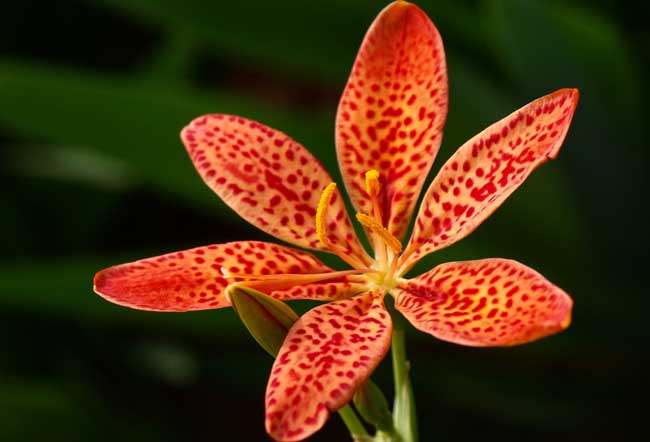
Blackberry lily, also called cungan, wushan, or golden butterfly, belongs to the Iridaceae family. Its rhizome is used as medicine and has the functions of clearing heat, detoxifying, resolving phlegm, and soothing the throat. Its rhizome contains components such as irisflorentin and sheganone, and has effects including anti-inflammatory and detoxifying, antiviral, diuretic, and inhibiting cervical cancer cells. Blackberry lily is mainly produced in Hubei, Henan, Jiangsu, Anhui and other provinces, and is also distributed in Zhejiang, Fujian, Shaanxi, Guizhou, Guangxi, Guangdong and other provinces and regions. Blackberry lily prefers warmth; when the temperature is 20-25°C and soil moisture is 50%, the seeds begin to germinate; when the temperature is 25-35°C, with long sunlight hours, high soil temperature, and sufficient rainfall, blackberry lily grows vigorously; blackberry lily is drought-tolerant and cold-tolerant, and can overwinter naturally in areas with a temperature of -17°C. Blackberry lily has low soil requirements, and plants grow well in fertile, loose, well-drained sandy loam soil on higher terrain. The soil pH is best neutral to slightly alkaline. Rhizomes rot easily in low-lying waterlogged land.
Land Selection and Land Preparation
For blackberry lily planting land, it is advisable to choose sandy loam land, flat land, or gently sloping land with higher terrain, facing the sun, deep soil layers, and good drainage. If using barren hillside land for planting, it is advisable to plow the land in the autumn or winter of the previous year so that it undergoes a period of weathering and maturation, then plow once more in the following spring, removing tree roots, weeds, and stones. For planting in cultivated land, plow once before planting, apply 2000 kg of compost or barnyard manure, 25 kg of superphosphate, and 50 kg of cake fertilizer per 667 sq m (1 mu) as base fertilizer, then harrow shallowly once after application to mix the fertilizer and soil evenly, and form high beds 120-130 cm wide, or form ridges 50-60 cm wide for planting.
Planting
Either spring planting in March or autumn planting in November is acceptable. When planting, on the prepared bed surface, open holes at a row spacing of 25 cm × 20 cm or 30 cm × 20 cm, with a hole depth of 15 cm. Apply 0.5 kg of farmyard manure at the bottom of the hole and mix it evenly with the soil in the hole, then place 1-2 segments of seed rhizome in each hole with the buds facing upward, or plant 1-2 seedlings per hole, cover with soil and press firm, pour in dilute human and livestock manure water, then cover with soil again and level the bed surface.
If blackberry lily is direct-seeded, spring sowing or autumn sowing can be carried out. Spring sowing is done in early March, and autumn sowing is done in October. On the prepared bed surface, dig holes at a row spacing of 30 cm and a plant spacing of 25 cm, with a hole depth of 6 cm. Level the bottom of the hole, first apply 0.5 kg of dry manure fertilizer to each hole, mix it evenly with the soil in the hole, then cover with about 2 cm of fine soil. Sow 5-6 seeds per hole, cover with fine soil after sowing, and cover the bed surface with grass. Strengthen management after sowing, water frequently to keep the bed soil moist, so as to facilitate seed germination, emergence, and seedling growth. After seedlings emerge, carry out timely intertillage and weeding, thin seedlings when the seedlings are 6-10 cm tall, thinning out weak and small seedlings and keeping strong and large seedlings, leaving 1-2 seedlings per hole. The seed rate is about 5 kg per 667 sq m.
Intertillage and Weeding
After blackberry lily emerges or after transplanted plants survive, frequent intertillage and weeding should be carried out to facilitate plant growth, usually 3-4 times per year. If it is the first year of spring sowing, carry out once in May, July, and November respectively. In the second year, carry out 3 times, respectively in March, June, and November. After the rows close, no more intertillage and weeding are carried out. In addition, after the plants turn yellow and wither each November, combine intertillage and weeding with one hilling, using fine soil from the furrows to mound around the root zone, so as to facilitate overwintering of the plants and prevent lodging.
Topdressing
Blackberry lily is a fertilizer-loving plant. In addition to applying sufficient base fertilizer, apply topdressing once each in spring, summer, autumn, and winter of the second year. For spring and summer topdressing, apply 1500 kg of human and livestock manure water or 25-30 kg of urea per 667 sq m, applying it in holes opened 10 cm away from the plants. In autumn, apply 1500-2000 kg of a mixed fertilizer of barnyard manure and plant ash plus 25 kg of compound fertilizer per 667 sq m, then hill up the soil after application. In winter, apply 1500 kg of decomposed barnyard manure, 20 kg of plant ash, 25 kg of superphosphate, and 30 kg of compound fertilizer per 667 sq m, mix evenly, apply, and then hill up the soil after application. The first two topdressings can promote the growth of aboveground stems and leaves, while the latter two topdressings can promote rhizome growth and increase yield.
Drainage and Irrigation
Blackberry lily is afraid of waterlogging. After heavy rain, ditches should be cleared promptly to drain away water in the field to prevent rhizome rot. Although blackberry lily is drought-tolerant, the bed soil should be kept moist during the seedling stage and after transplanting to facilitate seedling growth. If drought occurs during the seedling stage, water or irrigate appropriately. After the seedlings are 10 cm tall, irrigation can be reduced or stopped.
Bud Removal
When propagated by rhizome, it can bloom in the same year; when raised from seeds and transplanted or direct-seeded, it will not bloom until the following year, and its flowering period is long and it produces many flowers and fruits, consuming a large amount of nutrients and affecting rhizome growth. Except for seed-producing fields, the flower buds should be removed when the plants bolt, choosing a sunny morning after the dew has dried, and removed completely in stages and batches.