Detailed Explanation of the Key Points of Cordyceps Cultivation Techniques
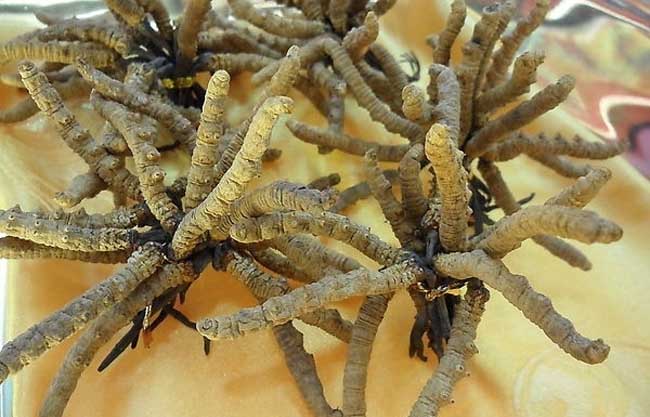
Cordyceps is also called Chongcao, Dongchongcao, or Xiacao Dongchong. It is the stroma of the fungus Cordyceps sinensis of the family Clavicipitaceae and the dried insect body of its host. Sweet, warm. It nourishes the lungs and tonifies the kidneys, and is mainly used to treat pulmonary tuberculosis, hemoptysis, asthmatic deficiency, night sweats, spermatorrhea, impotence, and soreness and pain of the waist and knees. It mostly grows in high-cold mountain areas, grasslands, river valleys, and among grasses. It is distributed in Gansu, Qinghai, Sichuan, Yunnan, Tibet and other provinces and autonomous regions.
Plant Characteristics
Cordyceps sinensis is a fungus-insect complex in which a fungus belonging to the class Ascomycetes, order Hypocreales, family Clavicipitaceae, genus Cordyceps parasitizes the larvae of moths of the family Hepialidae of the order Lepidoptera. The entire external form is made up of the insect body and the fruiting body connected together. The surface is yellow-brown or yellowish-brown. The insect body closely resembles a silkworm, slender and cylindrical, 3-5 cm long, about 0.3-1 cm thick, with 20-30 distinct segments and 8 pairs of legs on the abdomen, especially the middle 4 pairs being more obvious. The fruiting body refers to the reproductive organ extending outside the host insect body, formed after repeated intertwining and differentiation of hyphae, and visible to the naked eye. It is relatively brittle in texture, with a yellowish-white cross-section and a reddish-brown head, and bears a stroma. The stroma is mostly solitary, slender like a club, 4-10 cm long, with an enlarged top, brown surface, slightly tough texture, and a yellowish-white fibrous cross-section. The head of the stroma bears perithecia scattered or densely arranged, and within the perithecia countless asci are formed; in the asci are the ascospores capable of sexual reproduction.
Growth Characteristics
The distribution of Cordyceps sinensis is closely related to topography, landforms, and altitude. Its host, the swift moth, prefers to grow in moist, low-temperature, sunny, well-drained terrain and landforms.
Cultivation Techniques
1. Cultivation conditions. Artificial cultivation of Cordyceps sinensis mainly requires preparing two conditions: fungal spawn and insects.
(1) Fungal spawn: Cultivation of Cordyceps sinensis first requires excellent pure spawn. First, it should be early-maturing and high-yielding, with the main purpose of shortening the production cycle and reducing costs. Second, it should have strong infectivity, requiring the spawn to have strong vitality, a survival rate of 95% or more, and the ability to rapidly infect insects so that they sicken and die as quickly as possible. Third, it should have a wide range of adaptability, especially a certain resistance to changes in environmental temperature and infection by other miscellaneous fungi.
(2) Insects: Insects mainly use swift moth larvae as hosts for Cordyceps sinensis. The larvae must be alive, and larger, fatter ones are better. The quantity depends on one's own cultivation. Generally, each square meter requires 1 kg of larvae, one mother spawn, and 50 kg of fine sandy soil, and can produce 0.5 kg of fresh Cordyceps sinensis, 0.05 kg of dried product, worth 100 yuan.
(3) Environment: Artificial cultivation of Cordyceps sinensis can be carried out regardless of altitude; the key depends on temperature. Cordyceps sinensis is a medium- and low-temperature type fungus. The suitable temperature for mycelial growth and reproduction is 5-32°C, the most suitable is 12-18°C, and 10-25°C is suitable for the formation of sclerotia and stroma.
(4) Cultivation season: Using natural temperature, two seasons can be cultivated in a year, spring from March to May and autumn from September to November. If temperature is artificially controlled indoors, cultivation can be carried out all year round, and the growth period can also be shortened.
2. Cultivation methods. There are many ways to cultivate Cordyceps sinensis, including indoor and outdoor bottle cultivation, box cultivation, bed cultivation, and open-field cultivation, and one may choose freely according to one's own conditions. Regardless of the cultivation method, before cultivation the fungus-infected insects must first be cultured so that the insects are infected with this disease-causing fungal liquid before entering the soil; by the time they enter the soil they are already seriously ill and unsuitable for crawling around, which is beneficial for early death, rapid emergence, and uniform growth. The method of culturing fungus-infected insects is to spray the prepared liquid spawn onto the larvae with a sprayer until wet, spraying twice a day. After 3 days, these larvae affected by the fungal liquid show slowed movement and enter a comatose state, and can then be cultivated.
(1) Bottle cultivation: Suitable for household cultivation. After washing ordinary cans, first place a layer of 2.5-3 cm of fine sandy soil in the bottle, with a soil moisture content of 60%, then place the fungus-infected larvae on top. It is best to place two per bottle, requiring that the two larvae do not press close to each other, with the ventral side facing down and the body extended. Then cover with 3 cm of fine sandy soil and slightly flatten the surface. To maintain moisture, seal the mouth with plastic film, place it under suitable indoor or outdoor temperature for management, and avoid direct sunlight.
(2) Box cultivation: Also suitable for household cultivation. Wooden boxes or plastic basins of various sizes can be used for cultivation. The bottom and sides of the wooden box should have plastic film to prevent water loss. First spread fine sandy soil 5-7 cm thick, then evenly place the fungus-infected insects, with each insect 2-3 cm apart, then cover with sandy soil 3-5 cm, and use plastic film on the surface to retain moisture. To save space, wooden boxes can also be stacked.
(3) Bed cultivation: Bed-frame cultivation is a development method for large-scale production. This method is generally suitable indoors and can make full use of indoor space for tiered shelf cultivation, saving space. The bed frame is 100 cm wide, and the length is designed according to one's room. It is made of bamboo or wood, with each tier having four sides 12 cm high to retain soil. During cultivation, first spread a layer of plastic film, then pour in fine sandy soil 5-7 cm and pat flat, place the fungus-infected insects with spacing as in box cultivation, cover with sandy soil 3-5 cm, and then cover with plastic film.
(4) Open-field cultivation: Refers to outdoor cultivation. The key to outdoor cultivation is to select a good site. First, direct sunlight and rainwater erosion must be avoided, creating an environment that can provide shade, drainage, drought prevention, and protection from trampling by people and livestock. Cultivation methods can be flat-ground style or furrow style. Flat-ground cultivation is to remove 15 cm of topsoil from ordinary flat land, sloping land, or wasteland, with a width of 100 cm and unlimited length, then fill with 5 cm of sandy soil, place the fungus-infected insects as described above, then cover with fine sandy soil 5-7 cm, cover the outside with plastic film, have drainage ditches all around, and provide shade above with trees or a shade shed.
(5) Furrow-style cultivation: Furrow-style cultivation can avoid problems of sunlight and high temperature and is suitable for cultivation in vast rural areas. The furrow is 100 cm wide, 50 cm deep, and of unlimited length, and can also drain water all around. During cultivation, first spread fine sandy soil 5 cm thick at the bottom of the furrow, then place the fungus-infected insects as described above, then cover with fine sandy soil 5 cm, and finally cover with plastic film. Bamboo arches are used beside the furrow, covered with straw curtains for shading and cooling.
3. Management techniques. The management techniques after cultivation of Cordyceps sinensis are very simple, mainly management of temperature, humidity, light, and air.
(1) Temperature: Cordyceps sinensis has relatively broad temperature requirements, generally low first and then high, but it is better to be too low and grow slowly than too high and be affected. Mycelial growth is best at 12-18°C; low temperature slows growth, but there are fewer miscellaneous fungi and the survival rate is higher. Generally it will not freeze to death even at -40°C, but it will die above 40°C. In the later stroma growth stage, 20-25°C is favorable for growth.
(2) Humidity: Humidity management is key to the growth and development of Cordyceps sinensis. The nutrients and moisture in the insect body can basically meet its growth requirements; it does not need external nutrients and moisture, and only needs the external environment to keep the insect body's own temperature from drying out easily. Therefore, keep the sandy soil moist at all times, with a moisture content of 60% being suitable. If dry, spray a small amount of clean water to maintain corresponding moisture.
(3) Light: Cultivation of Cordyceps sinensis does not require strong light; avoiding light is better. In the later stage of stroma development, scattered light is better, but it must not be exposed to direct sunlight. Especially for outdoor cultivation, shade should be provided by tree shade, artificially built shade sheds, straw curtain covering, and other means.
(4) Air: The mycelial growth stage of Cordyceps sinensis does not need much air. Especially when the stroma is about to emerge from the soil, the plastic film should be removed immediately to increase air and facilitate stroma growth, and the relative air humidity should be maintained at about 75%-95%. About 10-20 days after emergence, it approaches maturity.
Harvesting and Processing
Under natural conditions, the growth period of Cordyceps sinensis is generally 9 months, and the speed of growth mainly depends on the nature of the variety. The maturity standard is that the stroma emerges from the soil and extends 3-5 cm high, and when the top develops into a perithecial fruiting body with a "brush tip" it can be harvested.
(1) Harvesting method: Gently dig away the sandy soil with a bamboo or wooden stick, pick out Cordyceps sinensis, and place it in a basket. Be careful not to break the insect body from the stroma, and even more not to dig the insect body or stroma to pieces. After collecting, rinse off the mud and sand with water and promptly sun-dry or oven-dry.
(2) Processing method: Packaged Cordyceps sinensis is processed using loose Cordyceps as raw material. That is, after the loose Cordyceps has absorbed moisture again, straighten it out, tie every 7-10 pieces into small bundles with thread, and bake over a low fire until completely dry. Then place 48 small bundles tail to tail into iron compartments, loading three layers, with more than 16 in each layer, press and seal, then fumigate with sulfur and dry, add a trademark, and tie firmly with red silk string. The specification requires that each package of Cordyceps should remain at about 0.25 grams. Pack in wooden boxes, line the inside with a layer of moisture-proof paper, bind the outside with iron straps, and store in a ventilated and dry place.