Detailed Guide to Safflower Cultivation Techniques: Planting Methods and Management Points
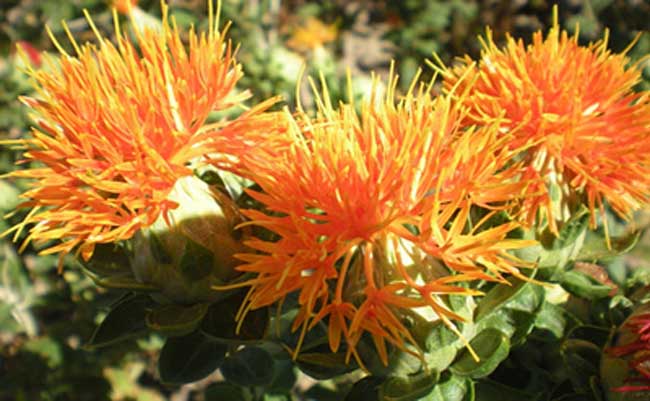
Safflower is an annual or biennial (autumn-sown) herbaceous plant of the Asteraceae family. It has a long cultivation history and is a well-known medicinal plant, with the effects of promoting blood circulation and regulating menstruation, and removing blood stasis and relieving pain. Safflower oil is suitable for various types of atherosclerosis, hypercholesterolemia, hypertension, stroke, myocardial infarction, angina pectoris, heart failure and other conditions. Therefore, the consumption of safflower has increased sharply both domestically and abroad. However, during safflower cultivation, some production factors are overlooked, resulting in low safflower yields.
Site Selection and Land Preparation
1. Site selection: Safflower has strong adaptability and can be planted below an altitude of 2100 m in our county. It prefers a warm, dry climate with ample sunlight, is drought-tolerant and cold-tolerant, and dislikes high temperature and high humidity. Sandy soil with medium fertility and good drainage is suitable. It should not be planted on low-lying, waterlogged clay soil.
2. Land preparation: Since safflower planting in our county is all autumn-planted, previous crops such as soybean, peanut, flue-cured tobacco and corn are all suitable. When preparing the land, simply deep-plow the plot once, remove dead branches and weeds, and break up clods finely, so that the soil is fine and the ground is level; paddy fields can be planted using no-till methods.
Timely Sowing and Reasonable Close Planting
1. Adjusting the sowing period: Safflower is a long-day plant, and yields differ with different sowing dates. Early sowing gives higher yields, while late sowing gives lower yields, so sowing should be early rather than late. Safflower seedlings are relatively cold-tolerant and can withstand low temperatures of -6.6°C, with some varieties able to withstand low temperatures of -15°C. Therefore, safflower is generally sown in early October; in dry land in cool mountainous areas, it can be sown in mid-to-late September, that is, planting by digging "corn feet" before the corn is harvested.
2. Seed treatment: To ensure high and stable yields, ensuring uniform and strong seedlings is key. For this, the seeds need to be soaked in clean water for 6-8 hours to allow them to fully absorb water and ensure emergence. The seeding rate is 1-2 kg per mu.
3. Reasonable close planting
Plant spacing of 6-7 cun, row spacing of 9 cun-1 chi, hole depth of 2-3 cun, sowing 3-4 seeds per hole, ensuring 10000-13000 holes per mu, leaving 2 plants per hole to maintain an effective 20000-26000 plants per mu, but appropriate adjustments should also be made according to the following conditions:
(1) Whether it is dry land or irrigated land. Dry land is suitable for sparse planting, especially in years of insufficient rain; too dense planting may reduce yield.
(2) Sowing period. Late sowing is suitable for close planting; early sowing is suitable for sparse planting.
(3) Every 4 rows must leave half a row empty, so as to allow entry into the field for flower picking.
When sowing, special attention must be paid to keeping the base fertilizer and seeds separate. For base fertilizer, 15 kg of compound fertilizer or 5 kg of urea can be used per mu (to ensure seedling emergence, chemical fertilizer is generally not applied as base fertilizer, but used as topdressing after the seedlings are uniform), and 1000 kg of farmyard manure per mu. The depth of the covering soil should not exceed 2 cun. In principle, the soil should be appropriately compacted when covering, which is more conducive to seedling emergence.
Intercultivation Management
1. Thinning: Plant according to the specifications of 6-7 cun plant spacing and 9 cun-1 chi row spacing. After the seedlings are uniform, leave only 2 plants per hole, pull out diseased and weak seedlings or overly large or small plants, and keep the middle plants.
2. Reasonable irrigation
Safflower has a strong root system and can absorb water from deep in the soil, and still yields something without irrigation. However, the highest safflower yield is obtained under irrigation. The average seed yields of safflower irrigated 1, 2, 3 and 4 times were 29%, 44%, 58% and 76% higher than the yield without watering, respectively. Since both the aboveground and underground parts of safflower are very sensitive to water, irrigation technique is also the key to successful safflower cultivation. If improper, even in arid areas with only 29.4 mm of precipitation, excessive irrigation can cause massive death of safflower. Therefore, irrigation must be done with extreme caution, and the following points should be noted technically:
(1) Before irrigation, check the soil moisture status. If the subsoil reached by the safflower root system is still moist, do not irrigate.
(2) If the weather forecast predicts rain within 2-3 days, it is best to temporarily refrain from watering.
(3) Apart from seedlings being relatively moisture-tolerant at low temperatures, safflower is very sensitive to water at other growth stages. Sprinkler irrigation easily causes rust and fusarium wilt, and flood irrigation easily causes root rot, all of which must be avoided. Furrow irrigation must be used, preferably alternate-row furrow irrigation, which both saves water and is safest.
(4) After irrigation is completed, the drainage system needs to be cleared in time to avoid water accumulation in case of rain.
(5) The last watering should be carried out 5 days before 95% of the flower heads bloom.
3. Fertilizer management
Safflower is well known for its drought tolerance, salt-alkali tolerance and barren tolerance. Therefore, most growers in safflower planting areas plant safflower in low-fertility soil. Most growers mistakenly believe that safflower does not need additional fertilizer; on the contrary, another group of growers apply more fertilizer to obtain high safflower yields, which also results in increased production without increased income.
The fertilizer demand of safflower generally depends on the natural soil fertility, moisture status, sowing period and so on. When the soil is fertile, nitrogen fertilizer may be omitted or applied sparingly. Generally, for low-to-medium fertility soil with irrigation conditions, after seedling establishment, combine intercultivation and weeding and apply 5-8 kg of urea to promote seedling growth, and at the bud stage apply 10-15 kg of urea per mu. For dry land without irrigation conditions, nitrogen fertilizer may be omitted (or 5-10 kg of urea per mu may be applied before heavy rain, or urea may be diluted with water for irrigation); applying trace fertilizers to safflower has an obvious yield-increasing effect. Generally, starting from the bud emergence stage, spray once every 7-10 days, and potassium dihydrogen phosphate, organic calcium fertilizer, liquid multi-element potassium fertilizer, potassium sulfate, boron sulfate and other trace fertilizers may be selected, for a total of 3-4 sprays.
4. Disease control
① Rust: High humidity favors the occurrence of rust. Spores spread with the wind, and teliospores and telial pustules overwinter on diseased residues. In late spring and early summer, when temperatures are low or moderate and humidity is relatively high, they infect leaf surfaces, causing leaves to wither and die. Control methods: seed treatment by mixing seeds with 15% triadimefon at 0.2%-0.4% of the seed weight; clean the field, collect and burn diseased residues, and implement crop rotation of more than 2-3 years; chemical control, spray fungicides promptly at the early stage of disease, once every 7-10 days, for 2-3 consecutive times, using 20% triadimefon EC 0.1% solution, 0.3° Baume lime-sulfur mixture and other agents alternately.
② Fusarium wilt: Fusarium wilt is also called root rot. The pathogen mainly damages the roots. At the early stage of disease, brown spots appear on the root crown, and a pink sticky substance appears on the surface of the stem base, ultimately causing the basal cortex and fibrous roots to rot and leading to plant death. Mild cases cause 10%-20% loss, while severe cases can destroy the entire field. Control methods: strictly implement crop rotation without continuous cropping, and keep the soil well drained; promptly pull out diseased plants and burn them, and disinfect the diseased holes with lime; remove dead branches, fallen leaves and weeds in the field to eliminate overwintering pathogens; drench roots with 50% carbendazim, 50% dexon 0.17%-0.20% solution and so on.
5. Hilling: After safflower bolts, the upper part has many branches and is prone to lodging, so hilling is carried out in early March.
6. Topping: When safflower plants reach 20-30 cm in height, pinch off the terminal buds to promote more branching, increase the number of flower buds, and raise safflower yield.
Harvesting and Processing
After safflower is sown, it generally flowers in 4-5 months. At first it is *, then turns orange-*, and can then be picked. One flower bud can be picked 3-5 times. Picking at the right time is the key to increasing safflower yield. After safflower is picked, place it in a ventilated and dry place to dry in the shade. After the flowers are picked, the seeds mature in 15-20 days and can be harvested and threshed.