Detailed Explanation of Schisandra Planting Techniques and Management Methods
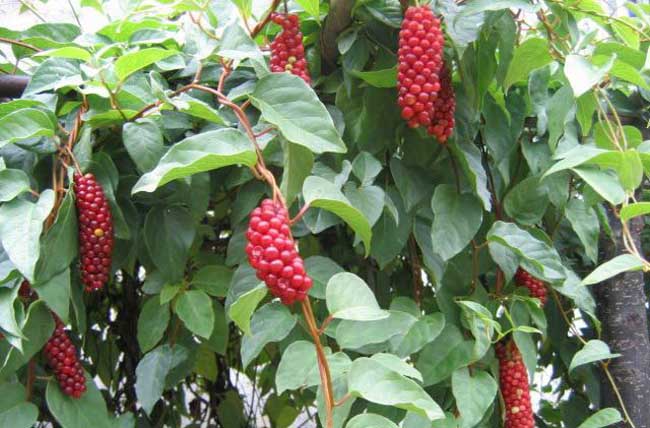
Schisandra is a plant of the genus Schisandra in the family Magnoliaceae, with its fruit used as medicine. It has the effects of astringing the lungs, nourishing the kidneys, stopping sweating, stopping diarrhea, and stopping seminal emission. It is commonly used clinically to treat cough and asthma, spontaneous sweating, night sweats, spermatorrhea, chronic diarrhea, and neurasthenia. It is mainly produced in the provinces of Northeast China, Hebei, Shanxi, Shaanxi, Ningxia, Shandong, Jiangxi, Hubei, Sichuan, Yunnan, and others.
Botanical Characteristics of Schisandra
It is a perennial deciduous woody vine, reaching up to 800 cm in length. The stem bark is grayish-brown with prominent lenticels; the branchlets are brown and slightly angular. The leaves are simple and alternate, with slender petioles; the leaf blades are thin, slightly membranous, ovate, broadly obovate to broadly elliptic, 5-11 cm long and 3-7 cm wide, with an acute or acuminate apex, a cuneate or broadly cuneate base, and sparsely glandular serrulate margins; the upper surface is glossy and glabrous, while the veins on the lower surface bear short pubescence when young. In summer it produces yellow-white flowers tinged with pink, fragrant, unisexual, with male and female flowers on separate plants; the tepals number 6-9, with the outer whorl smaller; male flowers have 5 stamens with filaments fused into a short column, anthers with a relatively broad connective, and pollen sacs borne on both sides; female flowers have numerous carpels arranged spirally. After flowering, the receptacle gradually elongates, becoming a long spike at fruit maturity, bearing sparsely arranged small spherical indehiscent fleshy fruits that are dark red when ripe and wrinkled on the surface when dried.
Growth Characteristics of Schisandra
It prefers shaded and moist environments and can be cultivated in humus soil or loose, fertile loam. It is tolerant of severe cold, dislikes low-lying land, and seedlings are afraid of strong light.
Propagation Methods of Schisandra
There are sexual and asexual propagation methods; for large-scale production, seed propagation is often used.
1. Seed Treatment
① Seed treatment: Soak the seeds in cold water for 3 days, then soak them in gibberellin at 2.5*10 to the -4th power or copper sulfate solution for 24 hours. After sowing, seedlings emerge only after 40 days, growing slowly, with germination rates of 68% and 56% respectively. Soak the seeds in copper sulfate for 7 minutes, operating carefully, take them out and wash with water, then place them in a gibberellin solution of 5*10 to the -4th power and soak for 12 hours. After sowing, seedlings emerge in 15 days to one month, and the seedling survival rate can reach 70%.
② Sowing time: Schisandra sowing is divided into spring sowing and autumn sowing. For spring sowing in May, broadcast or drill sowing with a row spacing of 10 cm, covering with soil 1.53 cm, and a sowing rate of about 0.03 kg per sq m. Water thoroughly and cover with grass to preserve moisture. After emergence, remove the covering grass and set up a frame for shade, providing ventilation and a small amount of sunlight. When the seedlings are 5-6 cm tall, remove the frame and thin to a plant spacing of 5 cm, and apply urea as a top dressing at 5 kg per hectare. In the second or third spring, transplant to the field at a row spacing of 100 cm * 50 cm. Apply fertilizer once a year, and promptly prune new branches growing from the rhizome. In actual production, autumn sowing is preferred. Some also use fresh seeds of the current year. Rinse off the fruit pulp with clean water, drain, and sow in August, then set up a frame 100-150 cm high, covering it with reed curtains or mats for shade. Water in dry soil. When the seedlings grow 2-3 true leaves, the shade material can be removed, and weeds should be regularly controlled. In winter, cover the seedlings with grass, and they can be transplanted in the following spring. Plant in north-south rows or on contours, with a plant and row spacing of 50-100 cm * 150-200 cm.
2. Layering propagation: Carry out before spring sprouting. Select robust stems and vines, clear away nearby dead branches, fallen leaves, and weeds, and dig a pit 10-15 cm deep at intervals on the ground. Carefully remove the Schisandra stems and vines from the climbing plants, place them in the pit, cover with soil, and firm it down. Once they take root and send out vines, they become new plants, to be transplanted the following year.
3. Cutting propagation: Before the plants sprout in spring, select one-year-old branches, or after flowering in autumn during the rainy season, cut firm and robust branches into 12-15 cm sections with 2-3 buds, with a flat upper cut and a 45-degree slanted lower cut. Soak the base of the cuttings in ABT No. 1 rooting powder at 150*10 to the -66th power for 6 hours, or in naphthaleneacetic acid (NAA) at 500*10 to the -6th power for 12 hours. Insert them into a seedbed of mixed loam with 3 parts soil to 1 part sand, with a row spacing of 12 cm and a plant spacing of 6-9 cm, inserting obliquely to a depth of 2/3 of the cutting length. Cover the bed surface with blue plastic film and water frequently. Cuttings can also be done in a greenhouse with an electrically heated temperature-controlled seedbed, covering the bed surface with blue plastic film and flower curtains, adjusting the temperature, and shading. Keep the temperature at 20-25°C, relative humidity at 90%, and shade at 60%-70%. The rooting rate is 38%-87%, and they are transplanted in the following spring.
Cultivation Techniques of Schisandra
1. Site selection and land preparation: Choose a moist environment, loose and fertile loam or humus soil, with irrigation conditions, under forest, in river valleys, on both banks of streams, or on slopes of about 15 degrees, with a shade level of 50%-60% and a location with ventilation and light penetration. Select a good site, prepare the land, plow, and make fine beds. For low-lying, easily waterlogged plots with abundant rain, make raised beds about 15 cm high; for dry, drought-prone areas with less rain, make flat beds. Regardless of the bed type, there must be more than 15 cm of loose soil layer. The bed width is 120-150 cm, and the length depends on the seeds and terrain. Apply 5-10 kg of decomposed barnyard manure per sq m, mix it evenly with the bed soil, and rake the bed surface smooth for sowing.
2. Field planting: About 60 cm from the tree stump, plant one plant on each side. This planting method gives high yields. Set up artificial frames and plant Schisandra seedlings at a row spacing of 100 cm * 50 cm or 60 cm * 50 cm. Use north-south rows to facilitate ventilation and light penetration. Dig holes about 30 cm deep and wide, mix fertilizer with soil, and fill into the holes. When planting seedlings, fill half the soil, then lift the seedling slightly so the root system straightens out, which helps survival. Firm the soil, water, and after the water seeps in, cover with a layer of soil to conserve moisture.
Field Management
1. Irrigation and fertilization: Schisandra likes water and fertilizer. The seedling stage grows very slowly, so it is necessary to water, weed, and fertilize frequently. During the bud, flowering, and fruiting stages, in addition to supplying sufficient water, a large amount of fertilizer is needed. Generally, top-dress twice a year: the first before leaf expansion, and the second before flowering. Apply 5-10 kg of decomposed farmyard manure per plant, 30-50 cm from the root, digging a ring-shaped ditch 15-20 cm deep around it, taking care not to damage the roots, and cover with soil after application; for the second top dressing, appropriately increase phosphorus and potassium fertilizer to promote fruit ripening.
2. Trellising: After the second year of transplanting, set up a trellis. Use concrete pillars or angle steel as uprights, and stretch a horizontal line on the upper part of the uprights with wooden poles, bamboo poles, or No. 8 wire. Set up a bamboo pole or wooden pole at each main vine, 250-300 cm high and 1.5-2 cm in diameter, and fix it to the horizontal line with rope. Guide the Schisandra stems and vines onto the trellis in a right-handed spiral direction, tie them well with rope, and afterward they will climb naturally.
3. Pruning: For each plant, select and retain 3-4 robust branches for cultivation, and prune off most of the remaining basal branches. Pruning is done three times a year in spring, summer, and autumn.
① Spring pruning: Prune off short fruiting branches and dead branches. For long fruiting branches, retain 8-12 buds and cut off the rest. After pruning, the branches should be moderately spaced and not interfere with each other. Carry out before sprouting.
② Summer pruning: Carry out from early May to mid-to-late August. Prune off basal branches, cavity branches, overlapping branches, and diseased and pest-infested branches. Overly dense new branches should also be thinned or shortened.
③ Autumn pruning: Carry out after leaf fall. Prune basal branches. In all three prunings, be careful to retain 2-3 vegetative branches as main branches and guide the vines onto the trellis.
4. Loosening soil and weeding: During the growth period of Schisandra, loosen the soil and weed in a timely manner to keep the soil loose and free of weeds, taking care not to damage the roots. At the same time, make a tree basin at the base to facilitate irrigation.
Pest and Disease Control
1. Leaf blight
[Damage characteristics] In the early stage of the disease, it starts from the leaf tip or edge and infects the entire leaf surface, causing it to wither, yellow, and fall off. In severe cases, the fruit clusters fall off.
[Control method] Strengthen field management and pay attention to ventilation and light penetration. In the early stage of the disease, spray with Bordeaux mixture at 1:1:100 dilution, once every 7 days, for several consecutive times.
2. Leaf roller
[Damage characteristics] The larvae cause damage, resulting in rolled leaves, affecting fruit growth and even causing them to fall off.
[Control method] Spray with 50% phoxim 1500-fold solution, or 50% phosphamidon 1500-fold solution, or 40% dimethoate 1000-fold solution, or 80% trichlorfon 1500-fold solution.
Harvesting and Processing of Schisandra
Seedling-grown Schisandra bears fruit after 5 years, while vegetatively propagated plants bear fruit in 3 years. Generally, after planting, they bear fruit abundantly in 4-5 years. In August-September, when the fruits turn purple-red, pick them and dry them in the sun or in the shade. Timely harvesting is very important; otherwise, it affects both yield and quality. Harvesting too early results in poor commodity quality, while harvesting too late means they are overripe, the fruit skin is easily broken, and drying is inconvenient. The method for sun-drying the fruit is: place branches under a mat, put a 3 cm thick layer of Schisandra on the mat, dry in the sun for 3-5 days until the fruit skin wrinkles, stir gently, and after 2-3 weeks they are sun-dried. If the harvest season meets cloudy and rainy days, dry them over a low fire, but the temperature must not be too high, otherwise the volatile oil is easily lost and the fruits become scorched.