How to prune honeysuckle into a tree form? Detailed explanation of the pruning technique key points
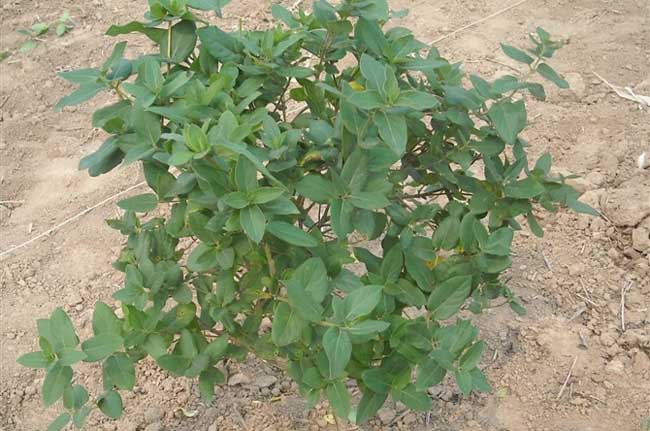
Although tree-form honeysuckle has the characteristic of naturally taking shape, it is very difficult to obtain an ideal tree form if it is allowed to grow unchecked. As long as a scientific set of shaping methods is adopted, the tree structure can be made more reasonable, the distribution of branches and leaves more uniform, the crown shape more graceful, the yield-increasing potential greater, and the product quality better. Let us take a look below at the tree-form pruning technique for honeysuckle!
Erect a stake to straighten the seedling
After the tree-form honeysuckle seedlings are planted, affected by the planting technique and the external environment, the seedlings are very prone to leaning and easily grow into “crooked-neck” trees, which affects the beauty of the crown. To ensure the trunk grows upright, after the seedlings are planted, set a small wooden stick or small bamboo stick about 40 cm long beside the seedling, and tie the seedling straight and fixed to prevent it from leaning.
Remove sprouts and set the trunk height
The sprouting ability of honeysuckle branches is very strong, and almost every bud at each node can sprout. The core of shaping tree-form honeysuckle is to ensure that the tree has an upright and obvious main trunk. If the sprouts on the trunk are not wiped off in time, it is very difficult to cultivate a graceful honeysuckle tree form. The trunk-setting height is 35—40 cm, with 1—2 nodes of buds left at the upper part as the shaping zone, and all sprouts on the trunk below 35—40 cm are wiped off. In the subsequent management process, once sprouts are found on the trunk, they must be wiped off.
Select and retain the main branches
Within the reserved shaping zone of the seedling, select and retain 2—3 branches that grow vigorously, are evenly distributed and have appropriate attachment angles as main branches (first-level framework branches) for cultivation, and remove all excess branches. When the main branches grow to 20—25 cm long, pinch off the growing tips to prevent the main branches from becoming too long and drooping, which would affect the shape of the crown.
Cultivate side branches
After the main branches are pinched, 3—5 side branches will grow on each main branch. For each main branch, retain only 2—3 side branches as second-level framework branches for cultivation, and remove all excess branches. When the second-level framework branches grow to 15—20 cm long, pinch off the growing tips, and of the branches growing on the second-level framework branches, retain 1—2 as third-level framework branches for cultivation. After one year of cultivation, the tree framework can be formed.
Promote early crown formation
Tree-form honeysuckle can send out shoots 5—6 times a year and belongs to the fast-growing tree species. As long as it is cultivated properly, in one year it can form a high-yielding crown with a trunk height of 30—40 cm, a tree height of 0.8—1.0 m, a crown width of 0.6—0.8 m, and 60—80 terminal branch tips. To achieve this goal, in addition to taking the above four measures, comprehensive measures such as topdressing fertilizer, cultivating and weeding, drought resistance and drainage, and pest and disease control must also be taken to promote the early formation of the crown.