Chengbu Taxi grapes become a profitable industry in Hunan
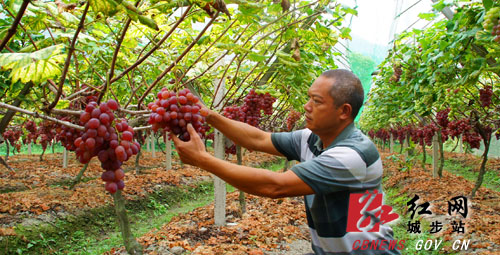
"The grapes are so sweet!" On September 11, at the Taxi Vineyard in Chengbu Miao Autonomous County, Hunan Province, some tourists were enjoying the joy of picking grapes, while others took out their phones and cameras to take photos as keepsakes. Under the grape trellises, clusters of grapes hung from the branches, the heavy fruit especially tempting.
"How did you come up with the idea of growing grapes?" Looking at the grapevines laden with fruit, the reporter could not help asking out of curiosity.
"In 2011, I learned online that growing grapes was a good way to make a fortune. I acted right away. In November of that year, I organized 14 farming households to plant 23 mu of grapes, and so began the road of entrepreneurship." Rao Likuan, in his 30s, talked on and on about growing grapes.
Rao Likuan said they initially introduced varieties such as "Red Globe" and "Summer Black" from Guangxi for planting, and the yield per mu was only more than 1,000 jin. To solve difficulties such as little pollen, low yield, poor technique and no professional technicians, the growers pooled money to invite Professor Shi Xuehui, an expert from Hunan Agricultural University, to give lectures. They adopted green and environmentally friendly cultivation techniques and meticulous management, using organic fertilizers such as pig manure, cow manure and sheep dung, which ensured the quality of the grapes. The number of growers increased from 14 at the beginning to 46, the planting area also expanded from the initial 23 mu to more than 200 mu, and the yield grew from the original 1,000 jin per mu to 3,000 jin per mu now, with a net income of about 15,000 yuan per mu. Today the grapes are sold far away to Shanghai, Guangdong and other places, and especially tourists visiting Nanshan call one after another to pre-order grapes.
"What is the purpose of bagging the grapes?" a tourist asked with great interest.
"The purpose of bagging is to prevent insects, disease and pollution," Rao Likuan said. Growing grapes is very hard work. From March they begin to be busy, pruning branches, thinning fruit and bagging, and sometimes they have to ask people for help to get it all done. The grapes can be sold from the end of July to the middle of October. Seeing a good harvest, all the hard work vanishes into thin air.
Walking on the road of entrepreneurship and prosperity, they formed the "Jiamei Grape Planting Cooperative" according to the model of "self-raised funds, unified prices, unified packaging, unified techniques and fixed-point sales," bringing scattered farmers together as a group and tying scattered funds together, achieving scaled operation through the clustering effect. Next, they will expand the planting area to 1,000 mu, build an ecological vineyard integrating tourism, sightseeing and leisure, and lead more fellow villagers to achieve prosperity and a moderately prosperous life." As for the future, Rao Likuan has a new blueprint.