How to build a free-range laying hen house? Detailed construction plan
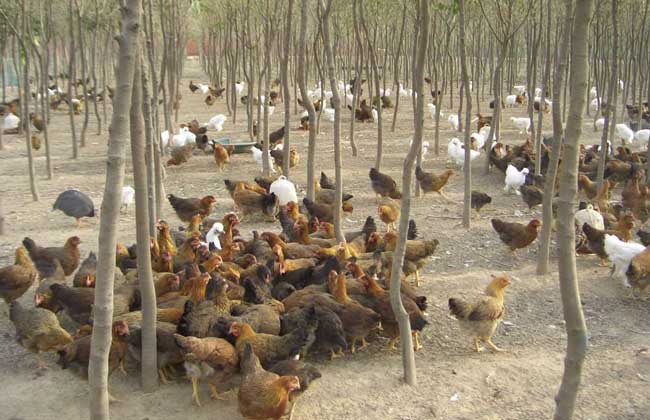
Modern free-range laying hens are not the large-scale free-range raising of native chicken breeds as in the past, but rather the selection of high-yielding laying hen breeds suitable for free-range raising, using orchards and woodland for large-scale free-range raising. In order for high-yielding laying hens to still achieve relatively high production performance under free-range conditions, scientific measures such as supplemental feeding, supplemental lighting, and heat prevention and cooling must be adopted. Below, let us take a look together at the free-range laying hen house construction plan!
Housing
When raising laying hens free-range, the housing mainly serves as a place for the chickens to rest at night and lay eggs. Generally, the housing can be built as an open shed facing south with three walls, with a height of 1.5-1.8 m, higher at the front and lower at the back. The width of the chicken house should not be too deep; about 4 m is best, so that in spring and autumn sunlight can reach inside. The length of the chicken house can be determined according to the number of chickens it will hold, but it should be divided into compartments of 3 m to 4 m to make it easy to place nest boxes, and each room can serve 100-120 chickens. The top frame is best made of a steel pipe structure or hard wooden boards, to provide strong support for the covering and prevent wind from blowing it off. The roof covering is laid from bottom to top in the following order: two layers of plastic sheeting, asphalt felt, a straw mat, and the outermost layer of asbestos tiles, fixed to the purlins with iron hooks, so as to secure the roof. Such a building is warm in winter and cool in summer, insulated against heat, windproof, and leakproof, and low in cost. Burlap sacks or straw curtains can be hung along the front edge of the house and lowered when the temperature is relatively low, so the chickens can move in and out freely while a certain temperature is maintained inside. For ground treatment in the chicken house, harden 50 cm along the wall edges with lime-sand-clay mixture to prevent rats from burrowing; the rest of the ground can simply be tamped plain soil, and 3-5 cm of coarse sand can be spread on the ground for the chickens to use for dust bathing. Along the north wall of the chicken house, use round wooden sticks or bamboo poles to nail together roosts. The roosts are tiered, with 4-5 tiers, each tier 25 cm high and each tier 20 cm wide.
Nest boxes
High-yielding laying hens generally lay eggs at relatively concentrated times, so the number of nests must meet the need; otherwise, the chickens will lay eggs everywhere. The nest boxes can be the double-layer nest boxes used for broiler breeders, or bricks can be used along both sides of the gable walls to build grid-like compartments 35 cm square, with wheat straw or rice straw spread inside. The number of nest boxes (nests) is best at one for every 3 to 4 chickens, and the nests should be somewhat concealed. Fence in and define the area around the selected site; the area of the fence can be determined according to the number of chickens and the trees and vegetation in the area. The fencing can take many forms, such as plastic netting, wire mesh, bamboo strips, wooden fencing, etc. The mesh size and height of the net should be such that they can both stop chickens from squeezing out or flying out and prevent intrusion by wild animals. Along the base of the walls, plant some climbing vine plants or vegetable crops that can climb walls, such as grapes, Boston ivy, and luffa. The exercise yard is the place where chickens obtain natural food and should have lush fruit trees, woodland, or flowers. Some trees and flowers and grasses can also be planted artificially; the grass can provide food for the chickens, and the trees can provide shade for the chickens in the hot summer, which helps prevent heat stress. Before the trees have grown into a grove, some shade awnings can be built for the chickens.
Supplemental feeding
Maintaining a relatively high egg production level in free-range high-yielding laying hens is inseparable from supplemental feeding. Set up feed buckets or troughs inside the free-range chicken house or outside along the wall in a rain-sheltered place. The feed buckets inside the house should be placed in the middle of the chicken house; one feed bucket with a diameter of 40 cm can allow 20 chickens to eat at the same time. The feed buckets should be hung with rope or wire to prevent the chickens from perching on them at night. Outside the house and within the free-range area, set up supplemental feed troughs according to the chickens' range of activity, and note that there must be shade and rain shelter above the troughs. The amount of supplemental feed can be determined according to the different seasons, the vegetation conditions of the free-range site, the amount of insects and grasses, and the foraging situation of the chickens. Generally, feed supplements twice a day. When the lights are turned on in the morning for supplemental lighting, add feed and feed once. Do not feed during the time when daily egg laying is concentrated. In the evening, after calling the chickens back with a whistle, feed once more. Each supplemental feeding should provide 80%-95% of the feed intake of caged chickens. The remaining 5%-20% is left for the chickens to obtain by eating insects and grasses in the environment.
Supplemental watering
Give the chickens water at fixed times 3-4 times a day. When supplementing feed to the chickens, waste of feed should be prevented. Watering equipment can use troughs, basins, or automatic drinking equipment. Around the chicken house, automatic drinkers can be used, and in places far from the chicken house, water basins can be placed at fixed points to ensure that the chickens can drink clean water without effort. Do not place drinking equipment inside the chicken house, to prevent water from overflowing and polluting the environment inside the house. Note that it is best to scrub the water troughs every day, clear away chicken manure and other debris in the troughs, and let the chickens drink clean, hygienic water.
Lighting
The role of light is to stimulate the development of the chickens' gonads, maintain normal ovulation, and enable the chickens to carry out various activities such as eating, drinking, and interacting. The ovulation time of chickens is generally controlled within 2 hours after laying, but in order to ensure that eggs are laid during the day, the chickens stop ovulating 2 hours before dark. Therefore, in order to ensure that free-range high-yielding laying hens can be highly productive, the same lighting program and light intensity as in intensive cage raising should be provided. Therefore, an lighting system should be installed in the chicken house according to the building area of the free-range house and the light intensity for adult chickens, with a certain number of light bulbs. The bulbs are generally installed in the place where the laying hens rest at night. A chicken house space of 16 sq m using one 40-watt bulb can meet the need.
Supplemental lighting
The method of supplemental lighting for free-range laying hens is basically the same as for caged chickens; the time of supplemental lighting is determined according to sunlight conditions. Because the free-range season for high-yielding laying hens is controlled from March to November, the brooding and rearing period is completed from October to February, that is, when free-range raising begins, the chickens are about 16-17 weeks old. In March, natural light is about 11 hours, and supplemental lighting begins at this time, increasing by half an hour to 1 hour each week until reaching 16-16.5 hours per day, and then kept constant. After 5-6 months of laying, adjust the daily light time to 17 hours per day. For the supplemental lighting method, fixedly begin supplemental lighting at 5 o'clock every morning. Generally, when it gets dark at about 6:30-7:30 in the evening, call the free-range chickens back to the house with a whistle, and supplement feed at the same time, while also providing supplemental lighting until the specified time. Once the lighting is fixed, do not change it easily. Free-range sites are generally quite remote, and the power supply is unstable. If the raising scale is relatively large, a small power generation device can be kept as a backup for emergencies.
Ventilation
The body temperature of chickens is relatively high. Under free-range conditions, they can actively seek cool shade under trees to escape the heat, and they can cool down through dust bathing, so cooling equipment is not needed inside the chicken house. Because the chicken house adopts an open-shed form with three walls, air exchange inside and outside the house is sufficient, and there is no need to install fans or blowers. It is very important for free-range chickens to have rain shelter during the rainy season. In the fenced area, choose high, dry terrain to set up several rain shelters to guard against sudden thunderstorms. Under normal circumstances, the keeper can call the chickens back to the house by whistling according to the weather conditions, and individual chickens that cannot return can take shelter from the rain nearby.
Rotational grazing
Divide and fence the area according to the size of the site, the amount of grass growth, and the number of free-range chickens, and adopt a regular rotational grazing raising method. After the grass in one free-range area is mostly eaten, drive them to another free-range area, so that once the chickens are free-range, they have edible grass, insects, or leaves every day. At the same time, this also helps with orchard plowing, handling chicken manure, orchard management, fertilization, and pesticide use, ensures the regrowth and growth of forage grass, and can also prevent the spread of disease between chicken flocks and facilitate disinfection. In order to ensure that free-range chickens have sufficient forage grass, some forage grasses edible by chickens, such as alfalfa, ryegrass, and finger millet, can be planted in the free-range area in advance. The main purpose of free-range raising is to improve egg quality and let the chickens eat insects, grasses, and other edible things in the external environment. After a period of time, the insects and grasses in the free-range area will be eaten up by the chickens. Therefore, the free-range area should be divided in advance into multiple free-range zones according to the number of free-range chickens, the length of the free-range period, and the free-range season, and fenced into zones for rotational stocking. After one zone has been used for free-range raising for one to two weeks, drive them to another fenced zone for free-range raising, letting the already-foraged small free-range zone rest and recover, and after the vegetation recovers, use it for free-range raising again, so that the chickens have edible insects, grasses, and other things throughout the entire free-range period.
Summary: Free-range raising of high-yielding laying hens requires reliable supporting facilities. Methods suited to local conditions should be adopted, and under the premise of meeting the physiological and production needs of the chickens, the construction cost should be reduced as much as possible. Using a sloped-roof open-shed structure with three walls has low cost and good air circulation. Inside the house, place nest boxes along both gable walls, hang feed buckets in the middle, and place roosts for the chickens to rest at night along the rear gable wall. This is not only convenient for management, but also convenient for supplemental lighting and supplemental feeding. In terms of supplemental lighting measures, adopt measures similar to those for caged chickens, making ovulation and egg laying of free-range chickens more regular. In order to allow free-range chickens to obtain sufficient nutrition and water, it is very important to add a certain number of supplemental feeding points and watering points in the free-range area. Attention should also be paid to environmental protection in the free-range area, adopting rotational free-range raising with rest and recovery.