What are the native chicken breeds? Introduction to common breeds
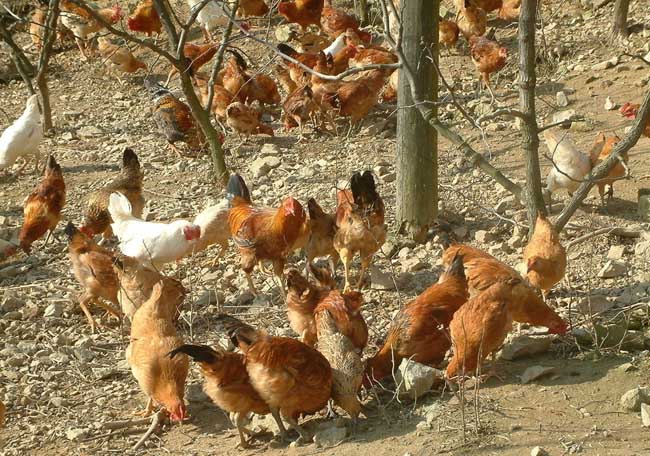
What are the common native chicken breeds? Native chickens are a type of poultry, different from caged broiler chickens, also called grass chickens or stupid chickens. They refer to meat chickens raised free-range in mountain forests and orchards, with characteristics such as tolerance to coarse feed, strong broodiness and strong disease resistance. The meat is delicious, and their eggs sell very well in urban and rural markets, with egg prices also higher than ordinary eggs. Below, the editor will introduce the common native chicken breeds for everyone!
Lushi Chicken
Lushi Chicken is one of the three major local improved chicken breeds in Henan (the other two are Gushi Chicken and Zhengyang Three-Yellow Chicken), and is an ancient chicken breed suitable for free-range raising in mountainous areas. Lushi chickens are light in size, strong in foraging ability, and tolerant of coarse feed. Their living habits and meat and egg quality are very similar to those of wild chickens. As early as the 1980s, they were included in the "Records of Improved Livestock and Poultry Breeds of China". Lushi Chicken is famous for its unique geographical location, climate characteristics and cultural factors of Lushi, as well as its distinct and prominent quality features of high protein and low cholesterol.
White-Ear Yellow Chicken
The White-Ear Yellow Chicken is a rare breed of white-ear yellow chicken in China. In 2001, it was among the first to be confirmed by the Ministry of Agriculture of China as one of China's 11 national-level resource protection breeds of local chicken breeds. In 2005, the Guangfeng White-Ear Yellow Chicken became the second live animal in Asia to obtain national product certification for protection of product of origin. In recent years, the county has vigorously implemented the White-Ear Yellow Chicken protection project, formulated and implemented technical standards such as the "Local Standard for White-Ear Yellow Chicken", established a White-Ear Yellow Chicken original breed farm and a technology promotion demonstration zone, and actively promoted the protection and development of the White-Ear Yellow Chicken.
Gushi Chicken
Gushi Chicken is an excellent chicken flock with outstanding characteristics, formed through long-term selective breeding under specific geographical, climatic and other environmental conditions and traditional feeding and management methods in a certain area centered on Gushi County, Henan. It is a famous local improved chicken breed in China used for both meat and eggs, and is one of the key protected livestock and poultry breeds in China. The feather color is mainly yellow and yellow-hemp, with blue shanks, blue feet and blue beak. It is medium in size and has characteristics such as tolerance to coarse feed, strong disease resistance and tender meat. In September 2006, the General Administration of Quality Supervision, Inspection and Quarantine approved the implementation of geographical indication product protection for Gushi Chicken.
Zhengyang Three-Yellow Chicken
Zhengyang Three-Yellow Chicken is distributed in the area where the three counties of Zhengyang, Runan and Queshan in Zhumadian City, Henan meet, in the Wenshu River basin across 29 townships within a radius of more than a hundred li. It has many favorable economic traits that are stably inherited, and is a valuable gene pool for breeding and creating new chicken breeds in China, with important value for preservation, utilization and scientific research. It is suitable for breeding improved breeds of dual-purpose meat and egg chickens for mechanized cage raising.
Langshan Chicken
Langshan Chicken is one of the dual-purpose meat and egg chicken breeds. It is famous for laying many eggs, large egg size, a plump and robust body, and delicious meat. According to feather color, it is divided into black and white types. The black one is called "Langshan Black"; its feathers are black with green and blue tints, glistening and brilliantly colored. Among "Langshan Black" there is a variety with a tuft of feathers behind the head crown, also called "Langshan Phoenix", which people from Rudong call "tufted-head chicken". The white one is called "Langshan White". "Langshan White" is very few in number; its feathers are spotlessly white, matched with a bright red comb, with red and white clearly distinct and pleasing to the eye.
Dagu Chicken
Dagu Chicken is also called Zhuanghe Chicken. Dagu Chicken has a long history of formation. According to records, as early as more than two hundred years ago, immigrants from Shandong brought large Shandong Shouguang chickens to Liaoning, crossbred them with local chickens, and then through long-term selection and breeding by local people, it was formed. It is mainly produced in Zhuanghe City, Liaoning Province. It is distributed in Donggou, Fengcheng, Jinxian, Xinjin, Fuxian and other places. Dagu Chicken is a dual-purpose local chicken breed with large eggs as its prominent feature. It has characteristics such as a solid and sturdy body, strong foraging ability, many and large eggs, thick and firm eggshells, and fresh and tender meat.
Beijing You Chicken
Beijing You Chicken is a local improved breed unique to the Beijing area, with a history of more than 300 years. It is an excellent dual-purpose local chicken breed for meat and eggs. It has the characteristics of a crest, feathered legs and a bearded beak, fine meat texture, delicious meat flavor, good egg quality, strong vitality and stable heredity.
Pudong Chicken
Pudong Chicken is produced in Shanghai, commonly known as Nine-Jin Yellow. Because adult roosters can grow to more than 9 jin, it is called "Nine-Jin Yellow", and it is also the only local native chicken breed in Shanghai. Pudong Chicken has a straight single comb, a broad chest and large body, a yellow beak and yellow feet. Hens have yellow or maroon feathers. Roosters have red or mixed black chests, yellow or red backs, golden-yellow or black wings, black tails, and many have feathers. Roosters weigh about 4 kg, and hens about 3 kg. Its meat is fatty and tender, and it lays one hundred and twenty eggs per year, with yellow-brown shells.
Shouguang Chicken
Shouguang Chicken is originally produced in the area of Daotian Township, Shouguang County, Shandong Province. The chickens raised in Cijia Village and Lunjia Village are the best, so it is also called Cilun Chicken. This chicken is characterized by a large body size and large eggs. It is an excellent local chicken breed used for both meat and eggs. According to the 1978 Shandong poultry. "Shouguang Chicken" meat is fresh and tender, rich in nutrition, and in the market, at a price 2-3 times higher than ordinary chickens, it has become a hot commodity in high-end guesthouses, hotels, whole-chicken restaurants and wedding banquets.
Xiaoshan Chicken
Xiaoshan Chicken is relatively large in size and round in appearance. Its characteristics are fast early growth, early maturity and easy fattening, disease resistance and tolerance to coarse feed, and strong adaptability. After fattening, the capon meat is tender, the fat is yellow, and it is delicious and especially fragrant, known as "Red-Feathered Large Capon". Xiaoshan Chicken is one of China's eight famous chickens. As early as the Spring and Autumn period, folk native chickens were selected and brought into the palace of the King of Yue for ornamental and amusement purposes, gradually forming a chicken breed with good traits, named "Yue Chicken", later spread from the palace to the people, and then carefully cultivated to become today's Xiaoshan Chicken, so its raising history has reached more than 2,000 years.
Luyuan Chicken
Luyuan Chicken is a local chicken breed in China, leaning toward the meat type, with the "four yellow" characteristics. This chicken is mainly produced in Luyuan Township, Shazhou County, Jiangsu Province. It is a local chicken breed in China, leaning toward the meat type, with the "four yellow" characteristics. This chicken has characteristics such as fast early growth and relatively early maturity; from 1 to 60 days of age, the average daily gain is nearly 13 grams, and it has fatty, fresh and tender meat and relatively good egg-laying performance. Adult roosters weigh about 3 kg, and adult hens more than 2 kg.
Bian Chicken
Bian Chicken belongs to the dual-purpose meat and egg breed, medium in size, shaped like a gold ingot. The shanks are long and thick. The comb type is mainly single comb, with a small number of strawberry combs, pea combs and occasional comb feathers. Rooster combs are upright, while hen combs are smaller, with obvious S-shaped curves, and the comb color is bright red.
Pengxian Yellow Chicken
Pengxian Yellow Chicken has fine and tender meat and good performance in both meat and egg production. It is one of the improved chicken breeds in Sichuan Province. It is mainly produced in Pengxian County and nearby counties in the western part of the Chengdu Plain in Chengdu City. It is widely distributed in the plains and hilly areas of Sichuan. It is the representative type among the tens of millions of yellow chicken groups in this plain and hilly area. According to a 1981 survey, there were nearly 300,000 Pengxian Yellow Chickens in Pengxian County.
Lindian Chicken
Lindian Chicken belongs to the dual-purpose breed leaning toward the meat type, and is produced in Lindian County, Daqing City, Heilongjiang Province. It is medium in size, with relatively thick feathers all over the body. Feather colors are mainly dark yellow, light yellow and black. Roosters are mostly golden yellow, with relatively long black tail feathers. The head, wattles and comb are all relatively small, mainly single comb, with a few chickens having rose combs. The eyes are large, and the iris is red. The beak, shanks and toes are black or brown. The shanks are relatively thin, and a few chickens have shank feathers. The skin is white. The birth weight is 37.6 grams, and adult body weight is 1,740 grams for roosters and 1,270 grams for hens. The age at first laying is 240-270 days, and annual egg production is 70-90 eggs, with some laying 120 eggs. Egg weight is 60 grams, and eggshells are light brown or brown.
Emei Black Chicken
Emei Black Chicken belongs to the dual-purpose meat and egg breed. It is relatively large in size, with black feathers all over the body and a metallic luster. Most have red single combs, and a few have red pea combs or purple single combs or pea combs. The beak is black. Some have shank feathers, and the shanks and toes are black. Very few have a beard (beard feathers) under the chin. The skin is white, with occasional individuals having black skin. The birth weight is 38 grams. At 6 months of age, roosters weigh 2,643 grams and hens 1,880 grams. Slaughter measurements: half-eviscerated weight is 80.25% for roosters and 70.96% for hens. The annual average egg production is 120 eggs, egg weight is 53.84 grams, egg shape index is 1.34, and eggshells are brown or light brown.
Jingyuan Chicken
Jingyuan Chicken is medium in build. Adult roosters vary in feather color, mainly red roosters and black-red roosters. Adult hens have relatively mixed feather colors, including yellow chickens, black chickens, white chickens and variegated chickens, with yellow chickens and hemp chickens being the most numerous. The comb type is mostly rose comb, with a few single combs. The breeding of Jingyuan Chicken has a long history. As early as the Han and Tang dynasties, military and administrative institutions were established in the Jingning area, and it was an important base for raising horses and soldiers for the state. Jingning, Longde and other counties and the Liupan Mountain area were also places that the northern route of the Silk Road from Chang'an to Europe had to pass through. Transportation and trade were relatively developed through the dynasties, and there was a great demand for poultry products. Many places became famous for operating roast chicken.
Wenshang Barred Feather Chicken
Barred Feather Chicken is a high-quality chicken, originally produced in Wenshang County, Shandong. It is raised in the greatest numbers in the 6 townships of Juntun, Yangdian, Guocang, Guolou, Chengguan and Yinsi in the northwestern part of the county, and is also distributed in areas adjacent to Wenshang County. The Barred Feather Chicken has an oval and large body, a single comb, and black-and-white alternating feathers. In roosters, the white bars are wider than the black, while in hens the bars are uniform in width.
Liyang Chicken
Liyang Chicken belongs to the meat-type breed. It is relatively large in size, with a square body, and the colors of feathers, beak and feet are mostly yellow. However, there are also very many with yellow-hemp and maroon colors. Roosters have upright single combs, usually with 5 comb points, and deep notches. Hens have single combs that may be upright or bent, and the iris is orange-red. Adult body weight is 3,850 grams for roosters and 2,600 grams for hens. Slaughter measurements: half-eviscerated weight is 87.5% for roosters and 79.3% for fully eviscerated; half-eviscerated weight is 85.4% for hens and 72.9% for fully eviscerated. The age at first laying is 243±39 days, egg production at 500 days of age is 145.4±25 eggs, egg weight is 57.2±4.9 grams, and eggshells are brown.
Wuding Chicken
Wuding Chicken belongs to the meat-type breed and is tall and large in size. Rooster feathers are mostly reddish red with luster. Hen wing feathers and tail feathers are entirely black, while the body and other parts are covered with crescent-striped grayish-white feathers. Single comb, red, upright, small at the front and large at the back. The beak is black. The shanks are the same color as the beak. Most have shank feathers and toe feathers. The skin is white. The chicken's feathers grow slowly, belonging to the slow-feathering type. Tail feathers only appear at about 1 kg body weight at 4-5 months of age; before that, the chest, back and abdomen often have no feathers. It is called "bald chicken". Adult body weight is 3KG for roosters and 2KG for hens. Slaughter measurements: half-eviscerated weight is 85% and fully eviscerated weight is 77% for 5-month-old capon roosters; half-eviscerated weight is 85.4% and fully eviscerated weight is 80.7% for adult capon hens. Hens begin laying at 6 months of age, with annual egg production of 90-130 eggs.
Taoyuan Chicken
Taoyuan Chicken is a local chicken breed in Hunan Province. It is famous for its tall and large body, so it is also called Taoyuan Large Breed Chicken. The main production area is in the central part of Taoyuan County. It is distributed in the area of Sanyanggang and Shejiaping north of the Yuan River and upstream of the Yanxi River, and there are also considerable numbers near the production area. Within the province, it is relatively common in Changsha, Yueyang, Chenzhou and other places. According to 1980 statistics, the county's raising volume reached 176,600 birds.
Huiyang Bearded Chicken
Huiyang Bearded Chicken, also known as Three-Yellow Bearded Chicken, Longgang Chicken, Longmen Chicken and Huizhou Chicken, is originally produced in the Huiyang area of Guangdong Province and is a relatively outstanding excellent local meat-type chicken breed in China. With its large population, wide distribution, well-developed breast muscles, early maturity and easy fattening, and especially good meat quality, it has become a traditional commodity with a large export volume of live chickens and relatively high economic value in China. Together with Xinghua Chicken and Qingyuan Ma Chicken, it has long been praised as one of the three major famous export chickens of Guangdong Province, and has long enjoyed a high reputation in the Hong Kong, China and Macao, China markets. It gets its name from the open stomach feathers under the chin that look like a beard.
Qingyuan Ma Chicken
Qingyuan Ma Chicken is originally produced in Qingxin County, Qingyuan City, Guangdong Province. Also known as Qingyuan free-range chicken, it is a domestic native chicken. Because the feathers on the sides of the hen's back have small black spots, it is called Ma Chicken. It is famous for its small size, well-developed subcutaneous and intramuscular fat, and thin skin and soft bones, and has long been one of China's small meat-type chickens for live chicken export.
Xinghua Chicken
Xinghua Chicken is also called "Mizi Chicken". Origin (or distribution): produced in Fengkai County, Guangdong. Main characteristics: belongs to the small meat-type chicken breed. Its body shape characteristics can be summarized as "two fine" (fine head, fine feet), "three yellow", and "three short" (short neck, short body, short feet). Chicks are mainly "three yellow", with light yellow down all over the body.
Xiayan Chicken
Xiayan Chicken belongs to the meat-type chicken breed. The body is short and round, the abdomen is full, and the chest width, chest depth and pelvic width are similar, giving it a square appearance. Male Xiayan chickens have yellow-red feathers, with neck feathers darker than chest and back feathers. The primary and secondary wing feathers have black spots or white spots. Some male Xiayan chickens have very faint barring on the saddle feathers and sickle feathers, and the tail feathers are not well developed. The abdominal skin of sexually mature male Xiayan chickens is mostly red, while female Xiayan chickens have yellow feathers. Single comb, wattles and earlobes are all bright red. The iris is orange-red. The base of the beak is dark brown, the tip of the beak is light yellow, the shanks are yellow or white, and the skin is yellow or white.
Hetian Chicken
Hetian Chicken, also known as Changting Hetian Chicken, is named for being mainly produced in Hetian Town, Changting County, Fujian. It is a traditional improved poultry breed in Fujian Province and one of the eight local meat chicken breeds nationwide included in the "Records of Poultry Breeds of China". Hetian Chicken is a local breed formed through long-term artificial selection. It mainly feeds on coarse grains such as rice and corn, and is suitable for free-range raising in purely natural environments such as orchards, bamboo hills and pine forests. Hetian Chicken contains much protein and suitable fat, with fine and tender meat, thin and crisp skin, and sweet clear meat broth; the beak, feet and skin are yellow, the feathers on the neck, wings and tail are black, and the feathers elsewhere are golden yellow and shiny; it has relatively high nutritional value and contains rich protein and eleven amino acids essential to the human body. In 2006, the General Administration of Quality Supervision, Inspection and Quarantine approved the implementation of geographical indication product protection for Changting Hetian Chicken.
Silkie Black-Bone Chicken
Silkie Black-Bone Chicken belongs to the medicinal-type chicken breed. It is renowned at home and abroad for its silky feathers as white as snow, its black skin, muscles and periosteum, and its unique medicinal value. It also has characteristics such as a gentle temperament, being not good at flying, strong adaptability, a beautiful appearance and fresh and tender meat.
Tibetan Chicken
Tibetan Chicken is light and small in size, relatively long and low, boat-shaped, and highly aggressive. The wing feathers and tail feathers are well developed, and it is good at flying. The large sickle feathers of roosters reach 40--60cm. The body is U-shaped, small, symmetrical, compact, agile in movement, and rather nervous. It holds its head high and tail up, and its wing feathers and tail feathers are especially well developed, making it good at flying. The large sickle feathers of roosters reach 40-60 cm.
Nandan Yao Chicken
Nandan Yao Chicken is originally produced in the Yao village settlements at an altitude of 800-1000 meters in the two ethnic townships of Lihu and Baxu in Nandan County, Guangxi. It was originally a wild chicken group species, produced in deep mountains and old forests, and formed as an excellent local chicken breed after being hunted and then domesticated and bred by the local Baiku Yao people. It is recognized as one of the four famous chickens of Guangxi.
Zhongshan Shalan Chicken
Zhongshan Shalan Chicken is also called Sanjiao Chicken, both named because it originates from Shalan Village, Sanjiao Town, Zhongshan City, Guangdong Province. Shalan Chicken belongs to the medium and small meat-type chicken breeds, and white-cut chicken made from it has thin skin, tender meat, little oil and beautiful color.
Yangshan Chicken
Yangshan Chicken is mainly produced in Guangdong and is one of the eight excellent chicken breeds in Guangdong Province. It has a long raising history. It has an excellent body shape, plump muscles and tender, smooth and delicious meat, and has characteristics such as strong disease resistance and good adaptability. The raising method is mainly grazing, and the feed is mainly corn, so it has the characteristics of yellow feathers, yellow feet and yellow skin, the "three yellow", and plump breast and leg muscles. White-cut chicken made from it has tender meat, thin skin, fragrant flavor, fine bones, soft and crisp texture, and is not greasy even after chewing for a long time. It has a unique flavor and is a high-grade dish for restaurant banquets and a fine gift.
Huaixiang Chicken
Huaixiang Chicken originates from Huaixiang Town, Xinyi City, under the jurisdiction of Maoming City, Guangdong Province. In addition, before 1983 Xinyi was under the jurisdiction of Zhanjiang, so Huaixiang Chicken is also called Xinyi Chicken and Zhanjiang Chicken. Huaixiang Chicken is a meat-type chicken breed, with plump muscles and tender, smooth meat, and has the characteristics of the three-yellow chicken (yellow feathers, yellow skin, yellow claws). In 1985 it was included in the "Records of Livestock and Poultry Breeds of Guangdong Province" and officially became a famous brand chicken breed of Guangdong Province. After the 1980s, due to the development of the breeding industry, the main production area spread throughout Xinyi. "Xinyi Huaixiang Chicken" has now been approved and registered by the State Administration for Industry and Commerce as a certification trademark for origin.
Jinyang Silky Chicken
Jinyang Silky Chicken is produced in Jinyang County, Liangshan Prefecture, Sichuan. Its feathers all over the body are silky and soft. The feathers all over the body come in three colors: white, black and variegated. The number is scarce, and it does not like being kept in confinement. In 2009 it was listed by the Ministry of Agriculture as a protected breed of livestock and poultry germplasm resources.
Jianghan Chicken
Jianghan Chicken is an excellent breeding chicken cultivated in Hanchuan over three hundred years. It originated from the Chai Chicken (also called native chicken) on the Jianghan Plain in Hubei Province and belongs to the local improved breeds. Since the reform and opening up, under the guidance of local protection area farms and poultry experts, targeted breeding, purification and strengthening have further developed and optimized the dual-purpose meat and egg characteristics of this chicken breed, achieving very good results. Jianghan Chicken belongs to the dual-purpose meat and egg chicken breed. It has characteristics such as strong adaptability, tolerance to coarse feed, and fine, tender and delicious meat.
Shuanglian Chicken
Shuanglian Chicken is mainly produced in Shuanglian Township and Wangdian Town, Dangyang City, Hubei Province. The formation of Shuanglian Chicken came from crossbreeding introduced large chickens with local small chickens, followed by selection and breeding of their offspring. This chicken breed has characteristics such as early sexual maturity, high egg production, heavy egg weight and fast growth. It is famous for its large individual size, fresh meat and high egg production. As early as 1958 it was exhibited at the National Agricultural Exhibition Hall. In 1959, during the province's survey of local improved livestock and poultry breeds, it was officially named "Shuanglian Chicken" because it is mainly produced in Shuanglian Township, Dangyang County, and was also listed as a provincial-level local improved livestock and poultry breed. Since then, the number of purebred "Shuanglian Chickens" has continued to increase, and body measurements and body weight have shown a trend toward development as small chickens, so selection and breed preservation work appears especially important. In 2009, it was included by the state in a selection and breed preservation project.
Yunyang Large Chicken
Yunyang Large Chicken belongs to the dual-purpose meat and egg breed. The formation of Yunyang Large Chicken has a long history. It is said that the morning-crowing chicken (some say fighting cock) of the ancient temple of Wudang Mountain in the Ming Dynasty was introduced by pilgrims from near and far, spread among the people, crossbred with local small chickens, and formed through long-term acclimatization and selection and breeding by the masses.