How much does it cost to build an insulated chicken coop per square meter?
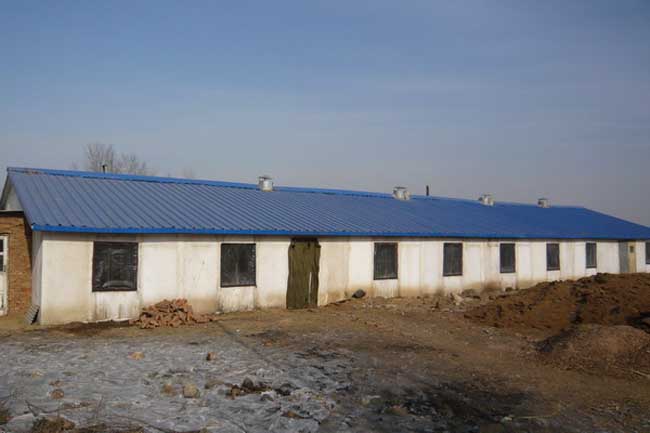
An insulated chicken coop is a building for raising chickens with insulation properties, made with foam sandwich panels as the insulation material and magnesite materials, fiberglass-reinforced plastic materials, cement and other materials as the surface reinforcing layer. It is also the basic type of environmentally safe livestock and poultry housing. Commonly known as the inorganic fiberglass-reinforced plastic insulated chicken coop, the insulated chicken coop is a newly emerging building material product in the rural poultry farming industry. The product takes advantage of magnesite cement's high strength, easy bonding with organic materials, heat and sound insulation, and is factory-prefabricated and assembled on site. It is an organic combination of traditional magnesite products and new insulation materials.
Performance requirements of the insulated chicken coop
1. Surface layer material: It features fire resistance, waterproofing, resistance to acids and alkalis, corrosion resistance, light weight and insulation. The foam board should have flame-retardant properties, and its insulation performance is higher than that of a brick wall. A 10 cm insulated wall can achieve the insulation performance of a 50 cm brick wall, reducing heating costs in winter. In summer it reduces heat radiation, helping with heat prevention and cooling.
2. Short construction period: Compared with traditional brick-and-tile chicken coops, the construction of an insulated chicken coop greatly shortens the construction period.
3. Environmental conditions: The insulated chicken coop uses columns as vertical supports, which increases the coop space, facilitates ventilation, and greatly improves the environmental conditions inside the coop.
4. Beneficial for disease prevention: The insulated chicken coop uses surface layer materials with smooth surfaces, making washing and disinfection easy. Combined with timely removal of chicken manure, it is very beneficial for coop disease prevention and disease control in the flock.
The cost of an insulated chicken coop
The new insulation board used in the insulated chicken coop costs 14 yuan per square meter in materials (calculated based on a 5 kg/m³ foam board), with labor at 2 yuan per sq m. Water and electricity costs are negligible, totaling 16 yuan per sq m. The current average market price of the new insulation board fluctuates around 30 yuan per sq m, meaning a gross profit of 14 yuan per square meter of insulation board. Calculated by floor area, the construction cost of an insulated chicken coop is about 45 yuan per sq m. The current market contract price is around 75 yuan per sq m, meaning a gross profit of 30 yuan per square meter of floor area. Taking a chicken coop 100 m long and 10 m wide as an example, the profit is around 30,000 yuan.
Advantages of the insulated chicken coop
1. Low cost: The construction cost of the new magnesite insulated chicken coop is less than 70 yuan per square meter, while the construction cost of a traditional red brick chicken coop is about 250-300 yuan per sq m. At the same time, the state has continuously introduced policies to restrict the production and use of clay bricks in order to protect arable land. The new magnesite insulated chicken coop does not use clay, in line with national policy direction.
2. Convenient construction: The new magnesite insulated chicken coop adopts factory prefabrication and on-site assembly. Compared with traditional brick-and-tile chicken coops, the construction of an insulated chicken coop greatly shortens the construction period.
3. Superior performance: The surface layer of the new magnesite insulated chicken coop is refined from organic fiber cloth and inorganic composite materials, with composite polymer cementitious material as the base material. Its corrosion resistance, acid and alkali resistance, aging resistance, earthquake resistance and pressure resistance are far superior to traditional materials. At the same time, this product has quite good elasticity and tensile strength, will not be cracked by frozen soil, and is suitable for use in the cold regions of the north.
4. Good insulation and heat preservation: The new magnesite insulated chicken coop uses new insulation and heat-insulating materials, with outstanding heat insulation effects and excellent insulation performance. Experimental data shows that the thermal conductivity of a 1 cm, 16 kg foam board is equivalent to that of a 10 cm brick wall. At the same time, the porous structure of the foam board has outstanding sound absorption performance, effectively reducing interference from external noise and creating a better living environment for poultry.
5. Easy to disinfect: The surface of the new magnesite insulated chicken coop panel is as smooth as a mirror, leaving bacteria and viruses nowhere to hide, making disinfection easy and benefiting coop disease prevention and disease control in the flock.
6. Good fire resistance: Magnesite cementitious material is one of the inorganic cementitious materials with the best fire resistance, withstanding high temperatures above 1000°C.
7. Long service life: The modified magnesite insulated chicken coop has stable physical and chemical properties, is lightweight and high-strength, and can be used for more than 30 years.
Features of the insulated chicken coop
1. Antibacterial and pest-resistant
The material itself not only does not breed bacteria, but can also inhibit bacterial growth. In addition, the coop walls are waterproof and moisture-proof, and the surface is as smooth as a mirror, which facilitates washing and improves the disinfection effect, thereby eliminating the generation of harmful substances.
2. Insulation and heat preservation
The coop building material uses fiberglass-reinforced plastic, featuring fire resistance, waterproofing, resistance to acids and alkalis, corrosion resistance, and insulation. Its insulation performance is higher than that of a brick wall (a 10 cm insulated wall can achieve the insulation performance of a 50 cm brick wall), reducing heating costs in winter. The coal consumption of an insulated chicken coop in one winter is one-half that of an ordinary one. In summer it reduces radiation, helping with heat prevention and cooling, and greatly reducing farming costs.
3. Low price
This insulated chicken coop is low in price. Compared with a brick-and-tile chicken coop, it saves 100-140 yuan per square meter in costs. With the same area, the investment in an insulated chicken coop is much lower.
4. Durability
Due to the special properties of this insulation material, the product has a hard and sturdy surface with excellent wind resistance and impact resistance. In addition, the insulated chicken coop has high temperature resistance, acid and alkali resistance, corrosion resistance, aging resistance and high overall performance, with a service life of more than 20 years.
5. Reasonable design
The coop has a ridge height of 3 m, an eave height of 2.1 m, a length of 72 m, a width of 10.5 m, 12 skylights and 48 side windows, and can raise 5,000 broiler chickens (it can also be built to other specifications on request). After long-term use by farmers, coops built to these specifications are unanimously considered very reasonably designed, convenient for ventilation and insulation. 6. Ease of installation. The insulated chicken coop is quite convenient and quick to set up, saving time and effort. For example, to build one coop of the above specifications (756 sq m), only 10 workers are needed, taking 6-8 days. Simple and convenient.
Construction types of the insulated chicken coop
The smooth surface of the surface layer material used in the insulated chicken coop provides convenient conditions for washing and disinfection in future use. It is also very beneficial for coop disease prevention and disease control in the flock.
Insulated chicken coops come in open, windowed and closed types, depending on climatic conditions. Open insulated chicken coops are suitable for warm climate regions, and shading and rain protection should be considered in the construction. Windowed insulated chicken coops basically use natural ventilation and can also be supplemented by mechanical ventilation. The window area must ensure air exchange while preventing heat radiation. Closed insulated chicken coops must have good insulation and heat preservation performance, with temperature, air and light inside the coop controlled manually, so as to create a suitable growing environment for the flock and maximize their production performance.