Key Technical Points for Silkie Chicken Farming and Scientific Feeding and Management Methods
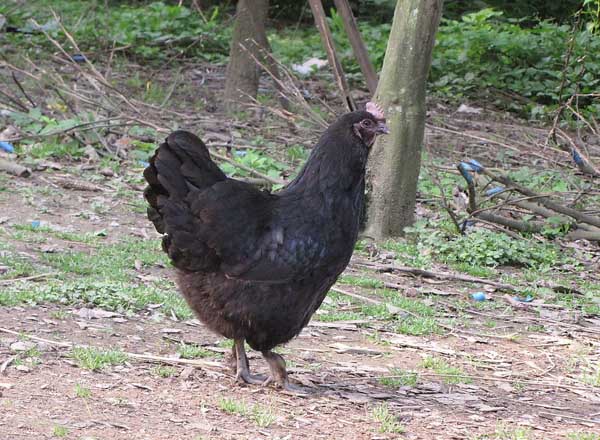
Silkie chicken, also known as Wushan chicken or silkie, is an omnivorous domestic bird. It originates from Wushan in Taihe County, Jiangxi Province, China. There, it has been raised for more than 2,000 years. Not only are their beaks, eyes, and feet black, but their skin, muscles, bones, and most internal organs are also black. In terms of nutritional value, silkie chicken is far more nutritious than ordinary chicken, and its taste is very tender. As for its medicinal and dietary therapeutic effects, ordinary chicken cannot compare, and people call it the "precious dietary therapeutic rare bird."
Chicken Coop Selection and Disinfection
Coop construction. The coop should be built on flat, sunny ground in the central area of the free-range site. Building materials can be adapted to local conditions and sourced locally; wood, bamboo, plastic, tar felt, canvas, straw curtains, and others are all suitable. Build a simple coop facing south, preferably pyramid-shaped or greenhouse-shaped, with an open door on the south side. The coop edge should be 1.5-2 m high, and the roof peak 2-2.5 m high. The ground should be level, compacted, and covered with bedding. The coop must be warm, windproof, rainproof, and free of standing water. Each square meter inside the coop can accommodate about 8-10 chickens. At the same time, set up a run outside the coop with an area more than 2 times that of the coop. Plant trees and build a rest shelter for sun and rain protection; install feeders and drinkers.
Coop disinfection. Remove all foreign matter from the coop, including chicken manure, bedding, water troughs, feed troughs, brooding nets, etc. Clean the floor and walls, replace the bedding soil, then close doors and windows for fumigation disinfection. Mix formalin at 30 mL per square meter with potassium permanganate at 15 g per square meter, seal for 24 hours, then open for ventilation.
Selection of Feeding Methods
All-in, all-out feeding method. Floor free-range rearing, with bedding replaced once midway. Determine the number of birds raised according to the building area, carry out all-in, all-out (or sell out within a short time), and focus sales on wholesale. After selling out, disinfect and leave the house empty for 1 week before raising the next batch.
Separated and staged feeding. Use 2 or more relatively independent houses, 1 as the brooding house and 1 as the growing house. After transfer, disinfect and leave the house empty for about 1 week, then bring in chicks for brooding. After the first batch is raised, carry out all-in, all-out (or sell out within a short time), and focus sales on wholesale. After selling out, disinfect and leave the house empty for about 1 week before raising the next batch.
Separated and staged feeding mainly for retail. Use 3 or more relatively independent rooms, divided into a brooding house, early growing house, and late growing house, with an area ratio of 1:2:4. Brood for 25-30 days, then transfer to the early growing house. After transfer, disinfect and leave the house empty for more than 1 week, then bring in chicks for brooding; raise for 30 days in the early stage, then transfer to the late growing house. After transfer, disinfect and leave the house empty for about 1 week, and continue the cycle; after about 20 days in the late stage, begin marketing, mainly retail. Sold chickens should weigh more than 1 kg per bird, and be sold out in about 10 days. After 20 days, whole chickens that have not reached sale weight should be discarded, and the empty house disinfected to prepare for the next transfer. With this cyclic feeding, the batch size should be 20 times the average daily sales volume.
Brooding and Rearing Techniques
The brooding period (0-8 weeks of age) is the key stage of the entire feeding and management process. The survival rate of chicks, the speed of growth and development, and the quality of their constitution all directly affect economic benefits. The following key points must be mastered.
1. Selection of chicks. At present, breeds used in courtyard farming in southern China include Xuefeng silkie, Jiangshan white-feathered silkie, Sichuan mountain silkie, Taihe silkie, and Jinyang silky chicken. Suitable breeds can be selected according to local consumption habits. Healthy silkie chicks are uniform in size, with glossy down, bright and spirited eyes, good yolk absorption, a flat umbilical ring with no blood traces, lively and active, with loud calls, elastic when held in the hand, struggling strongly, a clean vent, and no adhering feces.
2. Brooding temperature and humidity. Silkie chickens are small in size and have relatively high temperature requirements. At 1-4 days of age, it should be 36-37°C; at 5-8 days of age, 34-35°C; afterward, reduce by 2°C each week; after 5 weeks of age, maintain 23-25°C. While maintaining room temperature, pay attention to ventilation to keep indoor air fresh and avoid respiratory diseases. The relative humidity in the brooding room should be about 65% in the first week, and about 55% afterward, so that people feel it is appropriately warm and moist, not dry. If humidity is low, spray water with a sprayer; if humidity is high, strengthen ventilation and raise the temperature.
3. Timely drinking and starting feed. After the chicks enter the house, let them rest for 1-2 hours, then promptly give warm boiled water, preferably at about 20°C. Add 50 g glucose and 1 g oral rehydration salts to 1 L water, then give 0.01% potassium permanganate water once. After drinking enough water, they can start feeding, 6-7 times per day. Start feeding with half-cooked broken rice, then switch to chick feed. The amount fed should be finished in about 20 minutes. After 2-4 weeks of age, switch to trough feeding. Feed with the principle of small amounts and frequent additions, feeding to about 80% full. In the first week, feed 6-7 times per day; after 1 week, 5-6 times. As light duration shortens, gradually reduce feeding frequency. You can mix chick feed yourself with the formula: corn 55%, sorghum 5%, wheat bran 4%, barley 5%, fish meal 9%, soybean meal 16%, pagoda tree leaf powder 3%, bone meal 2.5%, salt 0.37%, multivitamins 0.05%, methionine 0.08%.
4. Stocking density and reasonable lighting. If density is too high, silkie chicks cannot eat and drink evenly, and development will be uneven. At 1-14 days of age, 50 birds per square meter; at 15-20 days of age, 30 birds per square meter; at 21-24 days of age, about 20 birds per square meter. Observe the chicks' drinking and feeding at any time, and adjust density and the size of drinkers and feed trays in a timely manner. Within 7 days of age, lighting should be 20-24 hours per day; after 7 days of age, reduce lighting by 2 hours each week until the light duration is 13 hours. Light intensity should be 4 watts per square meter, and after 15 days of age change to 1-2 watts per square meter.
5. Timely beak trimming to prevent feather pecking and reduce feed waste. At 7-10 days of age, use a beak trimmer to cut off half the length from the beak tip to the nostrils, and trim one third off the lower beak. At 20 days of age, chickens with incomplete beak trimming can be trimmed again. At the same time, add VK3 and electrolytic multivitamins to drinking water to reduce bleeding and stress.
6. Regular disinfection. Carry out disinfection with chickens present once every 3 days, spraying with a 1:2000 dilution of Baidusha. Using 2 disinfectants with different ingredients alternately will give better results.
Growing Chicken Rearing Techniques
Silkie growing chickens are divided into breeding growing chickens and meat-type growing chickens. Breeding growing chickens refer to growing chickens from the end of brooding to before the start of laying, that is, the 9-25 week stage; meat-type growing chickens refer to chickens from the end of brooding to the marketing stage, generally requiring 60-150 days of age and a body weight of 0.8-1.2 kg before they can be sold to pharmaceutical factories and for foreign trade. It is required to supply a complete diet to increase feed intake and improve the slaughter rate and commercial rate. Meat-type chickens are generally raised on the floor. All those not retained for breeding can be transferred into commercial chicken flocks. Feed a diet with higher energy and higher crude protein levels, with free access to feed, so that at marketing at 100-150 days of age they have plump muscles and a certain amount of fat stored in the body. Laying-type growing chickens are mainly raised in pens or by grazing.
1. Grouping. After brooding ends, silkie chickens grow noticeably faster, and feeding and management personnel should group them at any time by strength, size, and sex. Grouping is best done at night or in the morning, and multivitamins should be added to drinking water to prevent stress. At this time, density should be controlled at 8-10 birds per square meter. Those retained for laying or breeding should be transferred to the laying hen house at 120 days of age. If transferred only at the start of laying, it is easy to cause stimulation and affect the laying rate. Transfer should be carried out in the evening and kept as quiet as possible.
2. Feed supply. When chicks enter the growing period, the diet will change from chick feed to growing chicken feed and large chicken feed. To reduce stress caused by feed replacement, attention must be paid to feed transition; it must not be changed suddenly. The transition period is generally 3-5 days. The specific method is: on day 1, the diet consists of the pre-transition feed and post-transition feed; on day 2, it consists of the pre-transition feed and post-transition feed; on day 3, it consists of the pre-transition feed and post-transition feed; on day 4, it is completely changed to the post-transition feed. Feed large chicken feed 20 days before marketing, stop medication, and eliminate drug residues. Breeding chickens should be supplied with a complete diet, either mash or pellets. When feeding, limit the amount placed to about 2/3 of the trough capacity to prevent chickens from scratching it out and causing waste. Feeding 3-4 times per day is suitable; in winter, 1 additional feeding can be given at night. Moderate lighting, 14-16 hours of light per day, with light intensity of 40 watts per 15 square meters. It is best to turn on the lights at 5 a.m. and turn them off after sunrise. Turn on the lights in the evening and turn them off at 10 p.m. The house temperature should be maintained at 13-25°C, and the house should be kept quiet. Set up sand basins or sand baths in the run to let chickens freely eat sand grains and take sand baths, which can both prevent skin diseases and enhance digestive function. Egg collection: before growing chickens are transferred to the laying hen house, nest boxes should first be placed in the breeding chicken house. Silkie chickens are timid, so collective nest boxes are not suitable; nest boxes with small compartments should be used. Nest boxes should be evenly placed in darker, well-ventilated, and quiet places.
Winter and Summer Management of Silkie Chickens
1. Summer management. Summer weather is hot, and chickens have no sweat glands and are covered with feathers, so they have poor heat resistance and are prone to strong heat stress, causing meat chickens to show decreased feed intake, slow weight gain, and high mortality. Therefore, the key task in summer management is heat prevention and cooling. This issue should be considered during the design and construction of the coop, making the coop orientation reasonable and the spacing open, so as to help reduce solar radiation in summer and ensure good ventilation. Plant leafy trees or vine plants around the coop to provide shade and also reduce heat radiation. For coops with poor roof insulation, the method of whitewashing the roof to reduce heat absorption or spraying water on the roof to promote heat dissipation can be used to lower the house temperature. Adjust the diet structure and feeding methods, and supply sufficient drinking water. During the fattening period, if the temperature exceeds 27°C, feed intake will decrease noticeably. On the basis of the original dietary nutrient level, increase protein content by 1%-2% and multivitamins by 30%-50%, and ensure the diet is fresh. To reduce heat stress, appropriately add anti-stress drugs to the feed. For example, add bacitracin powder at 0.1-0.2 g per kg of diet; when the house temperature is above 26°C, add an appropriate amount of vitamin C, or 0.3% baking soda, or 0.5% ammonium chloride, or 0.1% potassium chloride, etc., to drinking water.
2. Winter management. The key to winter management is cold prevention and warmth, correct ventilation, and reducing humidity and harmful gas levels. If the roof has poor cold insulation, cover it with rice straw or plastic film, seal windows tightly with plastic film, adjust ventilation openings well, and provide artificial heating when temperatures are low. Frequently replace and add bedding to ensure dryness. Because chickens' maintenance needs increase in winter, the dietary energy level must be appropriately raised. When using split feeding, shorten as much as possible the time the flock spends empty-stomached on cold nights, and frequently inspect and repair flues to prevent gas poisoning and fires.
Environmental Hygiene on the Farm
1. Pay attention to ventilation and frequently replace bedding. Reasonable ventilation can promote the development of the heart and lung systems. Frequently replace bedding to ensure cleanliness and hygiene in the coop; generally replace bedding once every 10 days, and immediately replace bedding grass that has been wetted by water.
2. Do a good job of environmental hygiene and always maintain sanitation and epidemic prevention in the coop and surrounding activity areas. Persist in using disinfectants weekly to carry out disinfection with chickens present in the coop and surrounding activity areas.
3. Pay attention to biosecurity. Check whether there are rat holes in the coop and promptly block rat holes in the coop. Take effective measures to prevent cats and dogs and eliminate rodents, avoiding harm to chickens from cats, dogs, rats, and birds and reducing the spread of disease.