What is the difference between free-range eggs and regular eggs?
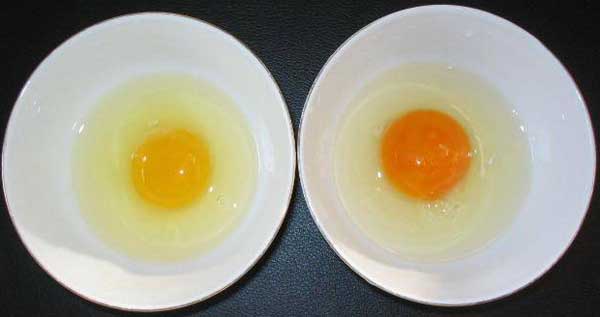
The common belief is that small size and deep-colored yolks are the hallmarks of free-range eggs. But unscrupulous traders exploit this widespread view by picking out the small eggs from among commercially farmed eggs to pass off as free-range eggs, and by adding pigments to chicken feed to make the yolks darker. Such eggs are even poorer in quality than commercially farmed eggs, yet their price is close to that of free-range eggs. This trick has deceived consumers at large.
The difference between free-range eggs and regular eggs
Free-range eggs have certain characteristics that regular eggs do not, and we can use these differences to identify them.
1. Free-range eggshells contain a large amount of calcium, are thick and hard, whereas commercially farmed eggshells are thinner and more fragile;
2. Free-range egg whites are clear and viscous, whereas commercially farmed egg whites are very thin.
3. The yolk has a high coagulation degree and floats on top of the egg white without sinking; a toothpick inserted into the middle of the yolk can stand upright;
4. Shell a boiled egg and knead it in your hand; even when squashed flat, the egg white will not crack and it remains a whole egg.
5. Genuine free-range eggs really do taste better than any kind of egg sold on the market. Genuine free-range eggs are delicious even simply boiled in plain water.
6. Commercially farmed eggs are large, with a lot of egg white and a lot of moisture; you can see this when frying an egg, as it sizzles loudly the moment it hits the oil.
Identifying free-range eggs and regular eggs
Judging free-range eggs by egg size and yolk color no longer works. Still, there are very easy ways to tell whether an egg is a free-range egg. The two identification methods below are intuitive and clear, and they capture the essential characteristics of free-range eggs.
1. Tell real from fake at first glance. Although a small egg is not necessarily a free-range egg, you can still easily tell real free-range eggs from fake ones by appearance. Because free-range chickens are raised in scattered flocks, individual variation is relatively large, and this is reflected in relatively large variation among the eggs, especially in egg size, shape and color. Generally, free-range farms sort eggs by size, so a batch of eggs seen on the market is roughly similar in size, but the colors do differ considerably. When a batch (10-odd eggs) shows obvious differences in color, it can basically be judged to be free-range eggs; otherwise, they are commercially farmed eggs.
2. Crack the egg open to tell real from fake. True free-range chickens are raised in scattered flocks, and within the flock the number of hens and roosters is matched at a ratio of about 10:1. Scattered raising suits the chickens' natural way of life, and the roosters and hens will mate, continuing the species. So free-range eggs are the product of mating between roosters and hens; they are fertilized eggs. Battery farms, however, do not keep roosters at all in order to raise egg production, and caged chickens cannot move freely, so there is no mating process; the eggs they lay are unfertilized, unlike free-range eggs, which are fertilized. By this standard, one can very clearly judge whether an egg was laid by a free-range chicken. If there is white flocculent matter in the egg white, it shows the egg is fertilized; if you look closely, you can also find a “egg eye” on the yolk.