Detailed Explanation of Free-Range Chicken Farming Cost Calculation Methods
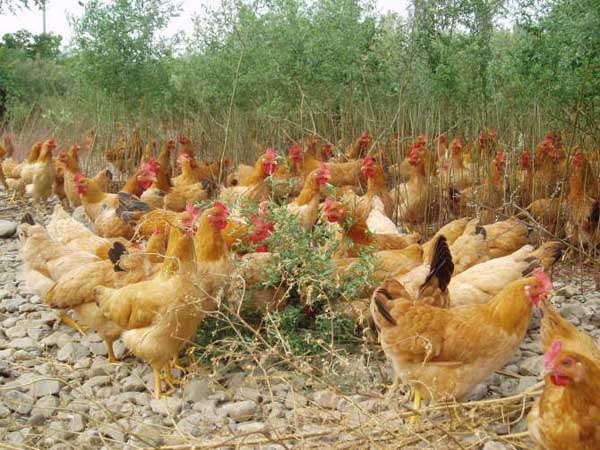
Since most free-range chickens are raised in forests or orchards, which better meets green and environmentally friendly requirements, they are more favored by consumers. For farmers with certain conditions, the cost of raising free-range chickens is relatively low, making it suitable for family farming, but the raising cycle is relatively long, generally about 6 months to reach adulthood. So how exactly should the cost of free-range chicken farming be calculated?
Cost Estimate for Free-Range Chicken Farming
Raising ecological free-range chickens for 90-100 days can reach 2.5-3.5 jin per bird, at which point they can be sold. However, to ensure meat quality, they are generally raised for 4 months, and the cost per chicken is about 15 yuan.
The specific calculation is as follows: raising one ecological free-range chicken for 4 months to market, weighing about 2.5-3 jin, the required feed separately is grain (rice, corn, wheat, sweet potato, soybean meal, chives, carrots, vegetable leaves are all acceptable) 6 jin, calculated at 1 yuan per 1 jin, that is 6 yuan; yellow mealworms 3 jin, self-raised at a cost of 1.5 yuan per jin, that is 4.5 yuan; fly maggots 3 jin, self-raised using chicken manure at a cost of 0.5 yuan per 1 jin, 3 jin is 1.5 yuan; green vegetables 5 jin at 1.5 yuan (self-grown or gathered vegetable leaves cost nothing); free-range chick self-hatched at about 2 yuan per bird; vaccine 0.2 yuan per bird. Total: 15.8 yuan.
Investment Cost Estimate for Free-Range Chicken Farming
1. How much money is needed to invest in raising chickens depends on the size of your farming operation. Taking raising 500 free-range chickens per month and 5000 chickens per year as an example, 26800-29800 yuan is needed; in rural areas, if you have your own grain, the initial investment only needs 6800 yuan, and at most 10000 yuan is enough. To raise 5000 chickens per year, you only need to prepare funds for 1500 free-range chickens for 3 months. If 1500 free-range chickens use a greenhouse technique to build a chicken shed, the cost is 1500 yuan; 1500 free-range chicks cost 3000-6000 yuan; raising 1500 chickens requires raising 200 boxes of yellow mealworms, and 200 boxes of yellow mealworms require 2000 yuan; 1500 chickens require 20000 yuan for insect-raising and chicken feed; the vaccine cost for 1500 chickens is 300 yuan. The total investment is about 26800-29800 yuan.
Raising 500 chickens per month, with an annual market output of 5000 chickens, the annual net profit is about 70000-100000 yuan.
2. How many free-range chickens can be raised per mu of land depends greatly on your raising methods, raising skills, and your raising environment. Theoretically, one chicken needs 0.25 sq m of activity space, which calculates to at least about 2600 chickens per mu of land. Currently, professional free-range chicken farmers nationwide mostly adopt free-range grazing methods, generally raising 200-500 free-range chickens per mu. With the ecological chain pen-raising and grazing method, after probiotic treatment, generally more than 1000 can be raised per mu, with 1000 being appropriate.
Free-range chickens need to be released for grazing. From the above, it can be seen that the disadvantage of raising free-range chickens is the relatively large land area required. However, because they are ecological, safe, pollution-free, and taste good, their price is more than 2 times higher than feed chickens, and the eggs they produce are also more than 2 times higher in price than those of penned chickens, and demand exceeds supply, making them very popular. For the vast rural population of our country, the large land area required for raising free-range chickens is not really a disadvantage. In rural areas, they can be raised in forest land, grassland, orchards, sandy land, and wasteland, but attention must be paid to preventing natural enemies such as rats.
Chicken Farming Profit Analysis
Free-range chicks cost about 2 yuan each. From hatching to market-ready commercial chicken, the feed consumed is 14-15 yuan. They can be sold at 4 months, reaching at least 2.5-3 jin. Commercial free-range chickens are sold at a wholesale price of 10 yuan per jin, that is: 3 jin × 10 yuan = 30 yuan. Subtracting the 2 yuan for the chick and 15 yuan for feed, a total of 17 yuan. The net profit from raising one commercial free-range chicken: 30-17=13 yuan. Calculating based on an investment of 500 free-range chickens, the required cost: 500 chicks require 500 birds × 2 yuan = 1000 yuan; feed requires 15 yuan per bird × 500 birds = 7500 yuan, with a total investment of 8500 yuan; in addition, building a chicken coop for 500 chickens requires 500 yuan, and the total investment for 500 chickens is about 10000 yuan. The net profit is between 5000 and 10000.
Specific Analysis of Feed Input
In addition, feed input accounts for about 70% of the total investment cost. Taking 500 chickens as an example, calculated according to the 4 parts of feed cost input: the early brooding stage (0-26 days of age) requires 160 kg of complete pellet feed, calculated at a feed price of 1.85 yuan/kg, the feed cost is 160×1.85=296 yuan; after removing temperature control, brooding for 30 days (27-56 days of age) feeds self-mixed complete feed, calculated at 0.06 kg of feed per bird per day and a feed price of 1.2 yuan/kg, the feed cost is 30×0.06×500×1.2=1080 yuan; the growing stage of 94 days (57-150 days of age) feeds self-mixed complete feed, calculated at 0.05 kg of feed per bird per day and a feed price of 1.1 yuan/kg, the feed cost is 94×0.05×500×1.1=2585 yuan; the laying stage of 215 days, calculated at 0.075 kg of complete feed supplement per bird per day and a feed price of 1.2 yuan/kg, the feed cost is 215×0.075×500×1.2=9675 yuan. The total feed cost for the whole process is 296+1080+2585+9675=13636 yuan.
Equipment Needed for Chicken Farming
Brooding house, feed troughs, feed buckets (must have different specifications), feed trays, drinkers (of different sizes and specifications), materials needed for infrastructure, heating and insulation tools, ventilation tools, syringes, nets, vaccines, other labor tools, circuit and other tools, chicken cages or transfer boxes (used for temporarily catching chickens), transport vehicles (for pulling feed or grain to feed chickens), straw curtains (for insulation), thermometers, hygrometers, scales, beak trimmers, and other necessary tools.