Detailed Explanation of the Key Points of Jiuyuan Black Chicken Breeding Technology
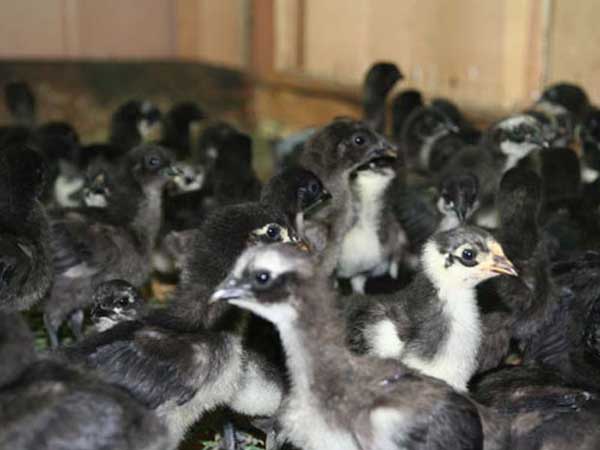
Ratio of Males to Females Among Breeding Chickens
The ratio of males to females among breeding chickens should be appropriate to ensure a high fertilization rate. If the ratio is inappropriate, with too many hens, they cannot all be mated by the rooster; with too many roosters, competition for mating occurs, and both situations reduce the fertilization rate of hatching eggs. The most appropriate ratio for Wanyuan Jiuyuan Black Chickens is 1:8—10.
Regarding the useful lifespan of breeding chickens, generally after sexual maturity, the first laying year has the highest egg production, the second laying year decreases by 15—25% compared with the first laying year, and the third laying year decreases by another 15—25%. Therefore, in general breeding chicken farms, the utilization time is relatively short, and the all-in-all-out system is often adopted, with a useful lifespan of 2—4 years.
Mating Methods
1. Natural Mating
(1) Large-group mating: A certain number of hens are matched with a certain number of roosters in proportion, so that every rooster and every hen has the opportunity to mate in combinations. This mating method often has a relatively high fertilization rate, but the parents of the chicks cannot be known for certain, so it is generally used only in breeding chicken farms, that is, multiplier farms. One rooster can be used with 8—10 hens. Breeding roosters over three years old have poor mating ability and are not suitable for large-group mating.
(2) Small-pen mating: A small mating pen generally accommodates 8—10 hens with one rooster. Both hens and roosters are given leg numbers or shoulder numbers, and trap nests are provided. Hatching eggs must be marked with the mating pen number and the hen's leg number or shoulder number, so that the parents of the chicks obtained from this mating can be clearly known. Small-pen mating often yields a lower fertilization rate of hatching eggs than large-group mating because of mating behavior and shyness.
(3) Individual controlled mating: This method involves keeping one rooster separately in a mating cage or mating pen, placing a hen inside, and removing her immediately after the rooster mates. To ensure a good fertilization rate, each hen must be placed in at least once a week. This mating method can make full use of particularly excellent roosters, but because mating depends on manual control, it requires more labor.
2. Artificial insemination: This method involves raising individually excellent roosters that conform to the breed's characteristics and traits, collecting semen artificially, and after dilution making it into pellet frozen semen or straw frozen semen, or using fresh semen, artificially inseminating each hen once a week. Each rooster can serve 1000—2000 hens.
Egg-laying Patterns
The amount of egg production depends on the length of the laying period and the laying rate during the laying period. During the laying year of a chicken, the laying period can be divided into three stages, namely the initial laying stage, the main laying stage, and the final laying stage.
1. Initial laying stage: From the beginning of laying the first egg to the start of normal laying, about 1 or 2 weeks pass; this is called the initial laying stage. During this stage, laying is irregular and abnormal. Generally, the following situations occur: (1) Long intervals between eggs. (2) Laying double-yolked eggs. (3) Laying soft-shelled eggs. (4) Laying one abnormal egg and one normal egg within a day, or two abnormal eggs.
2. Main laying stage: During this stage, the laying pattern tends to become normal. Each hen has its own unique laying pattern. The laying rate gradually increases, reaching its peak at about 32—34 weeks of age, and then gradually declines. The main laying stage is the longest laying period in a hen's laying year and plays an important role in egg production.
3. Final laying stage: This stage is quite short. Although the pituitary gland can still produce gonadotropins, egg production declines rapidly until no egg cells can be formed, and then it ends.
Disinfection of Hatching Eggs
After eggs are laid, they are often contaminated by manure and litter. Very dirty eggs are easily culled, while slightly dirty ones are easily overlooked. According to research, newly laid eggs have 100—300 bacteria on the shell surface, 500—600 after 15 minutes, and up to 4000—5000 after one hour. Especially in chicken houses using litter floor raising, hatching eggs are more easily contaminated by bacteria. Contamination of hatching eggs not only affects the hatchability rate, but more seriously contaminates incubators and equipment and transmits various diseases.
There are many methods for disinfecting hatching eggs, among which the fumigation method is more convenient and effective. For each cubic meter of fumigation cabinet or fumigation room volume, add 30 milliliters of formaldehyde and 15 grams of potassium permanganate, and fumigate for 20—30 minutes. During fumigation, close doors and windows tightly, and keep the indoor temperature at 25—270C and humidity at 75—80%. If the temperature and humidity are low, the disinfection effect is poor. After fumigation, exhaust the gas. To save chemicals, plastic sheeting can also be used to enclose the egg rack, with the medicine tray placed under the rack for fumigation.