What are the prevention and treatment methods for chicken airsacculitis?
The most harmful and most difficult-to-control disease in chickens during the rearing process is airsacculitis, especially from October of the current year to June of the following year, and in severe cases it can continue into July. The pathogens that cause airsacculitis are very complex. In clinical treatment, if there is no clear target, the pathogen is not accurately identified, and effective drugs are not selected accurately, it is very difficult to achieve results. Now let us take a look at the prevention and treatment methods for chicken airsacculitis!
Causes of Chicken Airsacculitis
1. Viral infection: especially from October of the current year to June of the following year, when the temperature difference is relatively large. In addition, chicks are not fully developed physiologically and are not sensitive to temperature differences in the early stage. Under existing feeding and management conditions, some weak chickens are infected first, and then the whole flock becomes affected.
2. Incomplete purification or early infection with Mycoplasma: for the currently complicated sources of hatching eggs, combined with the lack of scientific incubation, it is very easy to cause the spread of this disease. Often 3-4 days after the chicks arrive, sneezing and coughing begin to appear. Once vaccination is given, the disease occurs, especially after the first vaccination against infectious bursal disease or the second vaccination against Newcastle disease, and once mixed infection is caused, it is extremely difficult to control.
3. Improper feeding and management: long-term failure to disinfect the chicken house, irregular manure removal, and poor ventilation can very easily cause low humidity, excessive dust, and strong ammonia odor in the house, inducing or worsening the occurrence of this disease. Failure to pay attention to controlling drinking water sources and failure to disinfect equipment are the root causes of inducing diarrhea and intestinal diseases.
Symptoms of Chicken Airsacculitis
1. In the early stage of the disease, the flock has mild respiratory symptoms (grunting, sneezing), elongated eyelids, foam at the corners of the eyes, feed intake is basically unaffected, feces are relatively dry, and there is basically no mortality.
2. In the middle stage of the disease, the flock shows closed eyes and standing with the head lowered in a dazed state, and may even show difficulty breathing, open-mouth neck stretching, coughing and sneezing. The flock does not increase feed intake, yellow-green loose feces appear, and the mortality rate reaches 0.5-1%.
3. In affected chickens with a relatively long course of disease, the comb and wattles are red-purple, there are strange cries, and a “gurgling” sound is produced. The chickens are depressed, have elevated body temperature, no appetite, huddle together or stand dazed to one side, pass white feces or yellow-green loose feces, grow poorly, and feed intake drops severely. Some severely affected chickens lie on the ground with the beak slightly open and pant. Many dead chickens look quite normal in appearance, but on necropsy the bronchi are blocked by inflammatory secretions.
4. Chickens that die because airsacculitis triggers bronchial blockage are found with their bellies facing upward.
Necropsy of Chicken Airsacculitis
1. Pinpoint hemorrhages on the throat, cleft palate, and eyelids; the trachea is congested, hemorrhagic, and contains mucus.
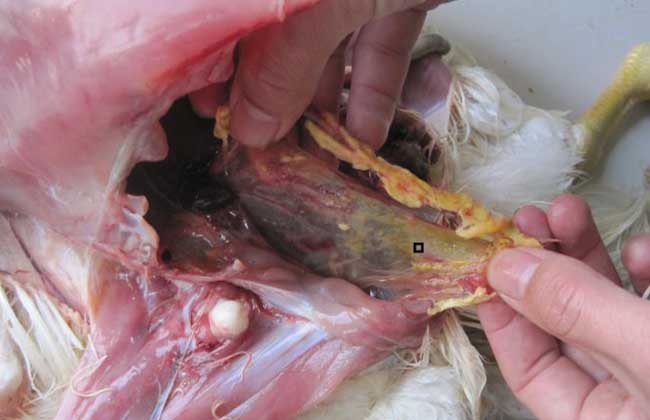
2. The thoracic air sacs are cloudy, thickened, and have yellow or yellowish-white inflammatory exudate. In cases with a longer course, block-like caseous material attaches to them.
3. The abdominal air sacs also become cloudy and thickened. The abdominal cavity often contains large numbers of small bubbles (white mucus-like in the early stage). In cases with a longer course, block-like caseous material attaches to them.
4. In severely affected chickens, necropsy findings include airsacculitis, pneumonia, pericarditis, perihepatitis, peritonitis, etc., diffuse hemorrhage in the duodenum, and enlargement and hemorrhage of the cecal tonsils.
5. The bursa of Fabricius is swollen or atrophied with purulent exudate, and the thymus is hemorrhagic and atrophied.
6. In severe cases, there are emboli in the lungs and bronchi.
Prevention and Treatment of Chicken Airsacculitis
1. Preventive measures
① At the time of chick arrival, promptly inject the ND-AI bivalent oil vaccine, especially to control the occurrence of H5. At the same time, in addition to adding drugs to purify Mycoplasma and pullorum disease to the drinking water, “Lijunkang” must be added, one bag mixed into 300 jin of feed.
② After preventing IBD, use Jinchan Dubai + Aqi Chuanding to enhance the body's immunity and prevent and control vaccine stress reactions. Use continuously for 3 days, which can effectively reduce the incidence of respiratory tract and Escherichia coli infections.
③ For the second vaccination against Newcastle disease, antibody levels must first be tested before using the freeze-dried vaccine, so as to avoid antibody neutralization causing an immune blank period and allowing disease to take advantage of the opportunity.
2. Treatment methods
① Mix Shuanghuanglian 200 jin water/bottle + analgin 8 jin water/g + tylosin 8 jin water/g and give as drinking water in the morning, and Ganjing (300 jin water/bag) as drinking water in the afternoon. This is used when depressed spirits are first found and flock mortality is not high. Continuous use for three days can significantly control further development of the disease.
② In the morning, Kayan (white packet, 400 jin water/bag), calculated according to the whole day's drinking water volume, given as concentrated drinking water once per day, continuously for 3—5 days. In the evening, Kayan (black packet, 400 jin water/bag), calculated according to the whole day's drinking water volume, given as concentrated drinking water once per day. At the same time, Jinchan Dubai (100 jin feed/bag) is soaked in boiling water for 30 minutes and then mixed into the feed for concentrated feeding. Use continuously for 3-5 days. This is used at the peak of mortality, and continuous use for four days can effectively control the disease.
3. Comprehensive prevention and treatment
① The source of chicks must be well controlled. In particular, the purification of breeder farms and the disinfection of hatching eggs must follow a scientific and complete process and system.
② Strengthen feeding and management, do a good job in vaccine prevention, carry out environmental and drinking water disinfection, hygiene, humidity, and temperature control according to scientific feeding and management requirements, and immunization with vaccines to create a good growth environment for poultry and eliminate disease-inducing factors.
③ Select good pure Chinese medicines for corresponding prevention to reduce the damage of Western medicines to the gastrointestinal tract of poultry and infection with Escherichia coli and Mycoplasma. In short, prevention is more important than treatment. Improving the scientific feeding and management concepts of the broad masses of farmers is the fundamental way to control the high incidence of this type of epidemic disease.