Detailed Explanation of Efficient Breeding Technology for the Golden Pheasant
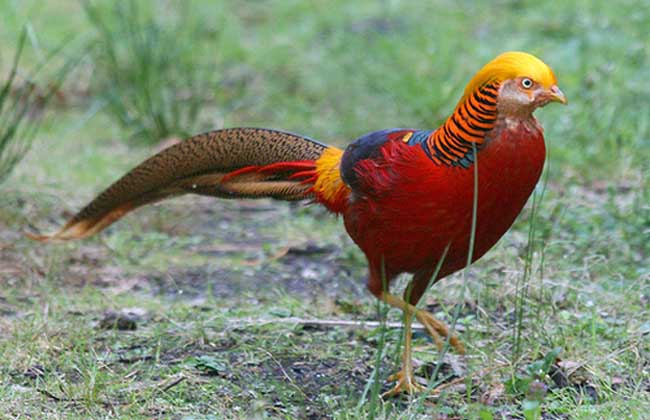
The Golden Pheasant (Chrysolophus pictus) was originally a world-renowned ornamental game bird, commonly known as the Golden Pheasant. Breeding has only begun to develop in recent years. Experts have proposed designating the Golden Pheasant as the national bird. At the launch ceremony of the "Chinese Birds" stamps held on March 3, 2008, Sun Yuehua, vice chairman of the Ornithological Society of China Zoological Society, revealed that as a rare and special bird species of China, the Golden Pheasant is expected to be elected as the national bird. "At present, more than 40 countries and regions around the world have determined their own national birds. As a major country in the world, China should determine its national bird as soon as possible." The breeding technology is introduced as follows:
Biological Characteristics
The distribution of the Golden Pheasant is limited to central and central-western China. Wild Golden Pheasants are forest-dwelling, living in evergreen broad-leaved forests or shrub and bamboo thickets at altitudes ranging from several hundred meters to 4000 m. Their diet is mainly plant-based, such as grass seeds, ferns, tender shoots of shrubs, flowers and berries. They are fond of eating wild cherries, sword ferns, raspberries, etc. During the breeding season, they like to eat insect larvae and sometimes also feed on crops. Usually they are active alone or in pairs. In winter, they often gather in groups of 10 to 20. Except for females that are incubating eggs and brooding chicks, Golden Pheasants perch in trees at night.
Breeding Cages and Housing
The form of the cages and housing can be determined according to specific circumstances. The more commonly used types are double-row and single-row cages and housing. Single-row cages and housing are suitable for small and medium-scale breeding, while double-row cages and housing are suitable for large-scale breeding. Regardless of the type, the width should be less than the length, and a length-to-width ratio of 5:1 or 4:1 is preferable. This form of housing gives the breeding Golden Pheasants a longer movement distance. For keeping one pair of Golden Pheasants or one male with several females, an area of 8 to 10 sq m and a height of 2 m are relatively suitable. Each housing unit consists of a roosting house and an exercise yard. The roosting house has an area of 1 to 2 sq m and is located at one end of the housing unit for the Golden Pheasants to roost at night and to shelter from wind and rain at ordinary times. The rest of the housing unit is the exercise yard, a place for the Golden Pheasants to feed and play.
Reproduction and Incubation
1. Reproduction: One-year-old Golden Pheasants already have courtship behavior and reproductive capacity. The breeding season is from April to July each year. When artificially breeding Golden Pheasants, the breeding male should be selected from individuals around 2 years old with bright plumage and frequent crowing; females can be mated and bred after 1 year of age, and individuals with normal development should be selected as breeding females. Generally, one male is matched with 2 to 3 females. During the breeding season, after laying 5 to 9 eggs per clutch, the Golden Pheasant builds its own nest and incubates. It can lay 1 to 2 clutches per year, and under good artificial feeding conditions it can lay more eggs.
2. Incubation: The incubation period of the Golden Pheasant is 22 to 24 days. Incubation can be done by domestic hens or with an electric incubator. Each domestic hen can incubate 15 to 20 eggs, not too many. Wipe the disinfected breeding eggs clean with a clean cloth, and then they can be placed for incubation. After being placed for incubation, check by candling once after 5 to 7 days and remove unfertilized eggs; the second candling is carried out at 14 days of incubation to remove eggs with dead embryos; when incubation reaches 21 to 22 days, the eggs can be given one warm water bath at 40°C. When the eggs are placed in water, those that sway from side to side are eggs with well-developed embryos, while dead embryos will not sway. When using an electric incubator for incubation, the temperature should be controlled at 38°C to 38.5°C, and the humidity should be maintained at 65% to 70%. Too high or too low temperature and humidity are both unfavorable for incubation.
Feeding and Management
1. Rearing of young Golden Pheasants: Fine sand or chopped short rice straw or stalks should be spread outside the brooding room. Before the young Golden Pheasants are moved into the brooding room, both the outside of the brooding room and the equipment must be disinfected. Spray the brooding room with 0.5% benzalkonium bromide solution, and soak and scrub the feeding utensils and equipment with 0.5% potassium permanganate solution. When multiple clutches of young Golden Pheasants are moved into the brooding room at the same time, the brooding room can be divided into several compartments with cardboard, with one clutch placed in each compartment. Young Golden Pheasants hatched by machine and those hatched by hens must not be mixed together, otherwise the foster hens can recognize chicks that they did not hatch themselves. Young Golden Pheasants hatched by an electric incubator or chicks collected in the wild need to be raised in artificial brooding boxes. Spread fine sand or short grass on the bottom of the box, and place a feed trough and a water trough. Install 1 to 2 thermometers on the wall of the box, and install a small piece of glass on the top as an observation window. When the chicks are 1 to 3 days old, the box temperature should be 32°C; at 4 to 7 days old, 30°C; at 8 to 12 days old, 28°C; at 13 to 20 days old, 25°C; after 20 days old, they can be raised under normal room temperature conditions. For the feed of young Golden Pheasants, use cooked egg yolk and breadworms in the first few days, feeding 5 to 6 times a day, with each feeding amount not too large. After 3 days old, add terramycin 5% to 10% glucose water solution as appropriate to prevent intestinal infections; after 7 days old, feed according to the ratio of 40% commercial chick feed, 25% cooked egg yolk, 25% breadworms, and 10% green feed; at 30 to 60 days old, prepare and feed according to the ratio of 50% commercial chick feed, 10% cooked egg yolk, 10% breadworms, 5% peanut powder and 5% soybean powder each, and 20% green feed; after 60 days old, feed as for growing chickens.
2. Feeding of Golden Pheasants during the growing stage: After 60 days of age, the plumage color of Golden Pheasants is similar to that of adult females, only slightly smaller in size. Their adaptability to climate change and resistance to disease are significantly enhanced compared with chicks. At this time, they should be transferred into cages and housing for rearing. The rearing density is preferably 2 to 3 birds per sq m of housing. Perches, water troughs and feed troughs can be appropriately added in the housing to ensure that every bird can eat and drink. The feed for young Golden Pheasants is mainly commercial chicken feed, with appropriate amounts of crushed peanut kernels, breadworms and green feed. When switching from chick feed to growing chicken feed, the amount of concentrated feed should be gradually reduced. One-year-old male Golden Pheasants can be completely fed with commercial chicken feed. One-year-old female Golden Pheasants already have reproductive capacity, and at this time it is best to raise males and females separately. The feathers of male birds at 90 days of age have already changed, and nuptial plumes have grown on the nape, making them very easy to distinguish from females.
3. Feeding and management of breeding Golden Pheasants: The feed for breeding birds is mainly commercial breeding chicken feed, but in the early breeding period and the breeding period, more oily feed and animal-based food should be given, such as peanuts, sunflower seeds, breadworms, locusts, etc., and special attention should be paid to providing sufficient green feed. During the breeding season, place nest boxes in the housing or set up artificial nests in the roosting house, check egg-laying every evening, and take out eggs promptly when found.