How to Build a Meat Duck Farming Greenhouse? Detailed Methods and Key Points
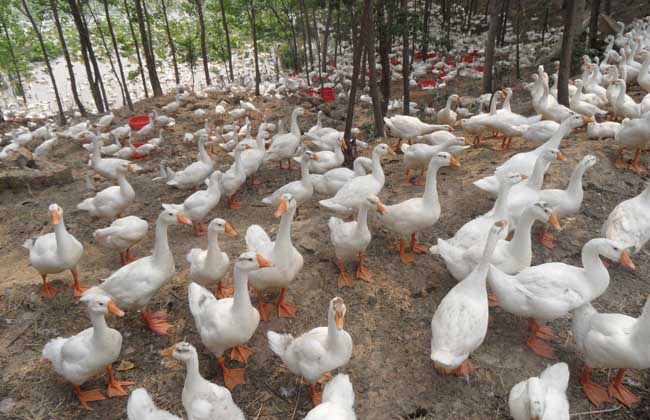
Greenhouse farming refers to covering open or semi-open livestock and poultry sheds with a layer of plastic film during cold seasons, making full use of solar energy and the heat emitted by the livestock and poultry themselves to raise the temperature inside the shed, reduce heat loss, lower maintenance requirements, and improve livestock and poultry production performance and poultry farming economic benefits. At present, many duck farmers use low-input, high-output plastic greenhouse sheds to raise ducks and have achieved good economic benefits. Let us take a look below at the construction methods for meat duck farming greenhouses!
Meat Duck Farming Greenhouse Construction
1. Shed specifications: Generally, a double-row type is used, with a width of 9.2 m. The length can be determined according to conditions, generally 30-50 m is suitable. The middle is a 1.2 m passage, and the eaves height is 2.0-2.2 m.
2. Ground construction: A certain slope is required (0.6-1.0%). It is best to use a cement or brick ground, with internal drainage ditches and external sewage collection ponds (biogas ponds).
3. Net bed construction: Install horizontal frames 40-50 cm above the ground (or lay plastic netting at 10-15 cm), with a row spacing of 2-3 m. Lay rectangular bamboo blocks or water bamboo strips on the horizontal frames. The length is a multiple of the horizontal frame row spacing. The bamboo blocks are 2-3 cm wide, and the spacing between bamboo blocks (water bamboo strips) is 5-10 cm. Lay plastic netting on the net bed. Generally, after brooding, the duck house is laid with plastic netting with a mesh size of 25×25 mm.
4. Roof construction: The roof uses small blue tiles or straw curtains + asbestos tiles.
5. Feeding trough setup: The water trough can be made by splitting a plastic water pipe with a diameter of 25 cm. Place it 5-10 cm in front of the net bed, install it against the wall, or use a plastic basin with a diameter of 40-50 cm with a cover to prevent sewage, and place it on the net bed. Feeding troughs generally use a "hopper" type trough, with a top opening 50-60 cm long and 30-40 cm wide. The bottom opening is 50-60 cm long and 10-20 cm wide. The base specifications are the same as the top opening, with a depth of 40-50 cm.
Notes on Greenhouse Construction
1. Site selection: Greenhouses used for large-scale duck farming should be built in places that are sheltered from the wind and face the sun, have good drainage, convenient transportation, are close to water sources, and are high and dry. To make full use of solar energy, the orientation should preferably be east-west.
2. Erection: The shed is arched, and the height should be above 2 m. The length and width depend on the farming scale. Use welded pipes with a diameter of 25 mm and a wall thickness of 1.35 mm, bent into a semicircular shape as supports. Every two pipes form one group, and sleeves with a diameter of 30 mm and a wall thickness of 1.5 mm are used to secure them. When building the shed, after installing the supports according to specification requirements, use wooden sticks or steel pipes to tightly fix the brackets on each support, then use bamboo poles and steel wire to secure the support netting for 3-5 rows, and set up 1 post every 2-4 m. After the shed frame is completed, first lay straw curtains on top, then cover the straw curtains with plastic film, and then cover the plastic film with 70%-80% sunshade netting. It is best to use cables to secure it tightly along the shed so it is easy to roll up, receive sunlight, and ventilate. It should be noted that movable doors must be installed at both ends of the greenhouse.
3. Shed frame: The shed frame used for farming meat ducks is made of bamboo or bamboo strips. Each is 2 m long and 0.5 m wide. Bamboo strips are divided into flat-laid and side-laid types, and can be fastened with small round steel bars. When making them, cut off sharp corners and smooth the joints to prevent injury to the ducks. During rearing, if plastic cushion netting can be laid on the shed frame to increase elasticity, the effect will be even better. The shed frame is raised 30-40 cm above the ground, and installation requires smooth and firm laying.
4. Operation: For raising meat ducks on shed frames, in winter on the sunny side from 9 a.m. to 4 p.m., 1/3 of the straw curtain can be rolled up to receive sunlight, keeping the temperature inside the shed within the suitable range of 18°C-20°C. In the morning and evening, the straw curtain should be covered well to achieve the goals of raising the shed temperature, saving fuel, and saving feed. On cloudy and snowy days, use straw curtains to cover the entire greenhouse tightly. Ordinarily, open and close the shed roof irregularly according to the temperature, humidity, and air pollution level inside the shed for ventilation. Because shed frames are laid inside the shed, it not only maintains a suitable growth temperature but also achieves off-ground rearing, significantly reducing the disease incidence of the duck flock. However, it should be noted that during greenhouse construction, it must be firm and durable. During farming, closely observe the temperature level and air turbidity, and adjust at any time by opening the shed roof and other methods. Never keep it sealed for a long time and suffocate the meat ducks.
Farming Greenhouse Construction Cost
1. Ground: The ground uses concrete ground (5 cm thick, 10 cm thick for the passage, requiring (8 m×40 m×0.05 m)+(1.2 m×40 m×0.1 m)=20.8 cubic m (concrete)). The labor wage for pouring the ground is 8 yuan/sq m. Cost: 20.8×375=7800 yuan. Allocated unit price 7800÷368+8 yuan/sq m=29.2 yuan/sq m.
2. Foundation: The foundation uses one layer of bluestone, requiring bluestone (9.2 m+40 m)×2÷0.8 m=123 loads. 123 loads×20 yuan/load=2460 yuan. Allocated unit price 2460 yuan÷368 sq m=6.7 yuan/sq m.
3. Brick columns: The spacing of brick columns is 4 m. Outer columns are 48×48, inner columns are 36×36, 18 of each. Required: (0.48×0.48×2.2×18)+(0.36×0.36×3.2×18)=16.59 cubic m (brick columns). Cost 16.59 cubic m×315.6 yuan/cubic m=5236 yuan. Allocated unit price 5236 yuan÷368 sq m=14.2 yuan/sq m.
4. Fence: The fence is 1 m high (net bed 60 cm, 40 cm above the net bed). Area 1×80=80 sq m. Cost 80 sq m×57.6 yuan/sq m=4608 yuan. Allocation 4608 yuan÷368 sq m=12.5 yuan/sq m.
5. Duck shed: Duck shed end wall area (9.2 m×2.2 m+9.2×1.2 m÷2)×2=51.52 sq m. Cost 51.52 sq m×57.6 yuan/sq m=2968 yuan. Allocation 2968 yuan÷368 sq m=8.1 yuan/sq m.
6. Net bed: 30 yuan/sq m (plastic netting 12 yuan/sq m, bamboo-wood frame or reinforced concrete frame 18 yuan/sq m).
7. Roof: Glazed tiles 80 yuan/sq m, small blue tiles 70 yuan/sq m, asbestos tiles plus straw curtains 40 yuan/sq m, double-layer color steel 140 yuan/sq m, single-layer color steel 100 yuan/sq m.
8. Manure treatment: Use sedimentation tank→biogas pond→oxidation pond→discharge to fish pond. For 10,000 ducks, build a sedimentation tank of 40 cubic m→biogas pond of 100 cubic m→oxidation pond of 60 cubic m.
Total: Farming greenhouse construction cost 68,000 yuan, feed room 50 sq m×340 yuan/sq m=17,000 yuan, water well 5,000 yuan.