Detailed Explanation of Key Points of Meat Duck Greenhouse Farming Technology
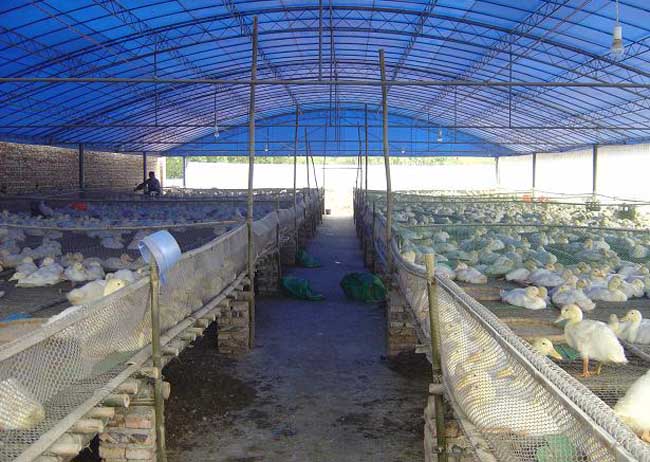
In the process of meat duck farming, if you want the meat ducks to eat less feed and grow more meat, you need to let the meat ducks grow within a suitable temperature range. Since the suitable growth temperature for meat ducks is generally between 12°C-24°C, within this temperature range feed can be utilized effectively. But in winter, especially in northern regions, it is very difficult to reach the growth temperature for meat ducks. What should be done? Actually, it is not difficult. You can use the greenhouse model to raise meat ducks. Below let us take a look at meat duck greenhouse farming technology!
Greenhouse Construction
1. Site selection and construction: Greenhouses used for large-scale duck farming should be built in a place that is sheltered from the wind and faces the sun, has good drainage, convenient transportation, is close to a water source, and has high and dry terrain. To make full use of solar energy, its orientation should preferably run east-west. The greenhouse is arched, and its height should be more than 2 m, with length and width depending on the farming scale. Use welded pipe with a diameter of 25 mm and a wall thickness of 1.35 mm, bent into a semicircular shape as supports, with every two pipes as one group, fastened with a sleeve pipe of 30 mm diameter and 1.5 mm wall thickness. When building the greenhouse, after installing the supports according to the specifications and requirements, use wooden sticks or steel pipes to tightly secure the brackets on each support, then use bamboo poles and steel wire to firmly net the supports in 3-5 rows, and set up 1 post every 2-4 m. After the greenhouse frame is completed, first lay straw curtains on top, then cover the straw curtains with plastic film, and then cover the plastic film with 70%-80% shade netting. It is best to fasten it firmly along the greenhouse with cables, so it is easy to roll up, receive sunlight, and ventilate. It should be noted that movable doors must be installed at both ends of the greenhouse.
2. Frame production and installation: The frames used for raising meat ducks are made of bamboo or bamboo strips, each 2 m long and 0.5 m wide. Bamboo strips are divided into two types: laid flat and laid edgewise, and can be fastened with small round steel bars. When making them, the edges and corners should be shaved off and the joints and forks smoothed to prevent injury to the ducks. During rearing, if plastic mat netting can be laid on the frames to increase elasticity, the effect will be even better. The frames should be raised 30-40 cm above the ground, and during installation they are required to be laid flat and firm.
3. Operation methods and precautions: For raising meat ducks on frames, in winter on the sunny side, from 9 a.m. to 4 p.m., 1/3 of the straw curtains can be rolled up to receive sunlight, keeping the temperature inside the greenhouse within the suitable range of 18°C-20°C. In the morning and evening, the straw curtains should be covered well to achieve the goals of raising the house temperature, saving fuel, and saving feed. On cloudy and snowy days, use straw curtains to cover the entire greenhouse tightly. Ordinarily, open and close the greenhouse roof irregularly according to the temperature, humidity, and air foulness inside the greenhouse for ventilation and air exchange. Because frames are laid inside the greenhouse, it not only maintains a suitable growth temperature but also achieves off-ground rearing, and the incidence of disease in the duck flock is significantly reduced. However, it should be noted that during greenhouse construction it must be firm and durable, and during farming the temperature level and air turbidity must be closely observed, and adjustments made at any time by opening the greenhouse roof and other methods. Absolutely avoid keeping it closed for a long time and suffocating the meat ducks.
Management Technology
1. Rearing preparation: According to the rearing plan, prepare the brooding room, rearing greenhouse (a broiler chicken greenhouse can also be modified by adding an exercise yard into a meat duck greenhouse), equipment, and tools. The brooding room (including walls, floor, tools, etc.) should be strictly and thoroughly disinfected. For the duck house space, add 30 ml of formalin to 15 g of potassium permanganate per cubic meter, seal and fumigate for 24 hours, then open doors and windows to release the gas. Check the heating and insulation and ventilation equipment to ensure normal operation. One day before the ducklings arrive, the brooding room should be heated, and at the same time check whether the temperature conditions required for brooding can be reached.
2. Brooding conditions: The brooding temperature on the first day is 30°C-32°C, then decrease by 1°C every three days, gradually removing the heat, so that the ducklings are evenly distributed and the temperature and humidity remain stable. For heating the duckling house, methods such as underground flues, wood shaving stoves, coal stoves, and infrared lamps can be used, but attention must be paid to good ventilation to prevent carbon monoxide poisoning and fires. At 1-3 days of age, round-the-clock lighting can be used; after 4 days of age, only turn on the lights in the morning and evening. For those with an exercise yard and water pool, the ducklings should also be trained and conditioned.
3. Drinking water and first feeding: For ducklings, the principle of “early drinking, early feeding, drinking first, feeding later” should be grasped. Within 24 hours after hatching, ducklings should drink 0.02% potassium permanganate water or 5% glucose water. About 1 hour after drinking, they can be fed. For the first feeding, generally crushed corn, crushed black beans, crushed brown rice, etc. can be used. Cook the above feed until half-cooked, then put it in clean water, soak it briefly, and scoop it out. The feed for the first feeding is required to be not raw, not hard, not hot, not mushy, and not sticky. Sprinkle it on an oilcloth or plastic sheet, and sprinkle it evenly, calling out while sprinkling to train them to eat. The second feeding can be switched to small duck complete pellet feed.
4. Scientific feeding: First feeding should be carried out after first drinking. When first feeding, put the feed on feed trays or burlap for free feeding. For bedding, choose dry, uncontaminated rice straw, rice husks, or burlap. Bedding should be replaced frequently to reduce harmful gases or filth.
① Feed selection: Complete pellet feed or concentrate (premix) can be used, or it can be mixed with corn, soybean cake, wheat bran, etc. in prescribed proportions into a self-mixed complete feed. Prevent imbalance of protein and energy. When self-mixing complete feed, add compound vitamins, trace elements, etc. reasonably and appropriately, pay attention to the appropriateness of the calcium-to-phosphorus ratio (2:1), and prevent nutritional and metabolic diseases such as rough feathers, unsteady walking, diarrhea, and feather pecking caused by unreasonable mixing. Because cage-raised meat ducks cannot get exercise and cannot be exposed to sunlight, they also need supplements such as vitamin AD, sodium selenite-vitamin E, and cod liver oil. In addition, changes in feed ratio and type should be made gradually.
② Feeding method: To improve feed returns, generally within 1 week of age feed 6 times a day and night. At each feeding, there should be no leftover feed in the tray, so that fresh feed is given each time. After 2 weeks of age, feed 5 times a day and night, and it is better that there is no leftover feed in the tray 1 hour before each feeding, so as to minimize feed waste.
③ Feeding principle: If the feed is finished in only 2-3 hours after being fed, then the feed amount should be appropriately increased. Otherwise, appropriately reduce the feed amount. Always maintain an appropriate feed withdrawal time to ensure the ducklings' feeding peak and promote the growth of the ducklings.
5. Daily management: Observe the activity of the duck flock frequently, adjust temperature, humidity, ventilation, and lighting in a timely manner, ensure sufficient clean drinking water, and feed high-quality feed as required, keep the duck house and environment clean and hygienic, and at the same time ensure the bedding is soft, not damp, and the feed is not caked. Epidemic prevention work should also be carried out in place. Dead and sick ducks should be subjected to harmless treatment such as deep burial to strictly prevent the spread of disease.
Disease Prevention and Control
First, start with improving the duck body's disease resistance and adopt comprehensive protective measures to avoid pathogens harming the ducklings' bodies. Workers must have a high sense of responsibility and strong awareness of epidemic prevention, strictly control the entry of people from outside the duck farm, and especially strictly prohibit duck farmers from visiting each other's duck houses. Implement single-variety production and ensure all-in, all-out. Do a good job in immunization vaccination. At present, the most serious diseases harming duck farming include highly pathogenic avian influenza, duckling viral hepatitis, duck plague, and serositis. The first three are viral diseases and must be controlled through preventive vaccination.
1. Reference immunization program for duckling diseases
① At 1 day of age, inject duck plague vaccine subcutaneously in the neck.
② At 5 days of age, inject duck infectious serositis and Escherichia coli bivalent vaccine intramuscularly.
③④ At 8 days of age, inject duck viral hepatitis freeze-dried vaccine subcutaneously.
④ The immunization time for duck avian influenza vaccine should be carried out according to the vaccine instructions, and strictly prevent the occurrence of avian influenza.
⑤ Before immunization against duck plague, duck infectious serositis, Escherichia coli, duck viral hepatitis, etc., carefully read the instructions and strictly prevent them according to the vaccine instructions.
2. Drug prevention
① The incidence and death of meat ducks mainly occur within 2 weeks of age. Poultry multivitamins can be added intermittently to drinking water within 1 week of age to enhance the resistance of the ducklings.
② At the same time, at 1-5 days of age, use 0.02% potassium permanganate solution as drinking water.
③ At 6-8 days of age, use quinolone drugs in drinking water.
④ At 9-13 days of age, switch to potassium permanganate.
⑤ At 14-16 days of age, switch to diaveridine.
Using drugs alternately for prevention in this way has both good results and low drug costs. Later, if the duck flock shows abnormal feces and other conditions, add antibiotics or quinolone drugs to the drinking water for prevention and control, so as to ensure the healthy and rapid growth of meat ducks, reduce the mortality rate, and improve duck farming benefits.
3. Regular disinfection
In addition to preventing and controlling common duck diseases, disinfection should also be done frequently. Duck houses, exercise yards, and water pools should be disinfected once every three days in summer and once a week in winter, and drinking water should be disinfected once every half month. Bedding and manure should be changed and removed frequently, and water troughs and feed troughs should be washed and disinfected frequently. In the event of an epidemic, disinfect every day.
4. Timely marketing
When meat ducks grow to about 45 days of age and reach a body weight of 2.5-3 kg, they should be sold in a timely manner to improve the economic benefits of duck farming.