Detailed Explanation of Key Points in Mallard Duck Farming Technology
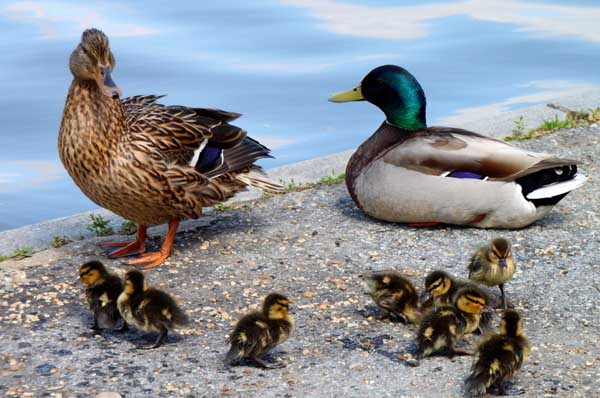
Mallard duck farming has four major characteristics: First, extremely strong disease resistance. Second, an extremely broad diet - rice, corn, barley and wheat, bran, oil cakes, fish meal, silkworm pupae, as well as green and coarse fodder and live animals are all highly favored. Third, extremely fast growth - meat-type mallard ducks can generally be raised to 70 days of age for market sale, reaching a body weight of 14 kg, 2 to 3 times larger than ordinary wild ducks. Fourth, extremely rich nutrition - low in fat, high in lean meat, tender meat, and rich in game flavor, making it a top-grade nourishing delicacy. Therefore, the prospects for mallard duck farming are very broad.
Farming Environment
The construction of wild duck housing must conform to the wild habits of wild ducks. Half should be a shed as a rest area, and half should be an open-air activity area; the activity area should be a pond or artificial pool. Some trees and grass can be planted in the activity area, and some algae cultivated in the pond. If a combined rearing and release method is adopted, the farm must be built beside rivers, lakes, and other places with open water and lush vegetation. At the same time, perimeter netting and overhead netting must be built. The overhead netting should be about 2 m above the water surface or ground, with perimeter netting added around it down to the bottom of the water, forming an enclosed body with the overhead netting to prevent wild ducks from flying away.
The mesh openings of the overhead netting and perimeter netting are 3×3 cm, and either nylon netting or rope netting can be used. Generally, the rearing area per 100 wild ducks: for 1 to 30 days of age, shed area 5 to 7 m. Exercise yard and water area 20 m each. For 70 days of age and above, shed area 15 to 20 m, exercise yard 20 m, water area 15 m.
Feed Selection
The nutritional requirements of mallard duck feed are basically the same as those of domestic ducks. Under normal circumstances, feeding special complete pellet feed for domestic ducks is sufficient; if mixing it yourself, the reference feed formula is as follows: for 1 to 30 days of age, corn 47.3%, wheat 15%, wheat bran 10%, soybean cake 22%, fish meal 4%, shell powder 1.5%, salt 0.2%; for 31 to 70 days of age, corn 40.8%, wheat 14.5%, rice bran 17.5%, rice 8%, soybean cake 14%, fish meal 4%, bone meal 1%, salt 0.2%.
Feeding Management
1. Feeding Management of Ducklings (1 to 30 Days of Age)
In raising ducklings, suitable temperatures must be mastered: 29 to 27°C for 1 to 3 days of age; 26 to 25°C for 4 to 6 days of age; 25 to 24°C for 7 to 10 days of age; 19 to 17°C after 10 days of age. Generally, brooding is done on flat ground, with soft rice straw spread on the ground and divided into small pens, each pen about 2 sq m, with one heat-preservation electric lamp installed in each pen, and 50 to 70 ducklings raised per small pen within 7 days. Because wild ducklings have the natural habit of sleeping in piles, someone must be on duty day and night, gently stirring and dispersing the piles by hand once every 1 hour to prevent them from piling up and being crushed or suffocated. Adjust the density after one week.
When starting to feed, provide water first and then feed, adding an appropriate amount of compound vitamin B preparation to the drinking water. Sufficient clean water must be provided for free drinking, and water must never be cut off. The number of feedings is generally 7 times per day within 10 days of age, and 4 to 5 times per day after 10 days of age. Each time, while feeding the compound feed, appropriately add tender grass, vegetable leaves, and other green fodder (chopped fine), as well as kelp essence powder and live animals such as small fish and shrimp, river snail meat, mussel meat, and earthworms, to benefit the growth of the ducklings.
2. Feeding Management of Adult Ducks (31 to 70 Days of Age)
To help adult ducks gain weight rapidly, compound feed may be supplied without limit throughout the rearing period, allowing them to feed freely, while also providing sufficient clean drinking water. After 50 days of age, due to increased body fat and physiological changes, adult ducks begin to learn to fly, so escape prevention must be strict; keepers should wear plain-colored clothing, and outsiders must be kept out of the housing to avoid disturbing the duck flock.
3. Feeding Management of Breeding Ducks (After 70 Days of Age)
Select and retain good male and female ducks at a ratio of 1:4 to 6. For males, choose those with a robust physique, lively movement, and quick reactions for breeding; for females, choose those with a small head, long neck, large eyes, broad back, and broad chest for breeding. The feed can be complete feed for laying ducks or breeding ducks, with 6% to 8% kelp essence powder added to the feed. During the peak laying period, the number of feedings should be increased to help achieve high and stable production. Throughout the laying period, some shallow nests can be made artificially on the ground, padded with some soft rice straw, to facilitate egg laying by the female ducks.