Before raising laying ducks, first learn about the common laying duck breeds
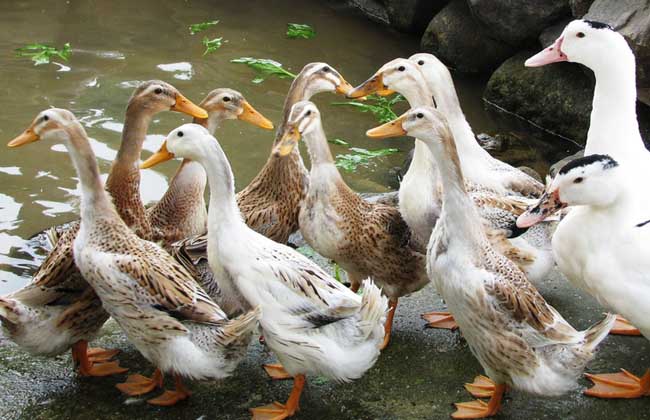
A female duck is called a laying duck from the time she starts laying until she is culled. Generally, the useful life of an egg-type female duck is about 350 days, which is called the first laying year. Some are kept for a second or third year after molting and resting, but their production performance declines year by year, so they are not suitable for retention. Common laying duck breeds include: Jinding duck, Shaoxing duck and Gaoyou duck.
Jinding Duck
The Jinding duck is a laying duck breed and a traditional fine poultry breed in Fujian. This excellent egg-type duck, raised mainly for egg production, originates chiefly from Zini Township in Dinghai County. The township has a village named Jinding, where ducks have been raised for more than 200 years, and the Jinding duck gets its name from this. The Jinding duck is a type of shelduck, also known as the mallard and the South China duck.
1. Appearance characteristics: The male duck has glossy feathers on the head and neck, a brown back, a reddish-brown chest, a grayish-white belly, blackish-brown main tail feathers, and black sexual feathers that tilt slightly upward; the bill is yellow-green, the neck and webbed feet are orange-yellow, and the claws are black. The female duck is covered with reddish-brown sparrow feathers, with black spots of varying sizes; the back feathers gradually darken from front to back, the belly feathers are lighter, the neck feathers have no spots, the wing feathers are dark brown with speculum feathers; the bill is bluish-black, and the shanks and webbed feet are orange-yellow with black claws.
2. Production performance: Adult male ducks weigh 1.76 kg, and females 1.78 kg. Female ducks begin laying at 110-120 days of age, producing 280 eggs per year, and can produce 300 eggs per year under housed conditions, with an egg weight of 72 grams. The eggshells are mainly blue, accounting for more than about 95%. The male-to-female ratio is 1:25, the fertilization rate is 90%, and the hatchability rate is 85%-92%. The brooding survival rate is 98%, the growing survival rate is 99%, the birth weight is 45.5 grams, and the body weight at 28 days of age during the brooding period is 0.7 kg. The feed conversion ratio during the duckling stage is 1.9:1, and the feed-to-egg ratio during the laying period (counted from a 5% laying rate) is 3.4:1.
3. Characteristics: The Jinding duck has the characteristics of high egg production, large eggs, blue eggshells, strong foraging ability, high feed conversion rate, and heat tolerance and cold resistance. The Jinding duck is intelligent in temperament, strong in build, agile in movement, and strong in foraging ability. Its uropygial gland is relatively well developed, and its feathers are highly water-resistant. It is suitable for grazing on beaches and in rivers, ponds, rice fields and plains, and can also be raised indoors. When the Jinding duck is crossed with other duck breeds for commercial production, the resulting market ducks not only have strong vitality and a high survival rate, but also higher egg production, meat production and feed returns.
Shaoxing Duck
The Shaoxing duck, abbreviated as Shao duck and also known as the Shaoxing shelduck, is an excellent small egg-type shelduck breed in China. Through long-term purification and rejuvenation and pure-line breeding, two strains have been formed: the white-wing-tip (WH) strain and the red-feather green-wing-tip (RE) strain. At present, it is raised in many regions across the country. The Shao duck has the characteristics of high egg production, high feed utilization rate, good crossbreeding results and strong adaptability to various environments.
1. Appearance characteristics
The female duck of the WH strain is mainly light brown sparrow feathers all over, with a white feather ring 2-6 cm wide in the middle of the neck; the tips of the main wing feathers and the feathers on the belly and rump are white; the bill, shanks and webbed feet are orange-yellow, the iris is grayish-blue, and the skin is yellow. The male duck's feathers are mainly light chestnut, with the upper head and neck and the tail sexual feathers all dark green and glossy, and a small number of speculum feathers; the rest is the same as the female duck. The down of the duckling is light yellow, and the hatching weight is 40 grams.
The female duck of the RE strain is mainly brown with freckled feathers all over, with a brownish-yellow chest and belly, dark green and glossy speculum feathers, a grayish-yellow bill, black bean-shaped markings on the bill, ocher iris, light yellow skin, and orange-yellow webbed feet. The male duck's feathers are mostly chestnut, with a yellow bill tinged with blue, and the upper head and neck, speculum feathers and tail feathers are all dark green and glossy. The duckling's down is fine and soft, dark yellow, with a black head spot, black line along the back, and black tail. The hatching weight is 42 grams.
2. Production performance
For the WH strain, the age at first egg is 97 days, the age at the start of laying is 132 days, the age at reaching a 90% laying rate is 178 days, the 90% or higher laying rate is maintained for 215 days, the egg production at 500 days of age is 291.5 eggs, the total egg weight is 21.07 kg, the egg weight is 69 kg, the feed-to-egg ratio during the laying period is 2.6:1, and the survival rate during the laying period is 97%.
For the RE strain, the age at first egg is 104 days, the age at the start of laying is 134 days, the age at reaching a 90% laying rate is 197 days, the 90% or higher laying rate is maintained for 180 days, the egg production at 500 days of age is 305 eggs, the total egg weight is 20.36 kg, the egg weight is 72 kg, the feed-to-egg ratio during the laying period is 2.64:1, and the survival rate during the laying period is 92%.
There is no significant difference in reproductive performance between the WH strain and the RE strain. The male-to-female ratio is 1:15-25, the fertilization rate is 90%, the hatchability rate of fertilized eggs is 85%, and the survival rate from hatching to 4 weeks of age is 95%. Ducklings are sexed immediately after hatching and separated into male and female groups. Male ducks at 60-70 days of age weigh about 1,000-1,200 grams and are supplied to the market as table ducks, with a half-eviscerated dressing percentage of 83%.
Gaoyou Duck
The Gaoyou duck, also known as the Gaoyou shelduck, originated in Gaoyou, Jiangsu Province, and is a famous large dual-purpose meat-and-egg shelduck breed in China. The Gaoyou duck is a fine breed in the Jianghuai region of China and is one of the three famous ducks nationwide. This duck is good at diving, tolerant of coarse feed, highly adaptable, has large eggs and good egg quality, and is long renowned for being good at producing double-yolked eggs. Gaoyou duck eggs are a delicacy for eating, with excellent taste; their texture has the characteristics of being fresh, fine, red, oily, tender and sandy, with the egg white congealing like jade and the yolk red like cinnabar.
1. Appearance characteristics: The female Gaoyou duck has brown feathers all over, with small black spots, like sparrow feathers; the main wing feathers are blue-black; the bill bean is black; the iris is dark brown; the shanks and webbed feet are grayish-brown, and the claws are black. The male duck is larger in build, with a broad back, wide shoulders, a deep chest and a long body, appearing rectangular. The upper half of the head and neck feathers is dark peacock green, the back, waist and chest are brown partridge feathers, the rump is black, and the belly is white. The bill is bluish-green, the toes and webbed feet are orange-red, and the claws are black.
2. Production performance: Adult male ducks weigh 3-4 kg, and females 2.5-3 kg. Ducklings raised by grazing reach 2.5 kg at 2 months of age. Female ducks begin laying at 180-210 days of age, producing about 169 eggs per year, with an egg weight of 70-80 grams, and the eggshells are white or blue-green. Under grazing conditions, the body weight generally reaches 1.5 kg by 70 days of age. With compound feed, the average body weight reaches 1.78 kg by 50 days of age. The Gaoyou duck is tolerant of coarse and mixed feed, has a strong foraging ability, is suitable for grazing and raising, and grows and develops quickly, fattens easily, and has good meat quality.