What are the factors affecting egg production in laying ducks?
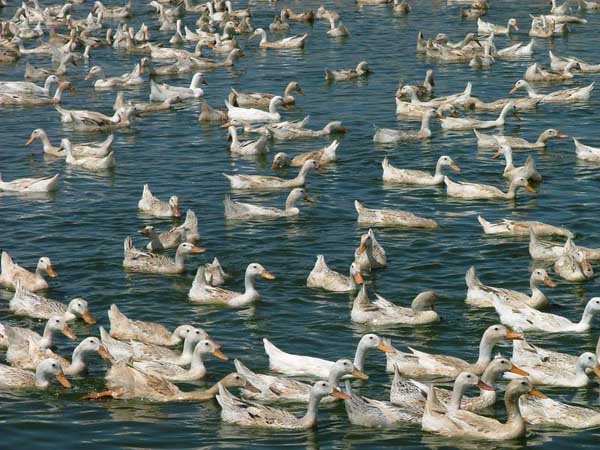
From sexual maturity onward, male and female ducks enter a new stage in which the male duck must mate and breed and the female duck must lay eggs and reproduce. The growth and development of all body parts have essentially finished, and all their activities revolve around the center of "reproduction." All feeding and management work must also serve this center, doing everything possible to create an environment and conditions capable of continuous, high and stable production, so as to obtain high-quality breeding eggs.
Breed factors
Breed is the prerequisite for achieving high production. The level of the laying rate, the length of the laying cycle, the strength of laying persistence and the size of the eggs are all closely related to the breed. If a good breed can be selected for raising, egg production can be increased by several tenths or even several times, and economic returns will rise accordingly. How to choose, based on one's own raising conditions and management skills, a high-yielding breed suitable for local raising is the key factor determining the success or failure of the operation.
Nutritional factors
After entering the laying period, laying ducks have a higher demand for nutrients than at any previous stage. In addition to the nutrients necessary for maintaining life activities, they also need large amounts of various nutrients essential for egg production. Nutrients such as energy, protein and calcium must be supplied in sufficient amounts. Otherwise, the laying rate will be affected.
To reach a level of continuous high production, besides breed being an innate factor, whether the nutrients in the diet are comprehensive and balanced and whether the amounts can meet the needs are the necessary conditions for maintaining high and stable production.
Environmental factors
Environmental factors are relatively complex, and the factors with the greatest influence on egg production are light and temperature.
1. Light
For laying ducks, the length of the light period is also closely related to egg production. The main role of light is to promote the maturation and ovulation of follicles. Therefore, during the rearing period, the light period is controlled in order to prevent young ducks from becoming too precocious; when they are about to enter the laying period, the light period should be gradually increased and the light intensity raised, in order to promote ovarian development and achieve timely onset of laying; after entering the peak laying period, the lighting regimen (light period and light intensity) should be kept stable, in order to maintain continuous high production. The light intensity during the laying period should preferably be 5-8 lux. If the bulb is 2 m above the ground, generally calculate 1.3-1.5 watts per sq m of duck house; a duck house of about 18 sq m is fitted with one 25 w bulb. In actual use, bulbs above 60 w are usually not used, because large bulbs distribute light unevenly and waste electricity. Fluorescent lamps are greatly affected by temperature and are generally not used either. Bulbs must be fitted with shades so that the light shines on the ducks' bodies rather than on the ceiling. Duck houses are dusty, so bulbs should be wiped frequently to keep them clean, lest dust cover them and affect brightness.
The effect of light generally requires 7-10 days to become apparent, so during the laying period, the light hours must not be suddenly increased or the light intensity suddenly raised just because an immediate effect is not achieved. Generally, each increase should not exceed 1 hour, and after the increase it should be kept stable for 5-7 days.
The principle of lighting after entering the laying period is: it should only be gradually extended until reaching 16-17 hours of light per day and night; it must not be switched on and off unpredictably, nor start early or late unpredictably; the light intensity must not be sometimes strong and sometimes weak, and may only gradually increase. Otherwise, the physiological functions of the laying ducks will be disturbed and the laying rate will be affected.
A reasonable lighting regimen can enable young ducks to begin laying at the right time and enable laying ducks to increase egg production; an unreasonable lighting regimen will advance or delay the sexual maturity of young ducks, reduce or stop the egg production of laying ducks, and even cause molting.
2. Temperature
The most suitable temperature for laying ducks is 13-20°C, at which both the laying rate and feed utilization are in the optimal state. Therefore, conditions should be created as far as possible, and in particular, wind protection and insulation work in winter should be done well, to provide an ideal ambient temperature for laying and obtain the highest laying rate.
Health factors
Without a healthy body, high production is impossible. Therefore, during the stage of rearing young ducks, prevention of the main infectious diseases must be done well. After entering the laying period, do a good job of environmental sanitation and feeding management, increase disease resistance, and reduce the occurrence of disease as much as possible, so as to maintain high and stable production.