Detailed Explanation of Key Technical Points and Field Management Methods for Raising Ducks in Rice Paddies
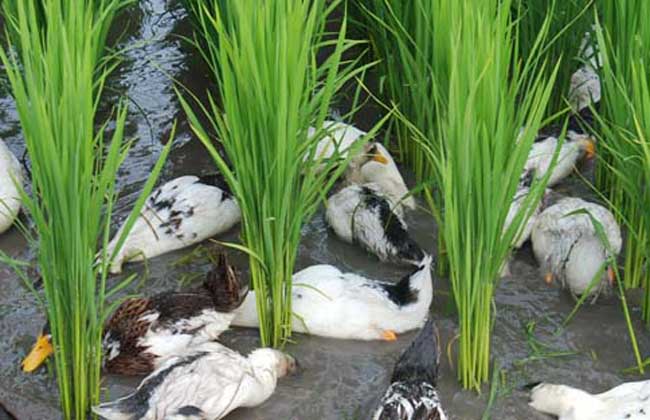
Raising ducks in rice paddies is a key technology for organic rice production, a comprehensive and environmentally friendly ecological agriculture technique, and a supporting technology that combines planting with breeding. In the rice paddy, without chemical fertilizers or pesticides, the ducks' strong omnivorous nature and continuous activity are used to eat weeds and pests in the paddy, massage and loosen the soil, and produce a muddy-water fertilizing effect, yielding purely pollution-free rice.
Site Setup
Taking 1 mu (634 sq m of rice area, 33 sq m of duck house and activity area) as an example, first use plastic mesh panels to enclose the 1-mu area into a mesh wall 80-100 cm high, with mesh openings small enough that ducks over 10 days old cannot squeeze through. Then mark off a 33 sq m open space at any corner of the rice paddy, and enclose it on all four sides with the same mesh panels, leaving only a 50 cm wide small gate facing the center of the main field. The open area should be able to form an independent enclosure, and its overall height should be no less than the field ridge. After the site is leveled and enclosed, take 12 sq m of it to build a simple duck house, ensuring it is windproof and rainproof and prevents rats and other animals from getting in; the other 21 sq m is used as the ducks' activity area.
Variety Selection
Select small- and medium-sized fine duck breeds with strong vitality, adaptability and stress resistance, such as Binhu Ma duck (Binhu partridge duck) and Jianchang duck, to suit the characteristics of rice cultivation so that the ducks can move freely through the paddy. If conditions permit, hybrids of wild ducks and domestic ducks may be selected. At the same time, disease prevention and control must be done well. Before the ducklings start feeding, they should be injected with duck viral hepatitis oil emulsion vaccine, and before release they should also be given a subcutaneous injection of duck plague vaccine, thereby improving disease resistance and increasing the survival rate of the ducklings.
Rice-Duck Co-cultivation
1. Rice cultivation: For single-season rice, seedlings can be raised in early May and transplanted in early June. Before transplanting to the main field, apply a base fertilizer of 2000 kg of decomposed organic fertilizer and 12-18 kg of ternary compound fertilizer per mu. During the entire growth period of the rice, there is no need to apply pesticides for pest control or herbicides for weed control; only on the fifth day after transplanting, apply 7.5 kg of urea per mu as a top dressing once. At ordinary times, always maintain a water layer of 3-6 cm (except for 7 days before harvest), and it is best not to let the mud show. Some snails and plenty of duckweed and other fast-reproducing aquatic animals and plants should be released in the main field so that the ducks have an adequate feed source.
2. Duck rearing: Two days before rice transplanting, at a rate of 50 ducks per mu, buy ducklings and first place them in the open enclosure at the corner of the field and raise them carefully for 10 days. On the seventh day after rice transplanting, drive the ducks into the field and let them freely forage for weeds and pests in the paddy. Supplement feeding in a timely manner according to how much feed the ducks need. Generally, when supplement feeding, first drive the ducks into the enclosure, with the time arranged from 3 to 5 p.m.; alternatively, grain-type feed can be scattered directly over a certain area of the main field so that while foraging, the ducks also loosen the soil and promote rice growth. After the ducks officially go into the field every day to be co-cultivated with the rice, they should be released into the main field before 8 a.m. every morning, and at around 5:30 p.m. driven back into the enclosure to move about, and promptly allowed into the house to rest.
3. Crop rotation arrangement: Light and small-sized meat ducks can reach market standard after 2 months of rearing. Generally, at least 2 batches can be raised in single-season rice paddies, while in double-season rice paddies at least about 3 batches can be raised. In the succession process, all-in and all-out must be practiced. Empty houses must also be strictly disinfected so as to achieve better returns.
Note: During the heading stage of rice, the ducks should be moved to the open enclosure for rearing to prevent the ducks' bills from pecking at the tender heads and causing reduced rice yield. At the same time, it is more suitable for promotion and use over a relatively large area, and it is convenient to build houses and live beside the fields, with specially assigned personnel to grow rice and raise ducks, preventing human-caused loss of ducks.