Detailed Explanation of Key Points for Spot-billed Duck Farming Techniques
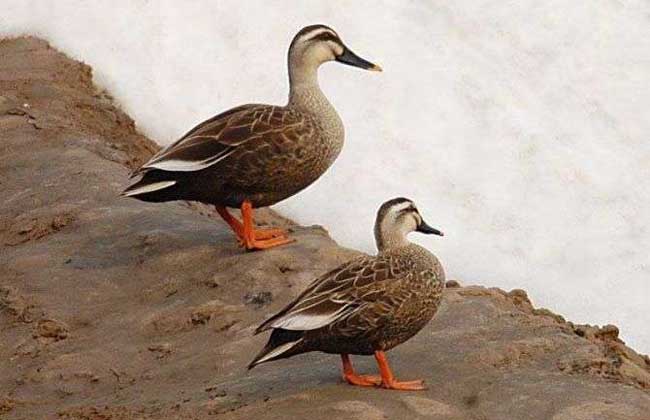
The spot-billed duck is similar in size to the mallard, weighing 890-1340 grams, with a body length of 560-632 mm. Males and females have similar plumage colors, with body feathers mostly dark brown; there is a distinct pale white-yellow eyebrow patch on the side of the head; the bill is black with a yellow tip, which distinguishes it from other wild ducks; the cheeks, chin, throat and front neck are all white; the wing speculum is metallic blue-green with a shimmer of grayish-purple.
Preparation Conditions
Incubation room, incubator, brooding room (2 sq m with small mesh netting), adult duck house (composed of duck shed, exercise yard and swimming pool), breeding duck house.
Incubation Details
1. Selection of breeding eggs: Carefully select, free of cracks, free of spoilage, free of off odors, with thick shells, and place them with the large end up on the incubation egg rack.
2. Disinfection of breeding eggs: Directly spray a 1000-fold potassium permanganate solution onto the breeding eggs, then place them into the incubator and close the door.
3. Incubation period management: Total incubation is 28 days, temperature set between 37.20-37.80°C, humidity between 42-65%, ensure good ventilation.
4. Cooling eggs: Every morning from 5 to 7 o'clock and evening from 17 to 19 o'clock, twice a day for two hours each time. The purpose of cooling eggs is to dissipate heat and breathe fresh air.
5. Turning eggs: From the first day onward, turn the eggs once every two hours.
6. Candling: A total of 5 times is needed. On the 7th day of candling, a black round dot can be seen, called "rising pearl." On the 13th day, blood vessels can be seen. On the 18th day, the head can be seen with swallowing movements. On the 21st day, it is completely dark with no bright area visible, called "closing the door," with a slanted opening.
7. Hatching: On the 26th day, the duckling is fully formed and the bill begins to peck at the shell. After the 28th day, the eggs must be transferred to the hatching machine, with temperature controlled at 38°C. To make it easier for the ducks to hatch, spray a layer of water on them to soften the eggshells. After two more days, the ducklings will fully hatch. After hatching, place the ducklings in bamboo baskets lined with straw. Before transferring to the brooding room, be sure to wet their feet, letting only the ducklings' feet touch the water without wetting the feathers. This helps the ducklings adapt to the living environment as quickly as possible, and then they can be transferred to the brooding room.
Newly hatched ducklings within 24 hours can go without drinking water or eating feed without affecting the survival rate. For long-distance transport, it is best to deliver within 24 hours, with the vehicle temperature at 25-30°C.
Brooding
Brooding requires 15 days, with the first 7 days being the most important.
1. Preparation before introducing ducklings: First spray the entire brooding room with a 1:1000 potassium permanganate solution, also spray the straw that will be used, dry it in the sun, then spread it in each pen at a thickness of about 5 cm, and then introduce the ducklings, with about 25-30 per sq m being appropriate.
2. First feeding: Fill water troughs with water and place them in the brooding pen. After the ducklings drink water, wait three hours before feeding. Place the feed on plastic sheeting to let the ducks forage freely. Use this plastic sheeting method for three days, then use feed troughs to feed the ducklings after three days.
3. Formal brooding: Feed water 6 times a day, once every 2 hours. After drinking water, feed them. Between 3-7 days of age, feed the ducklings compound feed. After feeding for 30 minutes, when the ducklings stop eating, remove the feed trough. Just like drinking water, also 6 times a day, all fed during the daytime. Each feeding amount is 2% of the duckling's body weight. (Difficult to master) For 60 ducklings, about 1-2 liang of feed.
4. Vaccination: Within two to three days of birth, ducklings must be injected with duck hepatitis vaccine, injected from the back of the duckling's neck. Dosage: 0.2 milliliters (ML) per duckling. Around the 15th day, inject avian influenza vaccine, injected from the inner side of the duckling's thigh, with 0.2 milliliters ML per duckling as the standard.
5. Temperature control: When the temperature is between 25-30°C, no treatment is needed. When the temperature is between 22-25°C, cover the upper half of the pen with plastic film. When the temperature is between 20-22°C, completely cover the top of the pen with plastic film. When the temperature is below 20°C, use a charcoal stove to raise the temperature, with 25°C as the threshold. When the temperature is above 30°C, open the outer film of the greenhouse, and cover it again when it drops below 25°C.
6. Test swimming: Ducklings at 3 days of age need to test swimming. Only let the ducklings enter the water when the temperature is above 25°C, preferably at noon on a sunny day. The time in the water should not be too long; after about one hour, drive them back ashore. After they are ashore and their feathers are dry, drive them into the water again, two or three times a day. After three days, the ducklings' feathers will no longer get wet.
7. Cleaning and hygiene: Clean every corner of the pen every day. Disinfect once every three days by mixing glutaraldehyde and benzalkonium chloride emulsion with water to make a 1500-fold dilute solution for disinfection. Wash feeding utensils every two days and disinfect with 1000-fold potassium permanganate.
8. Duckling cold: Symptoms include runny nose, listlessness, refusal to eat, weakness and inability to move, always lying on the ground, and whitish edges of the tongue. Penicillin and streptomycin can be used for intramuscular injection, with the injection site on the inner side of the duck's thigh, dosage of 0.15 ml, once a day, for three consecutive days to cure.
Commercial Ducks (Young Wild Ducks)
From 15 to 60 days of age, they are commercial ducks, raised entirely in a free-range form, with a density of 6-8 per sq m in the pen. The ducklings can be outside all day, managed in groups of 300, and driven back into the shed to rest at night.
1. Disinfection: Disinfect the pen once every three days by mixing glutaraldehyde and benzalkonium chloride emulsion with water to make a 2000-fold dilute solution and spraying it directly on every corner of the pen.
2. Feeding: After 15 days, free-range for more than 8 hours a day. If there is sufficient food outside, feed three times a day. Place the feed on plastic sheeting to let the ducks forage freely, feeding once every 4 hours, feeding for 30 minutes each time, with the feeding amount at about 1.5% of each duck's body weight.
Later-Stage Feeding of Commercial Ducks
From 60 days of age to the stage of leaving the pen, mainly feed green fodder and paddy rice. Green fodder is fed twice a day, with the weight of green fodder at about 3% of each individual's body weight. (Taking 1000 ducks weighing 2 jin each as an example, 60 jin needs to be fed.) Feeding times are 7-8 o'clock and 17-18 o'clock each day. Paddy rice is fed once a day at 16 o'clock in the afternoon, with the feeding amount at 2% of each individual's body weight as the standard. (Taking 1000 ducks weighing 2 jin each as an example, 40 jin needs to be fed.) 120*60=7200 jin 2400 jin.
1. Cleaning and hygiene: Clean every day, cleaning the pen and exercise yard, and removing all feces.
2. Disinfection: Both the pen and exercise yard must be disinfected once every three days by directly spraying 1000-fold potassium permanganate solution.
3. Exercise: Drive them multiple times to increase the ducks' activity level and maintain the wild flavor.
4. Leaving the pen: They can be sold at 120 days of age.
Breeding Duck Management
At 300-360 days of age, they reach sexual maturity. Keep breeding stock at a female-to-male ratio of 4:1. The laying period is from April to June each year. The other non-laying time is called the rest period. During the rest period, full-price feed and ryegrass are sufficient. Choose compound feed with a calcium-to-phosphorus ratio of 2:1, fed twice a day at 7 o'clock in the morning and 13 o'clock at noon, with each feeding amount at 4% of the total duck weight as the standard. Ryegrass is fed once a day at 17 o'clock in the afternoon. During the laying period, add protein to the feed, with 200 grams added per 1000 grams as the standard.