Key Technical Points for Feeding and Management of Meat Ducklings During the Brooding Period
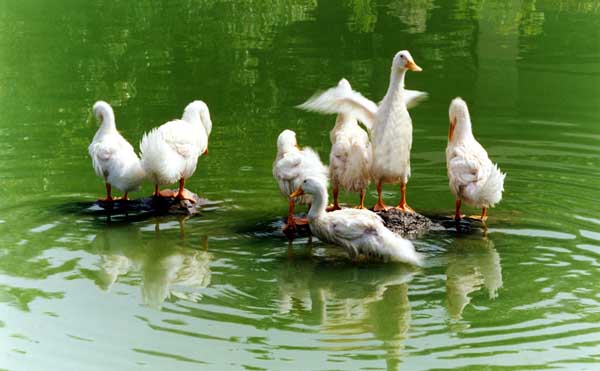
Meat-type ducklings grow especially rapidly and have high requirements for feeding and management. They are also very sensitive to their environment and rather delicate, so even a slight lapse in care can cause stunted growth and may even lead to increased mortality. Therefore, scientific feeding and management are needed, mainly carried out from the following aspects:
Selection of Ducklings
Commercial meat-type ducklings must come from excellent healthy mother duck flocks. The breeder ducks should have been vaccinated against duck plague, fowl cholera, viral hepatitis and other vaccines before laying, to ensure that the ducklings do not develop disease during the brooding period. The selected ducklings should be basically uniform in size, with a body weight of 55-60 grams, lively, with no large navel, no crooked head or lame legs, and with waxy yellow down color; those too dark or too pale are all culled.
Grouping
An overly large duckling flock is not conducive to management, environmental conditions are hard to control, and startling of the flock or deaths from crushing easily occur. Therefore, to improve the brooding rate, grouping management is carried out, with 300-500 ducklings per group.
Drinking Water
Water is crucial to the growth and development of ducklings. Before starting to feed, ducklings must drink water; this drinking is also called "opening water" or "flushing water." Adding an appropriate amount of vitamin C, glucose and antibiotics to the ducklings' drinking water will give better results, both increasing nutrition and improving the ducklings' disease resistance. The number of drinkers provided must be sufficient, water must not be cut off, and water must also be prevented from spilling out.
First Feeding
The first feeding is carried out 12-24 hours after the ducklings hatch, or when 1/3 of the ducklings in the flock begin to look for food. For raising meat-type ducklings, using a complete small-pellet feed gives better results. If such conditions are not available, half-cooked rice mixed with egg yolk can also be used for feeding, and after a few days switch to a nutrient-rich complete feed.
Feeding Methods
Ducklings in the first week of age should be allowed to feed freely, keeping feed often present in the feed tray. Do not feed too much at one time, to prevent feed left uneaten for a long time from becoming contaminated and causing illness in the ducklings or wasting feed. Therefore, feed little but often. In the first week, feed 35 grams per duck; in the second week, 105 grams; in the third week, 165 grams.
Strict Attention to Disease Prevention
Meat ducks raised intensively on wire netting are in large and concentrated flocks, so epidemics easily occur. Therefore, in addition to strengthening daily feeding and management, epidemic prevention work must be done especially well. At about 20 days of age, each duck is given an intramuscular injection of 1 milliliter of attenuated duck plague vaccine; at about 30 days of age, each duck is given an intramuscular injection of 2 milliliters of fowl cholera vaccine. Ordinarily, drinking water with 0.01%-0.02% potassium permanganate can also be used, and the effect is very good.