Detailed Explanation of Key Points of High-Density Dry-Rearing Technology for Meat Ducks
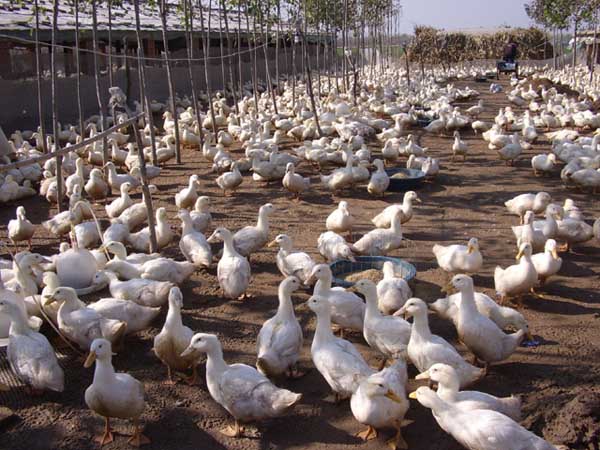
The new intensive dry-rearing technology for meat ducks is a practical breeding technique provided for water-scarce areas. The entire rearing process requires no water for the ducks to enter. By adopting new rearing methods such as complete confinement, killing feed and lighting, it can avoid parasites and infectious diseases while saving labor and feed, and it is easy to manage.
Duck House Construction
Choose a site with good soil permeability, a slope of 5-10 degrees, facing the sun and sheltered from the wind; the site should be level to prevent water accumulation.
Duckling Selection
At present, the main breeds include Shanghai White Duck, Beijing Duck (Peking Duck), Cherry Valley Duck, and Gaoyou Duck. These meat-type ducks are docile in temperament, highly adaptable, and good at fattening, making them very suitable for intensive group feeding in confinement.
Feeding Formula
Feed formula for ducklings (1-25): corn 50%, rapeseed cake 20%, broken rice 10%, wheat bran 10%, fish meal 7.5%, bone meal 1%, salt 0.5%. For mid-stage ducks (26-45 days of age): corn 50%, rapeseed cake 5%, broken rice 10%, wheat 17%, wheat bran 12%, fish meal 4.5%, shell powder 2%, bone meal 1%, salt 0.5%; in the later stage, remove the soybean, reduce rice bran by 5%, and increase corn by 10%.
Feeding Methods
When ducklings hatch, water should be provided promptly within 24 hours. The method is to place a piece of plastic film on the ground and sprinkle some boiled water or a 1-in-10,000 oxytetracycline aqueous solution, allowing the ducklings to drink freely. At the same time, mix the previously prepared feed with water until moist and scatter it on the plastic film for them to eat freely. Start by scattering a small amount, scattering while calling them to eat, and guide the ducks to finish eating within a short time. After 4 days of age, give less feed but add it frequently, encouraging the ducks to eat freely day and night, while drinking water must be clean and sufficient. The mid-duck stage is the period of fastest weight gain, so feed must be given at fixed times, letting them eat their fill and eat well, and increasing the amount of exercise to make them develop robustly. The fattening period mainly involves increasing the ducks' food intake. Artificial force-feeding is best: mix the compound drink [feed] with suitable warm boiled water until it is moderately soft and firm, then roll it by hand into particles the size of a finger and force-feed manually, 3-4 times a day. Each feeding amount depends on the duck's digestive capacity, and it is best to feed them until full, while reducing the amount of exercise.
Duck House Temperature
For 1-3 days of age, the house temperature is 30-31°C; for 4-7 days of age, 28-80°C; for 8-17 days of age, 25-28°C; and above 15 days of age, maintain 20-25°C.
Duck House Environment
The air should be fresh, the feed trough and drinking trough should be kept clean, the feed should be kept fresh, and the drinking water should be clean. During the duckling stage, the bedding straw must be changed and added frequently. Provide supplementary lighting at night. Stock 35-40 ducklings per square meter, and 10-15 adult ducks.