Detailed Explanation of Key Points for Efficient Meat Duck Farming in Winter
Select Suitable Breeds
Breeds suitable for winter rearing include Cherry Valley duck, Khaki Campbell duck, Beijing duck, Gaoyou duck, Cherry Valley duck, and Shanghai white duck.
Nursing of Ducklings
Strong ducklings should be selected for winter rearing. The standards for strong ducklings are: large and spirited eyes, lively temperament, well-proportioned body, clean and glossy down, soft and elastic abdomen, down covering the navel with well-healed umbilical area, thick legs, large bill, strong struggling when held, loud and crisp calls, warm feet when touched by hand, strong contraction when the cloaca is opened, cloaca clean and slightly moist. After hatching, keep the room temperature at 27-30°C for 7 days; after 7 days, reduce by 1-2°C per day; after 15 days, maintain at about 15°C; after 20 days, rear at normal temperature. Use commercial complete pellet feed for ducklings as much as possible. Reference formula for self-mixed feed: corn 45%, broken rice 10%, wheat 5%, wheat bran 5%, roasted soybeans 17%, rapeseed cake 7%, silkworm pupae 7%, shell powder 2.7%, bone meal 1%, salt 0.3%.
Growing of Intermediate Ducklings
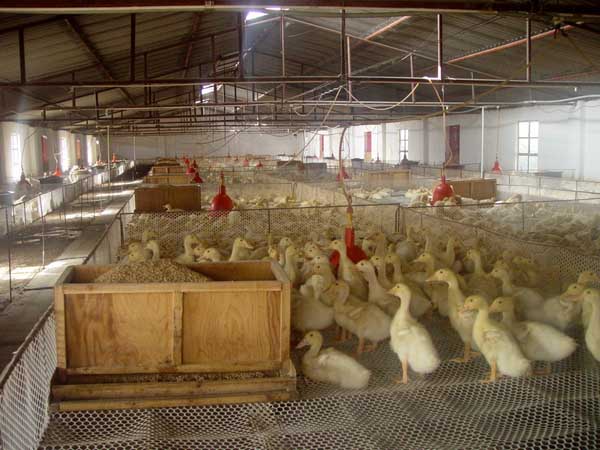
1. Indoor rearing, suitable for white-feathered breeds such as Cherry Valley duck, Beijing duck, and Cherry Valley duck. Inside the pen, use bamboo strips to build duck enclosures with 60 cm partitions, each 5 sq m, housing 20-30 ducks. Hang feeders and waterers outside the enclosure on the side facing the walkway. Reference formula for compound feed: corn 62%, wheat bran 15%, roasted peas 6%, fish meal 7%, rapeseed cake 7%, bone meal 2.8%, salt 0.2%. The ratio of green feed to compound feed is 1-1.5:1.
2. Herding for rearing. Suitable for shelduck breeds such as Gaoyou duck and Jianchang duck. Herd once each in the morning and afternoon, before 11:00 in the morning and before 16:00 in the afternoon. After each herding session, supplement with complete compound feed according to foraging conditions.
Short-term Fattening
Fattening is most suitable when ducks are 45-60 days old. Reference formula for self-mixed feed, early stage: corn 35%, flour 26.5%, rice bran 30%, roasted soybeans 5%, shell powder 2%, bone meal 1%, salt 0.5%; late stage: corn 35%, flour 30%, rice bran 25%, sorghum 6.5%, shell powder 2%, bone meal 1%, salt 0.5%. Fattening methods:
1. Self-feeding fattening. Feed at fixed times 4 times a day. After feeding, release ducks into water for bathing, and add one night feeding, supplying water while feeding. The duck house should be dimly lit to keep ducks less active and resting more. The activity area for ducks should be clean and dry.
2. Force-feeding fattening. Mix compound feed with water into a dry paste, roll by hand into round strips about 3 cm in diameter and 5 cm long. Use the round strips to force-feed ducks. When force-feeding, first dip the round strips in water to lubricate them, then insert from the duck's mouth into the esophagus. Force-feed 3 times a day. On days 1-3, feed 3-4 strips each time; on days 4-8, feed 4-6 strips each time; after day 8, feed 6-8 strips each time. After force-feeding, provide sufficient drinking water. The fattening period is generally 10-15 days.