Detailed Guide to Meat Duck Farming Techniques: Master Scientific Feeding and Management Methods
Duck House Construction
Choose a site with good soil permeability and a sunny, wind-sheltered location to build the duck house. Level the site into a slope of 50° to 100° to prevent water accumulation.
Breed Selection
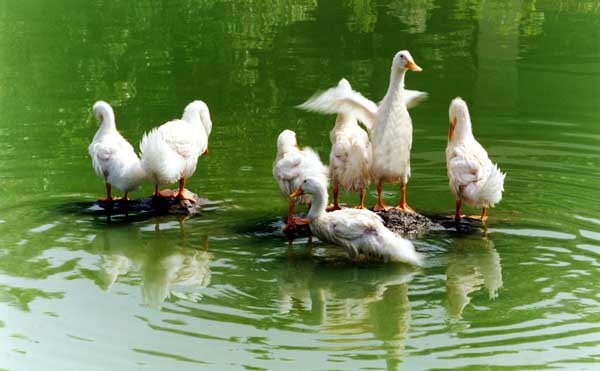
Currently, the main breeds include Shanghai White Duck, Zhongshan Ma Duck, Beijing Duck, Cherry Valley Duck, and Gaoyou Duck. These meat-type ducks are gentle in temperament, highly adaptable, and have good fattening performance, making them suitable for intensive group feeding and confinement rearing.
Feed Formula
Brooding duckling stage (1 to 25 days of age): corn 50%, rapeseed cake 20%, broken rice 10%, wheat bran 10%, fish meal 7.5%, bone meal 1%, shell powder 1%, salt 0.5%. Growing duck stage (26 to 45 days of age): corn 50%, rapeseed cake 5%, broken rice 10%, wheat 16%, wheat bran 12%, fish meal 4.5%, bone meal 1%, shell powder 1%, salt 0.5%. Fattening stage (7 to 15 days before sale): corn 35%, rice bran 30%, coarse flour 26.5%, soybean 5%, shell powder 2%, bone meal 1%, salt 0.5%. In the later period, remove the soybean, reduce rice bran by 5%, and increase corn by 10%.
Feeding Methods
Within 24 hours of hatching, provide water to the ducklings promptly. The method is to place a piece of plastic film on the ground, sprinkle some cool boiled water or a 1:10,000 oxytetracycline solution on it, and let the ducklings drink freely. After drinking, mix the previously prepared feed with water until moist and scatter it on the plastic film for the ducklings to eat freely. Start by scattering a small amount, scattering while calling to them, guiding the ducks to recognize and search for food. From 1 to 3 days of age, feed once per hour, and require them to finish eating within a short time. After 4 days of age, give less feed but add it frequently, encouraging the ducks to eat freely day and night, and provide sufficient clean drinking water. The growing duck stage is the period of fastest weight gain, so feed on a fixed schedule, let them eat their fill and eat well, and increase their activity level. The fattening stage mainly focuses on increasing the ducks' feed intake. Manual force-feeding is best: mix the compound feed with suitable warm boiled water to a moderately soft consistency, roll it into pellets the size of a finger by hand, and force-feed manually 3 to 4 times a day. The amount for each feeding should be determined by the duck's digestive capacity, and it is best to feed them until full, while reducing their activity level.
Environmental Control
For ducklings from 1 to 3 days of age, keep the house temperature at 30 to 31°C; from 4 to 7 days of age, keep the house temperature at 28 to 30°C; from 8 to 14 days of age, keep the house temperature at 25 to 28°C; from 15 days of age onward, keep the house temperature at 20 to 25°C. The duck house should have enhanced ventilation and light transmission, keeping the air fresh, the feed fresh, and the drinking water clean. Keep feed troughs and water troughs clean, and during the duckling stage, change and add bedding straw frequently. Provide supplemental lighting at night. Raise 35 to 40 ducklings per square meter, and 10 to 15 adult ducks per square meter.