Detailed Guide to Raising Ducks in Orchards: Master the Key Points for Easy Farming
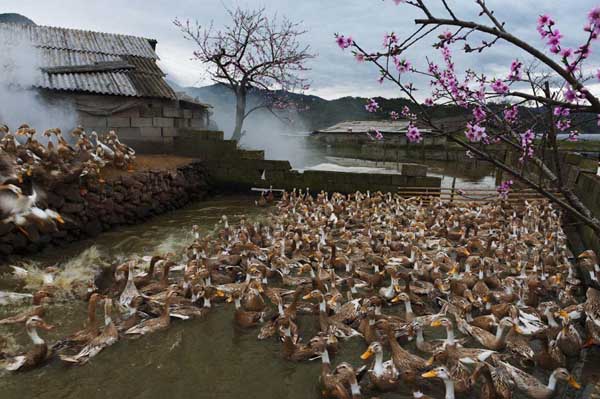
Raising ducks in orchards combines planting and breeding, allowing fruit trees and ducks to coexist for mutual benefit, which reduces the cost of planting and breeding and improves the economic returns of both. The key technical points are introduced below:
Stocking Time
Depending on the feed resources in the orchard, raising ducks in orchards is divided into a period focused on free-range grazing and a period focused on confined rearing. The most suitable stocking period is when plants and animals in the orchard are thriving, generally from mid-April (after Qingming and before Guyu) to the end of October. At this time, forage grass in the orchard grows lushly, and there is plenty of residual by-product from the fruit trees; the ducks can feed on various kinds of green grass, wild vegetables, and plant-based feed such as fallen flowers, leaves, and fruit, as well as animal-based feed such as various insect eggs, pupae, insects, and flying insects near the ground. Adult ducks can be stocked year-round.
Orchard Site Selection
Ducks move clumsily and cannot climb trees to peck for food, which provides assurance for low-fence grazing in orchards. Any orchard with good soil and water source conditions and with relatively tall trunks or old trees, such as apple, pear, apricot, hawthorn, persimmon, and walnut orchards, can be used for stocking. Stocked ducks can play a role in controlling weeds, and duck manure can provide a high-quality fertilizer source for the fruit trees. This is an effective measure for transforming orchards that are overgrown with weeds, extensively managed, severely affected by pests, or that fail to bear fruit at the proper age or are low-yielding and low-efficiency into high-quality, high-efficiency orchards.
Stocking Density
Stocking density is determined by the size and strength of the stocked ducks, following the principle of being sparse rather than dense. Generally, an average of 20-30 adult ducks are stocked per mu of orchard, and 2,000-3,000 are stocked in a 100-mu orchard.
Supplementary Feeding on Schedule
To make up for the shortage of feed during the stocking period, stocked ducks should be given supplementary feed at the proper time. Ducklings begin stocking at 4 weeks of age; the earlier stage is the brooding period, and they can be kept in pens or cages. Ducklings are given supplementary feed once each in the morning and evening to make up for insufficient energy. The amount of supplementary feed is determined by the principle of feeding them half-full in the morning and full in the evening, and the number and amount of feedings are gradually reduced to encourage the ducks to feed freely. As the ducklings grow, supplementary feeding for the stocked ducks can be determined based on how much they peck at weeds, wild vegetables, and insects. During the period focused on free-range grazing, supplementary feeding is carried out after the ducks return to the shed in the evening, and sufficient drinking water should be provided to meet their needs. In spring, before young ducklings are stocked, they should first be acclimated to changes in outside temperature and gradually introduced into the stocking orchard.
Epidemic Prevention and Disease Control
Disease prevention for stocked ducks likewise adheres to the policy of “prevention first, with prevention more important than treatment.” Routine prevention procedures should be followed, vaccinations should be carried out regularly, and epidemic prevention and disease control work should be done well.
Preventing Poisoning
When fruit trees in the stocking orchard must be sprayed with pesticides, highly toxic pesticides are strictly prohibited. Low-toxicity, high-efficiency pesticides or low-concentration, low-toxicity fungicide pesticides should be used. During the spraying period, limited-area fenced grazing should be implemented to avoid poisoning caused by uncontrolled ranging. The ducks can also be kept confined for 3-5 days and then released into the stocking area. During limited-area grazing, the amount of supplementary feed can be appropriately increased.