How to mix duck feed scientifically? Sharing practical mixing plans
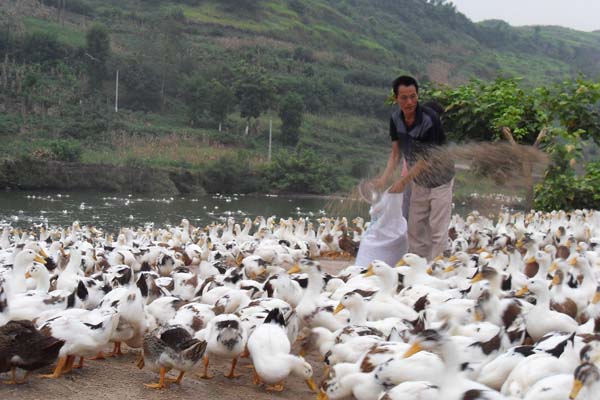
Formulating feed for meat ducks
To ensure that meat ducks can both grow and develop normally and fully realize their genetic potential, feed should be formulated according to their different physiological stages and nutritional requirements.
1. Feed ingredients: The feed ingredients selected should have an adequate source, reliable quality, and comply with national feed hygiene standards.
2. Scientific formulation: Attention should be paid to the meat ducks' rearing method, living environment, food source structure and nutritional characteristics, and production performance traits. If meat ducks are raised by grazing, their growth rate is slower, and feed should be formulated according to the nutritional characteristics of the food obtained from grazing, so as to improve feeding results and reduce rearing costs. The specific feed formulas are.
① Feed for ducklings (%): corn 50, rapeseed cake 20, broken rice 10, wheat bran 10, fish meal 7.5, meat meal 1, shell powder 1, salt 0.5.
② Feed for growing ducks and the fattening period (%): corn 50, wheat 17, wheat bran 12, broken rice 10, rapeseed cake 5, fish meal 4.5, shell powder 1, salt 0.5.
3. Good palatability: The feed should have good palatability, its nutritional composition should be stable, and it should be easy to store. Whether feed is mixed manually or processed by machine, the final feed product should be mixed evenly.
4. Prohibited drugs must not be used: Especially in feed for the later growth stage of meat ducks, no medicated feed additives of any kind may be used, to ensure the safety of duck meat products.
Formulating feed for laying ducks
1. Feed ingredients: When selecting ingredients for the formula, it should be easy to put into practice. Feed ingredients are required to have stable quality, adequate quantity, suitable price, and local resource advantages.
2. Suitable nutrition: When formulating the daily ration for laying ducks, the appropriate nutrient concentration of the compound feed should be determined according to the ducks' age group and feed intake. The reference formulas are:
① Laying ducklings (1-8 weeks): corn 58.7%, soybean meal 26%, rapeseed meal or cottonseed meal 7%, stone powder 4% (bone meal or shell powder may also be used), Teyu No. 6 premix 4%, salt 0.3%. It is recommended that ducklings in the first week all be fed complete pellet feed.
② Growing laying ducks (8 weeks to the start of laying): corn 64%, soybean meal 16%, rapeseed meal or cottonseed meal 6%, stone powder 9.7% (bone meal or shell powder may also be used), Teyu No. 6 premix 4%, salt 0.3%, Jinsaiwei as appropriate.
③ Laying-period ducks: corn 51%, soybean meal 22%, rapeseed meal or cottonseed meal 3%, wheat middlings 10%, stone powder 9.7% (bone meal or shell powder may also be used), Teyu No. 6 premix 4%, salt 0.3%.
3. Use additives: The main components of additives include amino acids, vitamins, and minerals, etc. Data confirm that adding 80 grams of methionine and 50 grams of lysine to 50 kg of conventional laying duck daily ration reduced fish meal from about 4 kg to about 2 kg, while egg production, egg weight, and so on were not affected. Vitamin additives can fully replace the nutritional function of green feed, not only supplementing vitamins, but also saving a large amount of green feed, reducing the labor intensity of duck farmers, and lowering the cost of duck production.
4. Feed should be kept fresh: To prevent feed from becoming moldy and deteriorating, feed should be stored in a dry place, and feed should not be stored inside the duck house.