How can the survival rate be improved in meat duck farming?
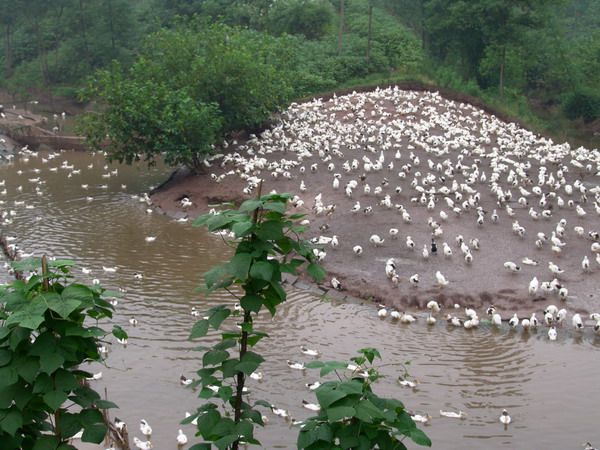
Select good ducklings
To buy ducklings, go to a breeding duck farm with good epidemic prevention work, where breeding ducks are strictly vaccinated against diseases such as fowl cholera, colibacillosis, duck plague, avian influenza and viral hepatitis according to the immunization program, and the hatchery's epidemic prevention conditions meet national regulations. When selecting ducklings, hold them in your hand and they should feel plump and strong, with glossy feathers, robust and lively, and loud calls; the selected ducklings should be uniform in size.
Do a good job at the brooding stage
1. Sanitation and disinfection of the brooding house: before the ducklings arrive, clean the brooding house thoroughly, wash away all duck droppings completely, spray once with a disinfectant (0.2% Baidusha solution), and after washing and drying the drinkers, feed trays and feed troughs, disinfect them.
2. Brooding methods for meat ducks: large-scale meat duck rearing generally uses floor brooding and wire-floor brooding. Wire-floor brooding has more advantages than floor brooding: a better sanitary environment, higher brooding density and better use of the brooding house, reduced occurrence of duckling diseases and lower mortality, a higher survival rate during the brooding period, and higher feed conversion efficiency and faster growth of the ducklings.
Management during the brooding period
1. Brooding temperature: newly hatched ducklings have poor thermoregulation, so heat preservation must be done well. For 1 to 3 days of age, the brooding temperature is 30°C to 32°C, then the temperature drops by 1°C every 2 days, and heating is stopped when the house temperature drops to close to the outside temperature.
2. Brooding density in the house: at 1 to 7 days of age, 20 to 40 ducks per sq m for floor brooding and 40 to 60 ducks per sq m for wire-floor brooding.
3. Timely drinking and feeding: 12 to 24 hours after hatching, give the ducklings water and feed in good time; the drinkers should be sufficient and evenly distributed, and if necessary, manually train them to drink. 1 to 2 hours after the ducklings drink, use a complete high-quality duckling feed (for 1 to 3 days of age, chick feed can be used as a substitute), soften it with water, and scatter it evenly on feed trays or plastic sheeting to attract them to eat; once all of them can forage normally, switch to feed troughs for free feeding.
4. Lighting: ducklings eat little, have strong digestion and grow fast, and feed continuously day and night, so the brooding house should have sufficient light, with electric lights on at night as well, so they can feed for 24 hours.
5. Pay attention to ventilation: the brooding house should be well ventilated to prevent excessively high concentrations of ammonia and carbon dioxide in the house, which can trigger disease and cause poisoning.
Do a good job in the prevention and control of duck diseases
During the rearing of meat ducks, prevention should be done for infectious diseases such as duck viral hepatitis, infectious serositis, influenza, colibacillosis, fowl cholera and avian influenza. For breeding ducks that have not received booster immunization with duck viral hepatitis and avian influenza vaccines, their offspring ducklings should be injected with anti-viral hepatitis yolk fluid after entering the brooding house, and after brooding ends they should be injected with avian influenza vaccine; other diseases can be prevented and treated with antibiotics. Pay attention to the routine cleaning and sanitation of the brooding house, remove duck droppings every day, prevent ammonia and carbon dioxide poisoning, and do a good job of disinfecting the house. After the meat ducks are sold, the rearing site can be disinfected alternately with quicklime and Xiaoteling, and the second batch of meat ducks can only be brought in after an interval of 7 to 15 days; in this way, the occurrence of diseases can be better controlled, and the survival rate and economic benefits of meat ducks can be improved.