What forage grass is better for goose farmers to plant?
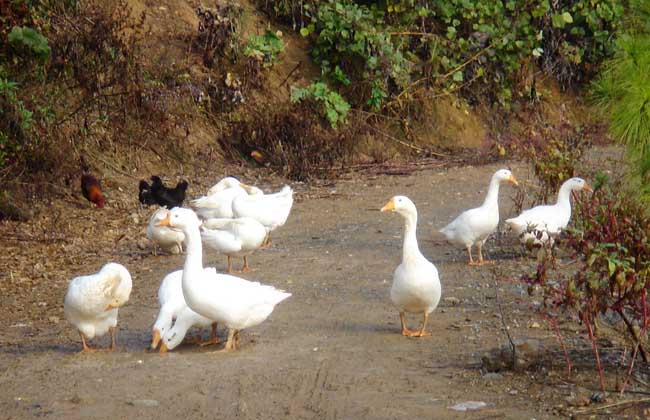
Raising geeseIn choosing forage feed crops, combine long-term and short-term types, with short-term quick-effect ones as the main focus, that is, combining protein-rich, tender and succulent leaf vegetables with grasses, mainly leaf vegetables. Specifically, give priority to grain amaranth, bitter lettuce, and chicory (rumex), and plant other forage grasses alongside them, such as barnyard millet, pearl millet, and ryegrass. Now let's take a look at what grass is good to plant for raising geese!
Grain amaranth combined with bitter lettuce and barnyard millet
Although grain amaranth, bitter lettuce, and barnyard millet all belong to annual plants, have good production performance, and have high nutritional value, they each play different roles in goose raising, and are currently the best combination for raising geese. They are suitable for planting all over the country, can be sown in spring, summer, and autumn, and supply green feed all year round. Grain amaranth is drought-tolerant, tolerant of barren soil, strongly stress-resistant, grows rapidly, regrows quickly, is high-yielding and high-quality, has good palatability, and is rich in nutrients, especially high in protein and lysine. Bitter lettuce is more tender than grain amaranth, and the whole plant contains white milky sap. It has excellent palatability, can promote the appetite of livestock and poultry, and has anti-inflammatory, fire-clearing, pain-relieving, disease-preventing, and epidemic-eliminating effects. The stems and leaves of barnyard millet have a high sugar content and a moderate crude fiber content, and feeding it in combination can further enhance palatability. Plant 1 mu of grain amaranth, 0.8 mu of bitter lettuce, and 0.7 mu of barnyard millet. When feeding, the fresh weight ratio is 2:1:1, which can supply green feed for 250-300 geese.
Bitter lettuce combined with barnyard millet (or pearl millet)
This combination is mostly used for planting grass to raise geese, especially on farms, pastures, and forest farms, because the local soil is fertile, rainfall is moderate, and land is vast while people are few. Although bitter lettuce has a lower yield than grain amaranth, its palatability is better. Plant 1 mu of bitter lettuce and 0.6 mu of barnyard millet (or pearl millet). When feeding, the fresh weight ratio is 2:1-1.5, which can supply green feed for 120-150 geese. Pearl millet, also known as candle millet, pearl millet, etc., is a species in the genus Pennisetum of the tribe Paniceae in the grass family. It is an annual herb and a dual-purpose grain and feed crop.
Chicory (or rumex) combined with barnyard millet (or pearl millet)
Chicory and rumex are both perennial forage grasses and both have the characteristics of high yield and high quality. In particular, chicory's palatability is second only to bitter lettuce, and it has great development prospects. However, there is an overwintering problem in the cold northern regions, and it is not well suited for cultivation in Heilongjiang, Jilin, and other provinces and regions. Rumex has strong cold resistance, but there is an oversummering problem in the south, and its palatability is average, so it is not very suitable for planting in the south. Plant 1 mu of chicory (or rumex) and 1 mu of barnyard millet (or pearl millet). When feeding, the fresh weight ratio is 2:1, which can supply green feed for about 200 geese.
Summary: In addition, Russian fodder kale and Wintergrazer 70 rye have strong cold resistance, turn yellow late, and green up early, so they can supply green feed in early winter and early spring, and can also be mixed and ensiled to feed geese. They can also be appropriately planted alongside purple alfalfa, hybrid Pennisetum, Italian ryegrass, fodder carrot, etc. to replace part of the other grass species. Trial planting and trial feeding tests should be carried out before demonstration and promotion. At the same time, when feeding, geese of different weeks of age have different requirements for green feed. The proportion of green feed in the mixed feed gradually increases, generally from 40% to 80%. During the 3-4 week fattening period, it gradually decreases again to 50%-40%. The 20% cake meal in the mixed feed cannot be reduced, otherwise it is unfavorable for goose growth.